Advertisement

The train from Oslo to Bergen in Norway. MariusLtu/Getty Images
There’s something special about traveling by train. Sometimes you find the magic inside – mingling with other travelers, dining in a restaurant car or sleeping in a private compartment as steel wheels swish on the rails beneath you. Sometimes the magic comes from outside and the landscape the train traverses – an adventure, an experience, an insight into the heart of a nation.
Europe is especially known for its train travel. From countryside views and mountain villages to alpine passes and landmark bridges, the continent offers up some of the most scenic train rides in the world.
You can crisscross Europe getting from A to B, or you can treat your train travel as an opportunity to get to know Europe in more depth. In fact getting around the continent on a Eurail pass is a right of passage for many travelers. And then there are the most scenic train trips that will take your breath away. These are journeys to plan a holiday around.
Here is a selection of the top 10 of the most amazing train rides for scenery in Europe.

1. The Centovalli Express, Switzerland and Italy
Route: Locarno to Domodossola
Best bit: Taking in the Isorno viaduct, the site of Switzerland’s first bungee jump
Distance: 52km (32 miles)
Duration: 2 hours
Often eclipsed by Switzerland’s more famous rail rides, this two-hour route from Locarno on the palm-rimmed shores of Lake Maggiore to Domodossola over the Italian border in Piedmont is something of an unsung beauty.
Brush up your Italian to swoon in sync with fellow passengers as the dinky train clatters across 83 bridges and burrows its way through 34 tunnels. The views make for spirit-lifting stuff: waterfalls shooting past cliffside views, hillside vineyards, gracefully arched viaducts, slate-roofed hamlets, glacier-carved ravines and mile after mile of chestnut and beech forests, all set against the puckered backdrop of mountains that are snow-capped in winter.
Make it happen: Several Centovalli Express trains run from Locarno to Domodossola every day. To view the full timetable, visit the railway website. Tickets can be purchased from machines at the station or in advance online. The only benefit of upgrading to 1st class (for which you’ll fork out almost double the price of 2nd-class fares), is extra space and fewer crowds. It’s worth allowing time to stop in the Centovalli; you could combine the trip with a couple of days hiking to mountain villages. Trains operate year-round, but autumn (September to November) is the best time to see the woods in all their golden glory.

2. The Heart of Wales Line, Wales and England
Route: Swansea to Shrewsbury
Best bit: Disembarking at lonely Sugar Loaf Station for a walk or picnic around the iconic nearby knoll of the same name
Distance: 194km (121 miles)
Duration: 4 hours
Experience Swansea to Shrewsbury the slow and, frankly, surreal way. This one-carriage train traverses track through Wales and England that might easily have been consigned to a museum or an out-of-print book, but that has somehow defied time and logic to survive as a passenger route.
You can expect a spectrum of scenery, alternating from the sand-edged estuaries of South Wales, via bucolic farming towns and tracts of forest and hill country you probably never knew existed, through to one of England’s prettiest medieval cities.
Make it happen: The end-stations are well connected. Swansea has direct trains to Cardiff and London while Shrewsbury is linked directly to Aberyswyth, Manchester and Birmingham. Any of the UK’s nationwide train-booking websites will let you purchase tickets for any journey along this route.

3. Nova Gorica to Jesenice, Slovenia
Route: Nova Gorica to Jesenice
Best bit: Catching a glimpse of picture-perfect Lake Bled’s church, castle and bright-blue water
Distance: 89km (55 miles)
Duration: 2 hours
Here is a near-perfect railway adventure that most people have never heard of. Then again, you could be forgiven for missing it. The Bohinj Railway, after all, connects two places whose significance can be lost to modern travelers. Europe’s shifting borders and politics may have rather marooned the Nova Gorica–Jesenice line, but that only adds to the appeal.
An unassuming regional train rattling out of a faded-grandeur halt on the Italy–Slovenia border doesn’t even hint at what’s to come. The journey is a spectacular tour of Slovenia’s upland highlights, climbing through mountain towns and villages along the Soča River, passing through superb Alpine scenery close to Lake Bohinj, and past world-famous Lake Bled, offering photo opportunities galore.
Make it happen: With the exception of the steam special, there’s no need to book ahead for this trip. Buy your tickets when you arrive at Nova Gorica or Jesenice. Check train times online. Some services on the line originate and terminate in Sežana, which is about an hour southeast of Nova Gorica. From Sežana you can pick up the onward route to the well-serviced city of Trieste, in Italy, though you should check connection times first.

Meet your new travel partner
Get unlimited data while you travel with Holafly eSIM. Peace of mind and no hidden fees wherever you go.
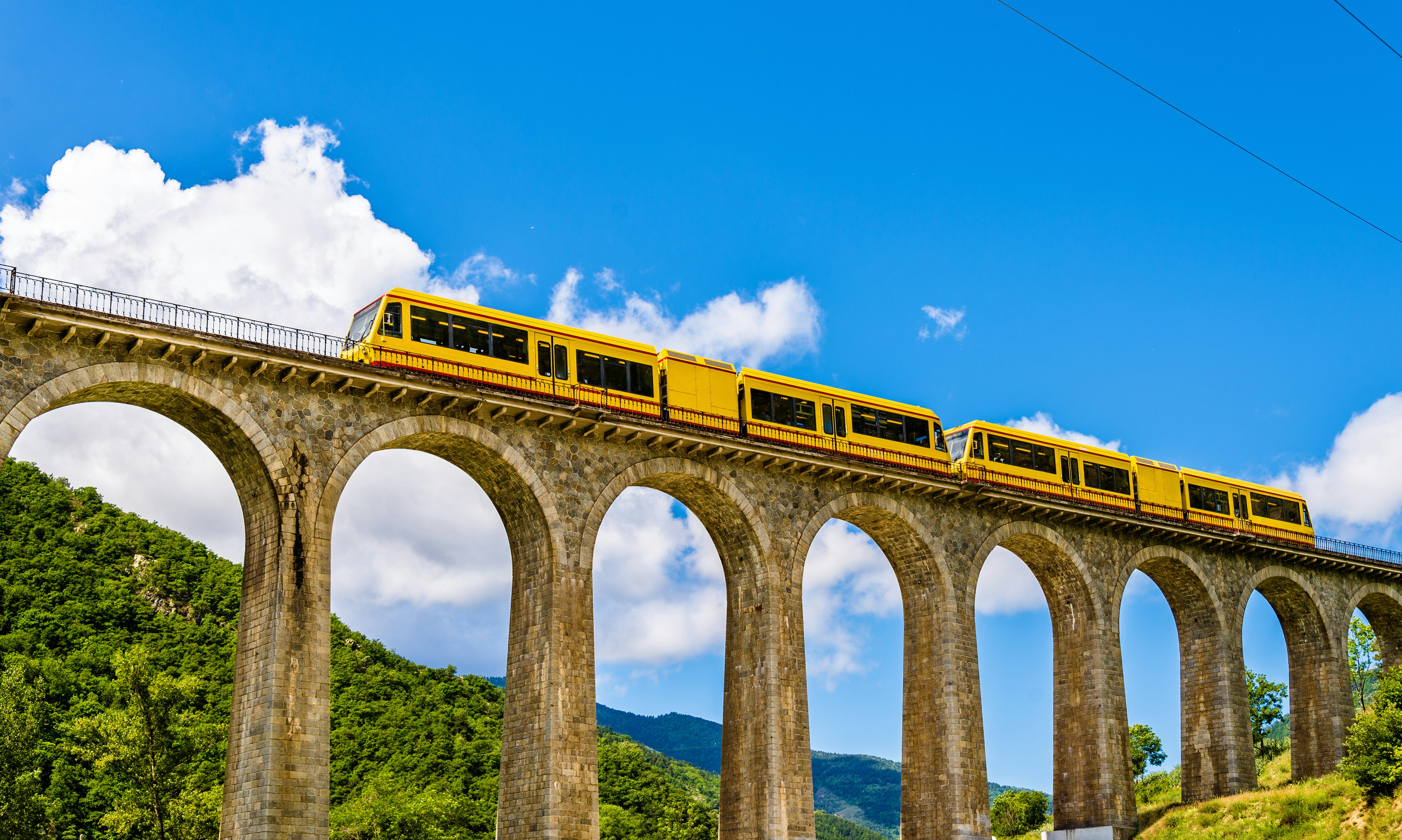
4. Le Petit Train Jaune, France
Route: Villefranche-de-Conflent to Latour-de-Carol
Best bit: Holding your breath as you cross the gravity-defying Pont Gisclard
Distance: 63km (39 miles)
Duration: 4 hours 30 minutes
Since 1910, the dinky, sunflower-yellow carriages of the Ligne de Cerdagne have been rattling and clattering their way through the rolling forests and saw-toothed mountains of the Pyrenees, and they have secured a special place in the hearts of many French travelers.
Affectionately known as the Canary, or Le Petit Train Jaune (Little Yellow Train), this mountain railway is frequently cited as the most scenic in France, but it’s definitely not a luxury service – it’s a rollercoaster ride on which you will feel the wind in your hair and the chill of the mountain breeze as you ratchet your way up to the highest train station in France. On y va! (Let's go!)
Make it happen: Le Petit Train Jaune runs year-round. There are usually between five and eight trains per day in summer, with a reduced service in winter. Tickets can be booked online.
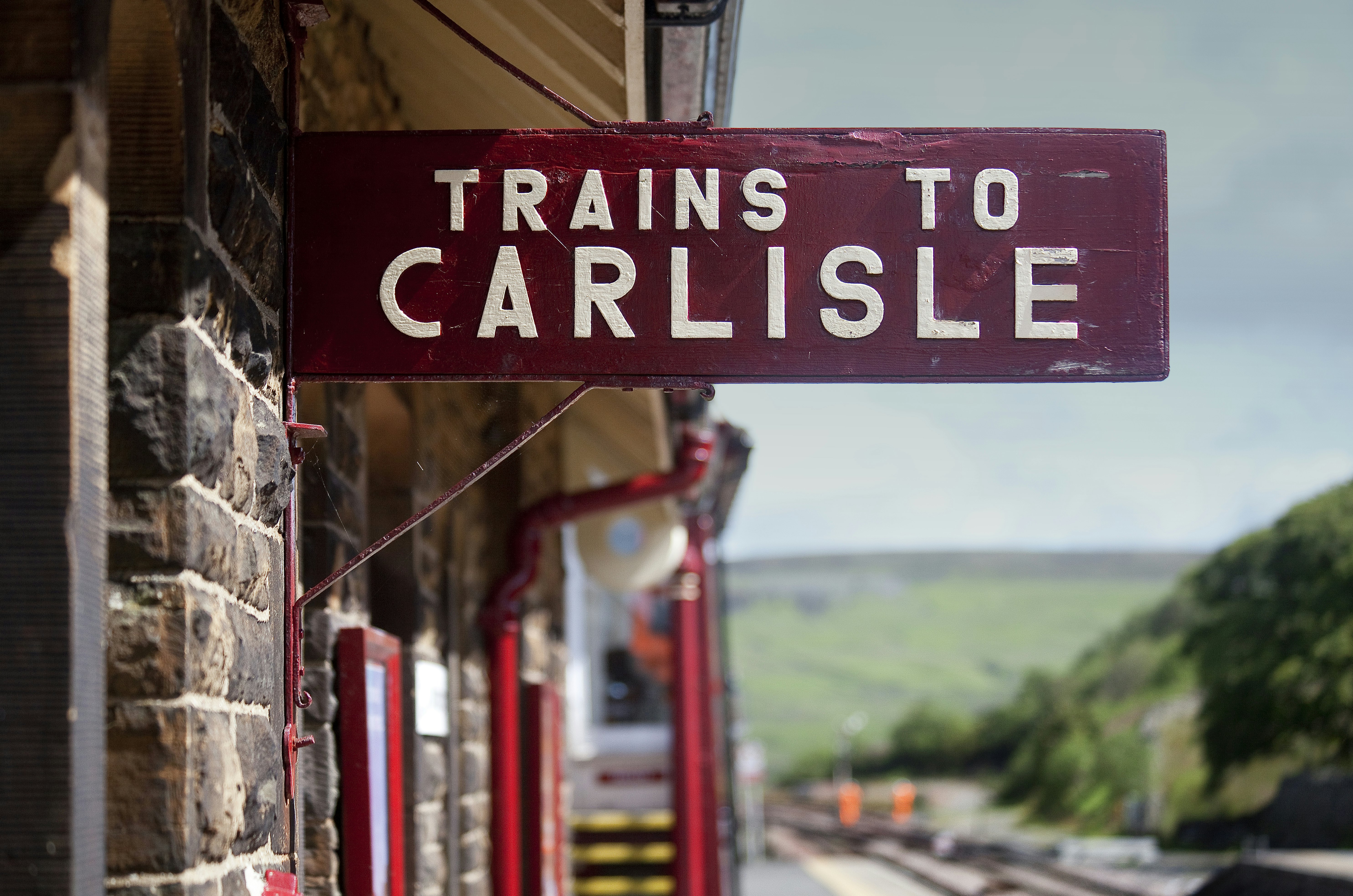
5. Settle to Carlisle, England
Route: Settle to Carlisle
Best bit: Marveling at the Ribblehead Viaduct, one of the great views of northern England, preferably as a steam train thunders over
Distance: 73 miles
Duration: 1 hour 40 minutes
England’s Settle-to-Carlisle line has long been synonymous with the fight to preserve beautiful and historic stretches of railway. But this is no heritage line. Proudly part of the British rail network and served by regular mainline trains, the railway enjoys a double life as a frequent host of steam specials and, even rarer, steam-hauled mainline services.
Whether you have the whiff of steam in your nostrils or the hard-working growl of diesel-hauled regular trains in your ears, the views from the carriages are pretty much unmatched on the English railway network.
Passengers can feast their eyes on mile after mile of magnificent Yorkshire Dales and North Pennines scenery, interrupted only by stations so pretty you would expect to find them pictured on a box of biscuits.
Make it happen: Trains depart up to eight times a day in both directions, seven days a week. Book ahead online for the best fares. The line is busiest at weekends and during UK school holidays, but the views are magic year-round.

6. Belgrade-to-Bar Railway, Serbia and Montenegro
Route: Belgrade to Bar
Best bit: Levitating atop the 499m-long (1637ft), 198m-tall (650ft) Mala Rijeka Viaduct, one of the planet’s highest railway bridges, before the train glides over the Balkans’ largest lake, Skadar
Distance: 476km (296 miles)
Duration: 12 hours
Dramatic is the operative word for this route, which rumbles over an unsullied, mountainous landscape from Serbia's capital, Belgrade, to Montenegro’s Adriatic Coast. Like the region it serves, the railway, which chugs across the heart of the Western Balkans, eludes most tourists’ maps. The reward for treasure-hunting travelers, who are informed (or lucky) enough to know where to dig: an embarrassment of authentic culture and pristine geographic riches at every bend.
During the 12-hour journey, the train disappears into the Dinaric Alps, charges through canyons, teeters on stilted bridges spanning river gorges and skims atop an ancient, tectonic lake.
Make it happen: The Belgrade–Bar railway is serviced by daytime “Tara” trains, running summer only, and nightime “Lovcen” sleepers which travel year-round. Reservations need to be purchased in addition to your ticket. The best way to experience the journey is one-way from Belgrade, ending your journey on the Adriatic Coast. The early Tara train from Belgrade provides epic sunset views through Montenegro’s Dinaric Alps, across Lake Skadar and to the Adriatic. Sit on the right side of the train for the best views. For up-to-date timetables and further information visit Serbian Railways website or contact a local tour operator.

7. Munich to Venice on the Brenner Railway, Germany, Austria and Italy
Route: Munich to Venice
Best bit: Stretching your legs at the 1371m (4498ft) Brenner Pass, the highest point on the trip
Distance: 563km (350 miles)
Duration: 6 hours 30 minutes
The Brenner Railway is attractive for two key reasons: mountains and wine. There may be more technically astonishing high-altitude trains, but this was the first to cross the Alps in the 1860s.
On a surprisingly speedy day trip, you pass through three countries – Germany, Austria and Italy – and descend from the snow line to sea level. You’re rarely far from highways, but the vineyard views are still stunning. Bonus: you'll find great European cities with historic architecture – Munich and Venice – at either end.
Make it happen: The Munich to Venice EuroCity runs once a day on weekdays; on weekends, two other trains also run through. You can also change in Verona. Book your ticket with either Deutsche Bahn (DB) or ÖBB. Although the train is rarely crowded, it’s wise to book ahead and pay the small fee to guarantee a window seat. The route is beautiful all year round, but if you want to stop off for a hike in the mountains, May to October is the safest time to do so.

8. Bergensbanen, Norway
Route: Oslo to Bergen
Best bit: Gazing over the soul-stirring landscape of Hardangervidda between Geilo and Finse.
Distance: 496km (308 miles)
Duration: 6 hours 30 minutes
All aboard for the Oslo to Bergen train line, Bergensbanen: a mainline into Norwegian nature.
This astonishing train is one of the wonders of 19th-century railway building, and yet outside Norway hardly anyone knows about it. In just over six hours and some 490km (300 miles), it covers the spectrum of Norway’s natural splendor: climbing canyons, crossing rivers, burrowing through mountainsides, swooping past fjords and traversing barren icescapes.
Make it happen: There are up to four daily trains between Oslo and Bergen in both directions. Bookings are made directly through the railway’s website. For the cheapest fares, you’ll need to buy in advance and be flexible with your travel times; travelling early or late in the day to avoid the intercity commuter peak. Families can book a seat in or near the family-friendly carriage where there is space for toddlers to play.

9. The Kyle of Lochalsh Line, Scotland
Route: Inverness to Kyle of Lochalsh
Best bit: Passing under the gentle grassy slopes of Fionn Bheinn – a munro rising high over Achnasheen
Distance: 135km (84 miles)
Duration: 2 hours 30 minutes
Scotland has an abundance of windswept railways – the West Highland Line and the Far North Line to Thurso among them. Though comparatively unsung, perhaps the loneliest of all is the Kyle of Lochalsh Line – with trains rumbling doggedly from Inverness through desolate glens and past snowy munros, connecting the cold shores of the North Sea to the furious whitewater of the Atlantic.
It is a railway line full of poetry and beloved by aficionados – but it’s also a useful way for independent travelers to access remote nooks of the Highlands and make a journey to the Isle of Skye.
Make it happen: ScotRail currently operate the Kyle of Lochalsh line. Though Kyle of Lochalsh is out on a limb transport-wise, Inverness is well connected with ScotRail services to the Central Belt, and also direct Caledonian Sleeper services from London. It requires a bit of planning, but there’s a way of making a railway circuit incorporating Skye, without having to retrace your footsteps to Inverness. Firstly board an Inverness–Kyle service, then explore Skye via its comprehensive bus network. Whenever you want to return to the mainland, catch a bus to the south-coast ferry port of Armadale, where a Caledonian MacBrayne ferry takes 30 minutes to cross to Mallaig. At Mallaig, the equally beautiful West Highland Line threads its way through the glens towards Glasgow.
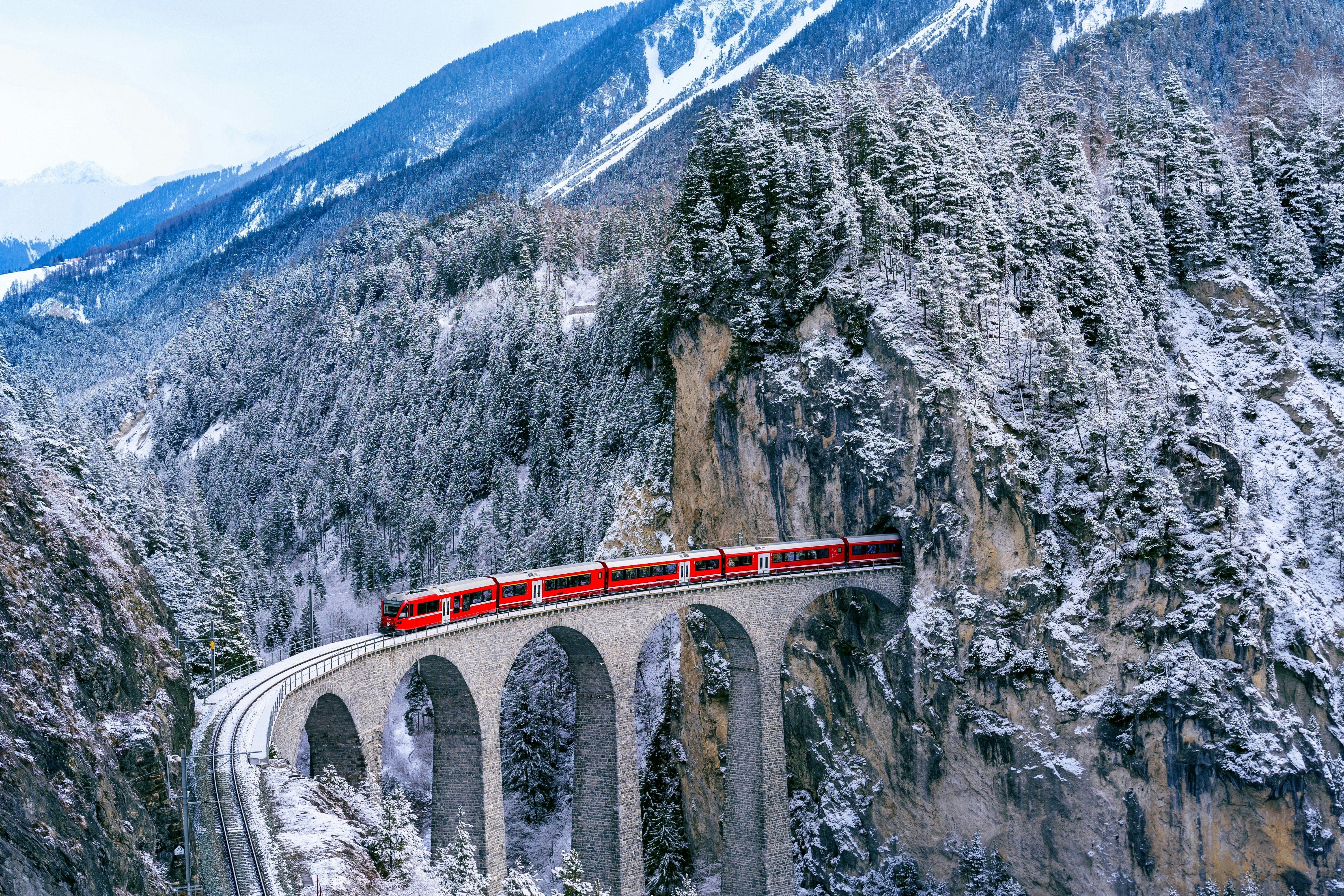
10. The Bernina Express, Switzerland
Route: Chur to Tirano
Best bit: Marveling at the astonishingly turquoise Lago Bianco from the route’s highest station, Ospizio Bernina (2253m/7392ft)
Distance: 156km (96 miles)
Duration: 4 hours 30 minutes
Rolling from Chur in Graubünden to Tirano in northern Italy in around four hours, this narrow-gauge train often tops polls of the world’s most beautiful rail journeys. It's certainly one of the most scenic train journeys in Switzerland.
We could wax lyrical about the glacier-capped mountains, waterfall-draped ravines, jewel-colored lakes and endless spruce forests glimpsed through panoramic windows on Switzerland’s Bernina Express – but, trust us, seeing is believing.
Beyond the phenomenal Alpine landscape, the railway itself is a masterpiece of early 20th-century engineering, taking 55 tunnels and 196 bridges in its stride. The line is on the UNESCO World Heritage List – and with good reason.
Make it happen: The service departs daily and advance tickets can be booked online. Securing a ticket a couple of days ahead is usually fine, but the sooner the better during the peak summer season. For a little more space, fewer passengers and even bigger windows, upgrade to the 1st-class carriage. For the best views, sit on the right-hand side of the train when going south and the left going north.
This article was adapted from Lonely Planet’s Amazing Train Journeys, published in February 2024.
Advertisement