
Sep 18, 20265 min read
The 5 Best Jazz Bars in HanoiFeb 27, 2026
12 MIN READ

Writer
Nom Village outside of Hanoi, Vietnam. Bien Nguyen

Writer
Lonely Planet may earn a commission from affiliate links on our site. All recommendations and reviews reflect our own independent opinions.
I call Hanoi "a big village" because that's what it still feels like to me – crowded, loud, familiar in a way that's comforting until it's not. I love the early-morning pho chaos, the way the city wakes up all at once. But after a few days straight, the noise and concrete start to press in. The good thing is how close the quiet is. Drive an hour or two out and things slow down fast – fewer horns, more open land, and air that feels easier to breathe.
These trips aren't about seeing famous places. They're about changing pace. Time to drink green tea on someone's old wooden porch, climb limestone hills, swim in a wild waterfall, or wander a morning village market. They're all close enough for a day trip but far enough that you actually feel the difference.
Travel time: 40 mins
How to travel: car, motorbike
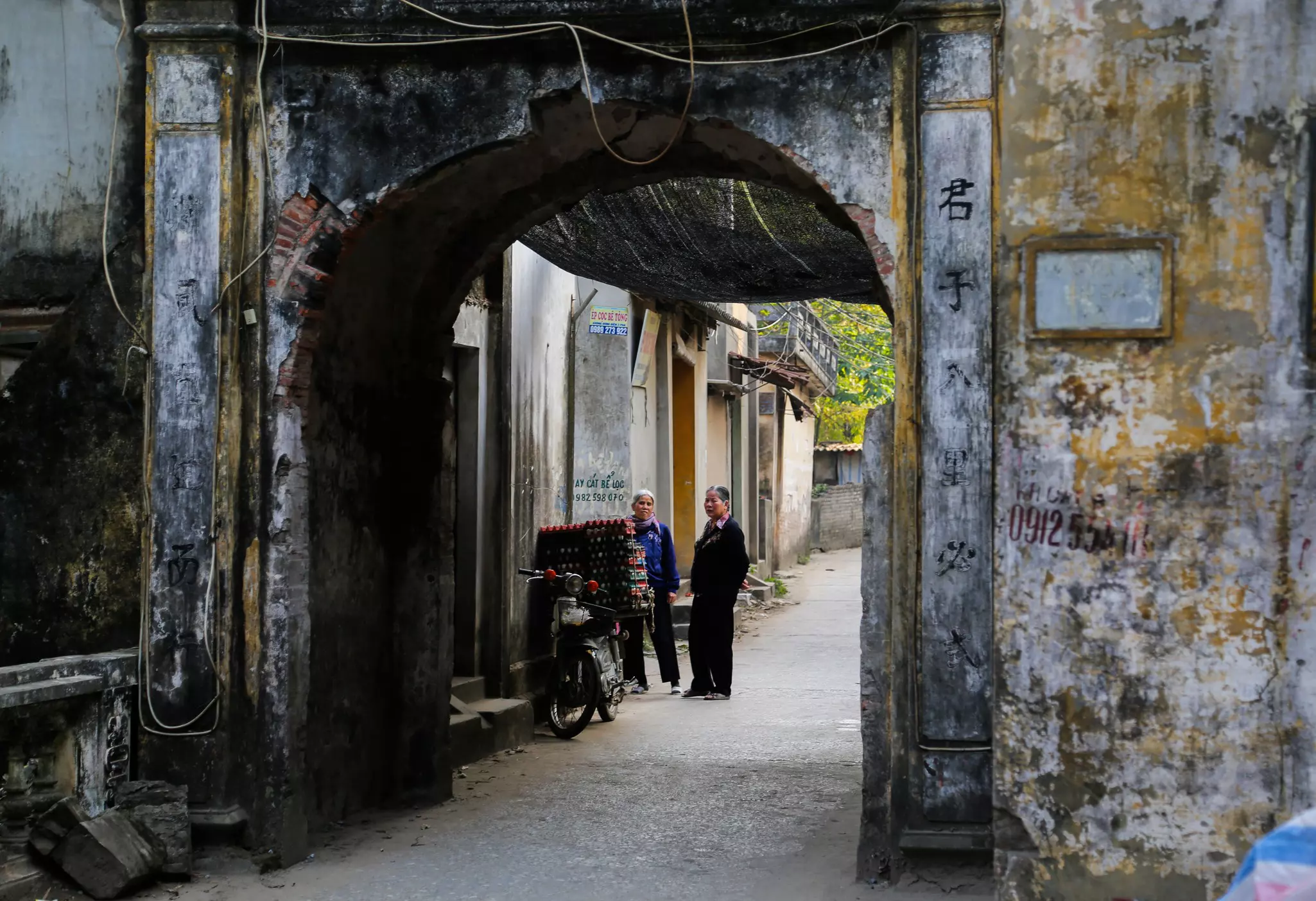
Cu Da is over 400 years old and doesn't look like a typical northern Vietnamese village. Alongside classic three- and five-compartment houses, you'll find elegant two-story French colonial homes with balconies and curved roofs. Strangely, the mix works beautifully. Wander slowly through narrow alleys and look for moss-covered gates carved with Chinese characters and century-old houses tucked behind low walls. If you smile and ask, locals often invite you inside for green tea.
The village is famous for mien dong, glass noodles made from canna starch. Visit on a sunny day and the whole village glows yellow – walls, rooftops and courtyards covered with noodles drying in the sun. Don't miss the 300-year-old Cu Da Pagoda. The village sits by the polluted Nhue River, and the smell can be unpleasant at times, but Cu Da is still worth visiting as one of Northern Vietnam's most distinctive craft villages.
Since Cu Da is still ignored by most itineraries, there are no trendy cafés here. You'll find simple local eateries instead. As you walk, you may notice cat meat restaurants, which can be confronting – best to simply pass them by.
If a full day feels long, combine it with Dinh Khuc Thuy, an old communal house restored in 1920 with carved gates, roof dragons, and Nguyen-era details.
How to get to Cu Da from Hanoi:
Just 16km from Hanoi center. A Grab car works perfectly.
Travel time: 1 hour
How to travel: car, motorbike
Forty-five minutes from Hanoi, Thay Pagoda sits quietly at the foot of Sai Son Mountain. Built during the Ly Dynasty, it's one of the oldest temple complexes near Hanoi where traditional water puppetry is still performed. The pagoda spreads across Long Tri Lake with wooden walkways and graceful bridges. The path climbs from the Lower Pagoda to the Upper Pagoda, then steeply to Chua Cao for countryside views.
A short drive away, Tay Phuong Pagoda is known for its remarkable sculptures of the 18 Arhats with unusually human expressions.
Continue to Tram Gian Pagoda, founded in 1185, with 104 chambers spread across three sections. Highlights include the two-story bell tower from 1693 and more than 150 statues.
How to get to Thay Pagoda from Hanoi:
Head southwest on National Highway 6. Having your own transport or hired car is best.
Travel time: 1 hour 15 minutes
How to travel: car, motorbike
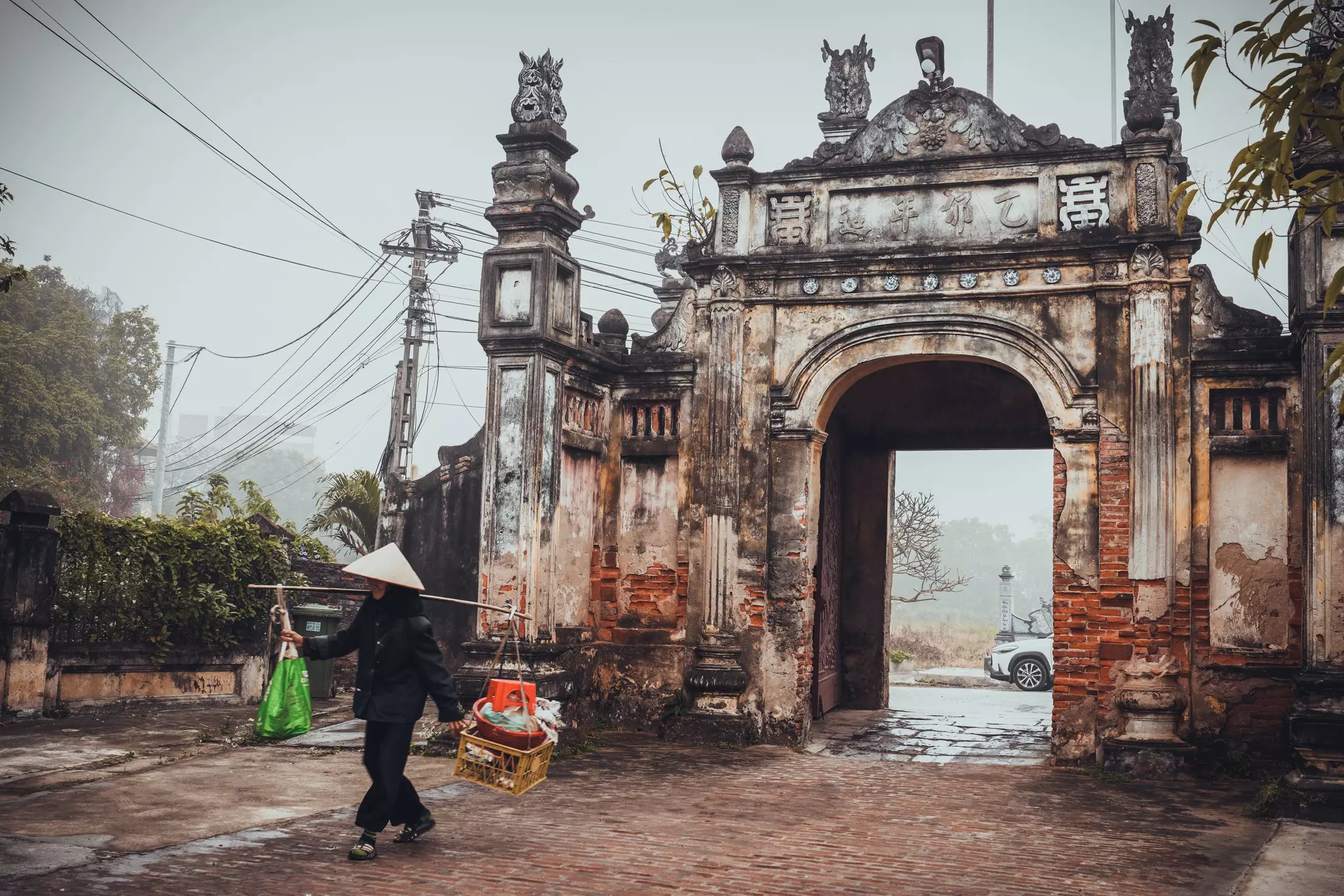
Once prosperous through scrap-metal and bronze trading, Nom Village preserved its cultural sites remarkably well. Enter through the 200-year-old village gate and walk toward the central pond. Ancient trees reflect in still water alongside five-compartment houses and colorful shrines. Three old stone wells remain scattered through the village.
Visit the communal house honoring St Tam Giang, then walk to the nine-span Nom Stone Bridge, built entirely without mortar. Cross it to reach Nom Market, where the countryside vibe remains. Market days follow the lunar calendar (12 days each month: 1, 4, 6, 9, 11, 14, 16, 19, 21, 24, 26, 29); come in the morning for the liveliest atmosphere. Beyond the market stands Nom Pagoda, over 500 years old, with more than 100 well-preserved fired clay statues.
Nom isn't shaped by tourism. Eat simply at market stalls. If time allows, take the longer route back via the Chu Dong Tu - Tien Dung Temple, rebuilt in 1890 and dedicated to one of Vietnam’s Four Immortals.
How to get to Nom Village from Hanoi:
About 30km from Hanoi along National Highway 5. Easy by car or motorbike.
Travel time: 1 hour
How to travel: car, motorbike
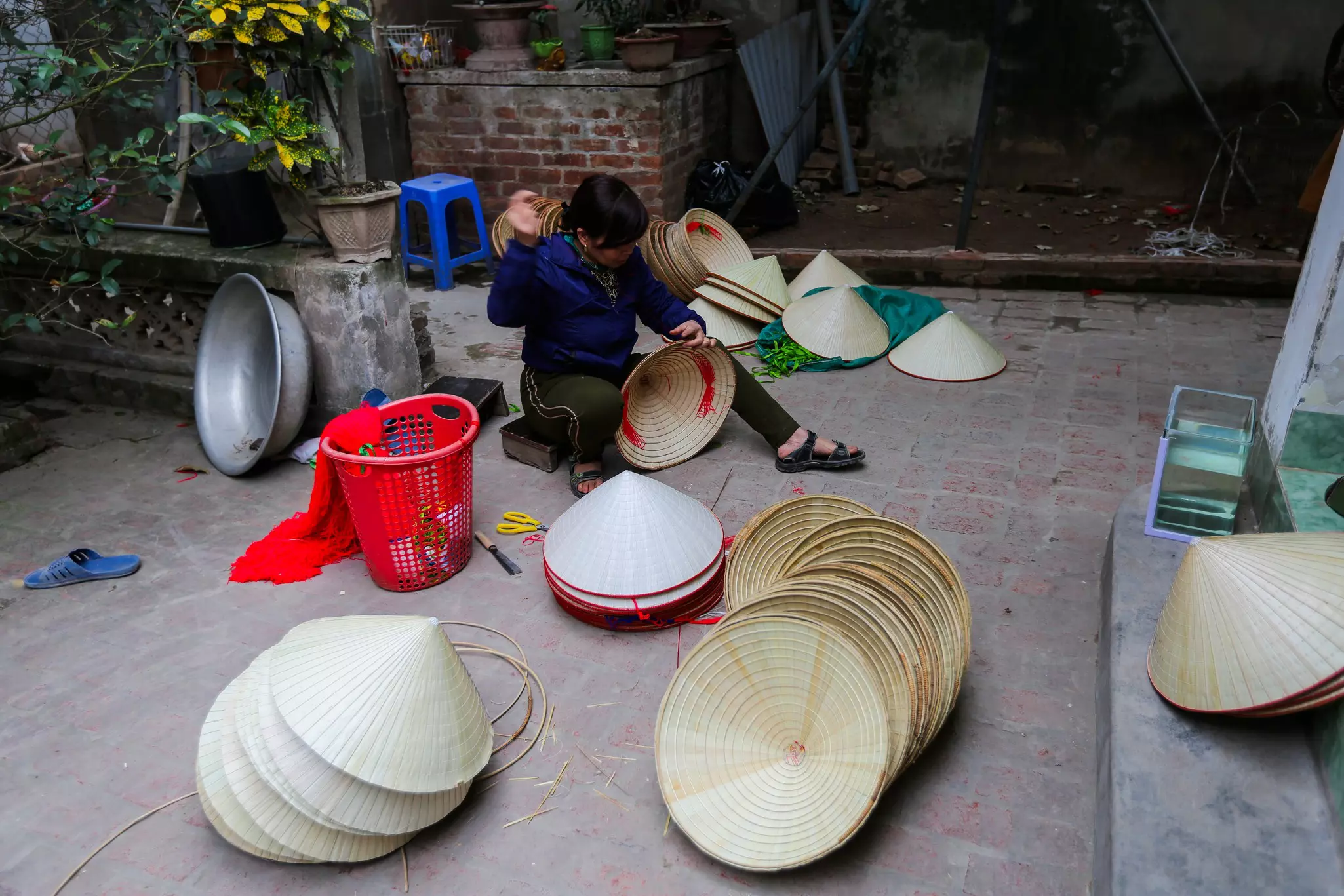
About 40km west of Hanoi, three neighboring villages in Thanh Oai and Ung Hoa each focus on a single traditional craft – conical hats, pork sausage and incense – making them an easy, revealing day trip into craft-village life.
Chuong Village has made traditional conical hats (non la) since the 8th century. Across its eight hamlets, families still handmake hats at home, and they are often happy to let visitors watch or try a simple step. Don't miss the 130-year-old Chuong Temple and the old wooden houses in Quang Trung hamlet. Visit early on lunar market days (4th, 10th, 14th, 20th, 24th, and 30th) when materials and produce are sold before 7am.
A few kilometers away, Uoc Le Village is known for inventing pork sausages (gio cha) in the 16th century. You'll smell gio que everywhere – pork sausage seasoned with cinnamon and wrapped in banana leaves. Try it fresh with sticky rice. The village gate, communal house, and 500-year-old So Pagoda add quiet historical depth.
Finish at Quang Phu Cau, where incense has been made for over a century. The village smells of sandalwood, cinnamon and pine, and its bright red and yellow incense bundles have made it famous with photographers. Some families charge a small fee (50,000–100,000 Vietnamese dong) for photos. Wander beyond the photo spots to see the full process of cutting, dyeing, rolling and sun-drying incense.
How to get to Chong Village from Hanoi:
Drive southwest via National Highway 6. About one hour by car or motorbike.
Travel time: 1.5 hours
How to travel: car, motorbike
Duong Lam (entrance fee: 20,000 VND) was Vietnam's first village recognized as a national historic monument. It's built mostly from laterite – red clay stone that hardens in the sun – giving the walls, houses and wells a warm, rusty glow.
The village has a beautiful gate leading to its 500-year-old communal house, Dinh Mong Phu. You’ll also come across nearly 400-year-old houses such as Nha Co Ong Hung, Nha Co Ong The, and Nha Co Ba Dien, where you’re often invited in for tea with che lam (ginger sticky rice cake) or keo lac (peanut candy).
The best way to experience Duong Lam is to wander its narrow alleys and slow down with village life. Don't miss Mia Pagoda, home to 287 beautifully preserved Buddha statues. For a break, stop at Ca Phe Lang or DOAI Community Space. For lunch, Bep Lang Duong Lam serves comforting home-cooked food.
In the afternoon, walk to the temples of two kings born here, Phung Hung and Ngo Quyen.
How to get to Duong Lam from Hanoi:
The village is 45–50km west of Hanoi. A private car is easiest; the dike road by motorbike is scenic and quieter.
Travel time: 1.5 hours
How to travel: car, motorbike

Although Bat Trang draws crowds, the villages along the Cau River feel quieter and more real.
Tho Ha, founded in the 12th century, was once one of Vietnam's great pottery centers, known for dense ceramics that rang when tapped. Today, the village has switched to making rice paper, rice wine and raising pigs, so instead of pottery workshops you'll see translucent sheets drying everywhere, and smell the distinct scent of fermented bran and farm life along narrow alleys. However, the old walls stacked from broken pottery and covered in glossy dark-brown terracotta tiles remind us the village once had much pride in the craft. Start at the village gate, where you'll see ancient banyan trees and rows of rice paper drying on bamboo frames. Don't miss the Tho Ha Communal House, a famous historic site filled with beautiful wood carvings from the Le Dynasty. For lunch, Mr. Viet (+84 355 382 620) can sometimes arrange a home-cooked meal and simple activities like rice-paper making, depending on his schedule.
A 15-minute drive away, Bo Da Pagoda offers a quiet, mossy pause, built from local earth and terracotta.
About 50 minutes further is Phu Lang, making pottery since the early 14th century. Unlike Bat Trang's white clay, Phu Lang artisans use reddish clay that produces its famous eel-skin yellow glaze and deep browns. Walking around the village, you'll notice the village walls are built from pottery shards and old ceramic coffins. Drop into workshops to watch traditional techniques still in use. Phu Lang pottery centers on religious pieces, household wares and decorative items, and you can try it yourself at Khu Trai Nghiem Lang Gom Phu Lang. Once close to disappearing, Phu Lang is now alive again with over 200 active kilns.
How to get to Tho Ha from Hanoi:
Private car is easiest. From Hanoi, drive northeast to Ben Do Tho Ha and take a short ferry to Tho Ha. Tho Ha to Phu Lang takes an additional 55 minutes by car.
Travel time: 2.5 hours
How to travel: car, motorbike
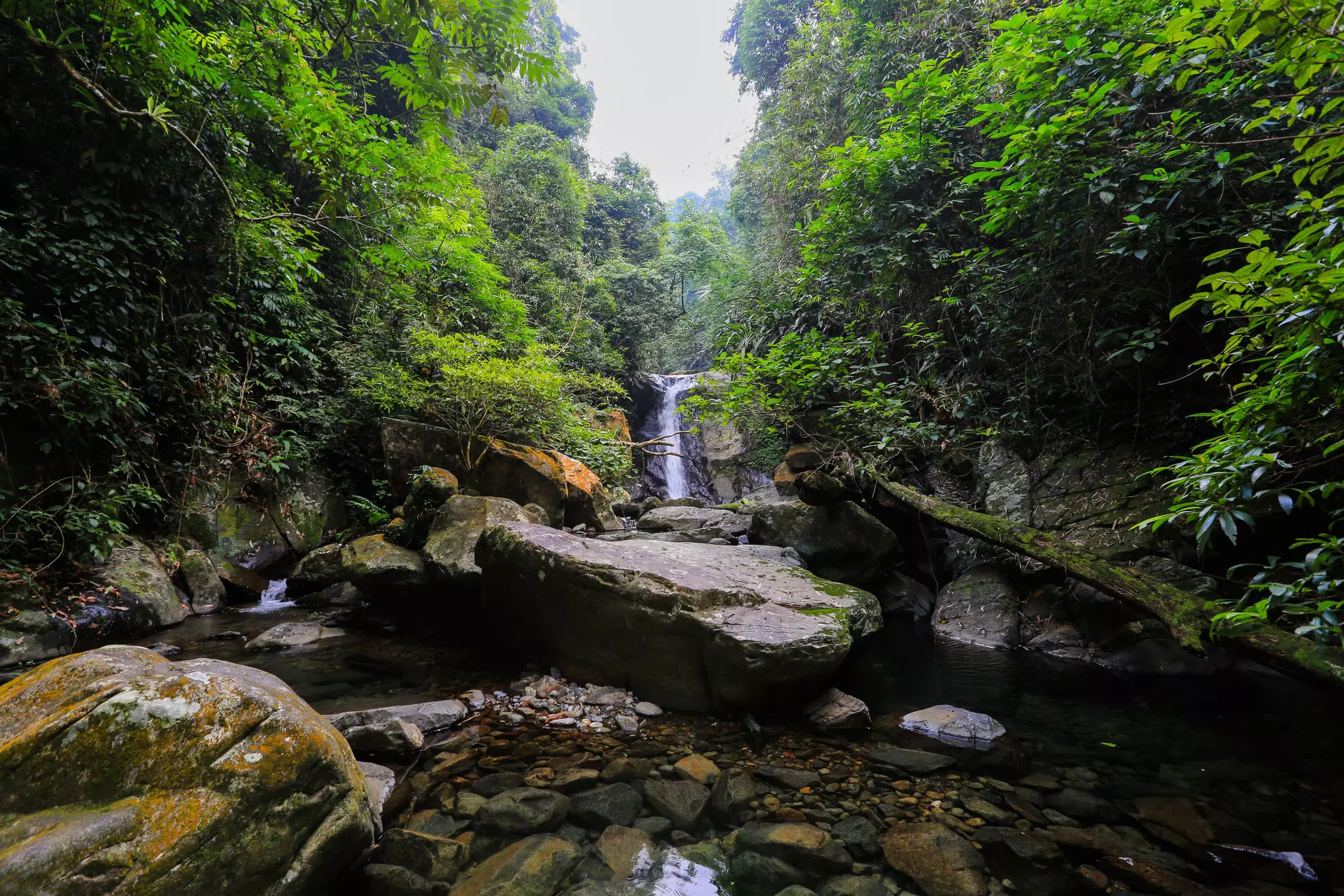
This is the "wild card" for people who find normal tours dull. Cua Tu sits east of Tam Dao National Park in Thai Nguyen. The name translates to "Death's Door," which sounds dramatic but it's perfectly safe with a guide.
The hike starts from Xom Dong Khuon, a village in sprawling tea fields. It's a moderate trek but slippery in spots, and the jungle's thick. There are seven waterfalls hidden under old canopy and limestone cliffs. On a day trip you can hit three, including Thac Thien Duong (Paradise Falls), where there's a massive stone slide carved by water. It's an absolute blast to slide down to a clear pool.
No crowds, no selfie sticks. You enjoy lunch by the stream with grilled pork or chicken and sticky rice wrapped in banana leaves.
Book with Tung Nui at Hoang Nong Farm ahead of time (WhatsApp: +84353797336). The trailhead isn't obvious and you need someone who knows the jungle. You may consider staying one night at Hoang Nong Farm.
How to get to Cua Tu from Hanoi:
Take Highway 3 toward Thai Nguyen City, continue on National Highway 37 toward Dai Tu district. A private car can be booked, or ride a motorbike if you're confident.
Travel time: 2.5 hours
How to travel: car, motorbike, train
Ninh Binh is often called "Ha Long Bay on land," but this place feels quieter and more grounded – limestone towers rising straight out of flat, emerald rice paddies. For a day trip, choose one boat ride: Trang An or Tam Coc.
In Trang An, you move entirely at the river's pace. The boat ride takes 3–4 hours and costs around 250,000VND per person. You drift past limestone mountains, slip through water caves like Hang May and Hang Dia Linh, and come out into quiet lagoons. Along the way are historic sites like Tran Temple.
If you're drawn to everyday life, Tam Coc is the better choice. The river winds through rice fields, farmers work nearby, and the limestone rises at its own pace. The boat ride takes 1.5–2 hours and costs around 270,000VND per person. Rent a bicycle and follow dirt paths along the base of the karsts past small villages.
For Vietnamese lunch, visit Nha Hang Com Nieu Viet Xua in both locations. Try Ninh Binh specialties: goat meat and com chay (crispy rice).
End your day at Mua Cave. The climb – about 500 stone steps – is steep, but the view makes it worthwhile. At sunset, the Ngo Dong River snakes through the valley, rice fields glowing as the light fades.
How to get to Trang An or Tam Coc from Hanoi:
Shared limousine vans are fast with hotel pick-up. The train to Ninh Bình is a charming, old-school option. Daily tours also run from the Old Quarter.
Travel time: 3 hours
How to travel: car, motorbike
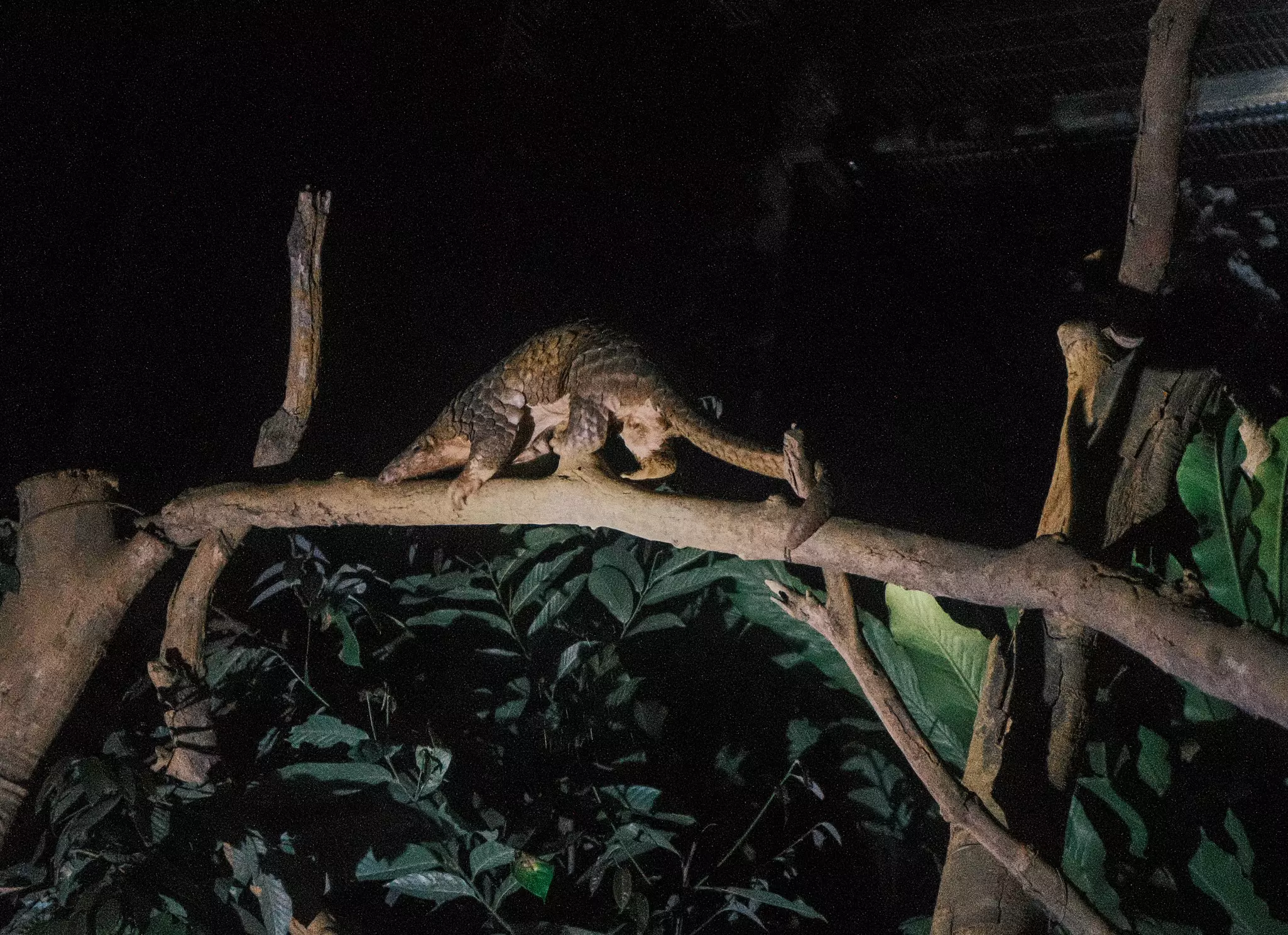
Cuc Phuong is Vietnam's oldest national park, and it still feels untouched. The air is heavy – damp earth, wild orchids, rot and growth layered together.
The wildlife centers are worth your time. The Endangered Primate Rescue Center is home to red-shanked douc langurs and gibbons that sing on their own schedule. Nearby are the Turtle Conservation Center and Save Vietnam's Wildlife, which rescues pangolins, civets and otters.
In the afternoon, visit the Cave of Prehistoric Man – cool, silent, and used as a shelter over 7000 years ago – then hike toward the thousand-year-old tree. Come in late April to see millions of butterflies drifting along the trail.
Hire a park guide for the best experience. Contact Mr. Hai at +84 915 666 916 in advance or arrange on arrival.
Cuc Phuong is worth at least one night, especially if paired with Trang An or Tam Coc. Waking up to gibbons singing through the forest is reason enough.
Getting there: Private car is best. The park is large, and having your own transport makes everything easier. Head to the park’s headquarters entrance.
Explore related stories