The Summer Palace and the ruins of the Old Summer Palace offer tantalizing glimpses of the Beijing that was. A marvel of Chinese garden design and one of Beijing’s must-see attractions, the Summer Palace, in the northwest fringes of the city, seems to rise up from the waters of Kunming Lake. It was once a royal retreat for emperors fleeing the suffocating heat of the imperial city and was the preferred residence of the Empress Dowager Cixi, who ruled the city and empire in the late 19th century. The lakes, parks, pagoda-topped hills, ornate palace buildings and mounds of intricately carved masonry hint at the awesome scale of Beijing’s imperial precincts.
What’s the History of Beijing’s Summer Palace?

The Summer Palace was part of Beijing’s vast collection of imperial gardens long before the Qianlong Emperor reinvented it as the Garden of Clear Ripples in the mid-18th century. Kunming Lake was excavated as part of a Yuan dynasty reservoir project in the 13th century, and the hill behind it, later renamed Longevity Hill, was used as a location for temples and gardens in the 15th and 16th centuries.
The Summer Palace itself took shape in the 1750s, as the Qianlong Emperor expanded Kunming Lake to provide additional water for the growing city, using the excavated soil to landscape his new garden on the edge of Longevity Hill. The Summer Palace compound was completed in 1764, drawing inspiration from feng shui principles; the mythical islands of Penglai, Fangzhang and Yingzhouin in the East Sea (hence the three islands in the lake); and the famous West Lake in Hangzhou.
After the Second Opium War, British and French troops occupied and ransacked the Summer Palace and the Old Summer Palace – a second lavish compound of palaces and gardens constructed for the emperors of the Qing dynasty in the 18th century – destroying the latter completely. The Summer Palace, however, survived, and the Empress Dowager Cixi adopted it as her main residence. After the abdication of Puyi, the last Chinese emperor, in 1912, the palace was opened to the public as a museum.
How Do I Get to the Summer Palace?
The main entrance to the Summer Palace complex is the East Palace Gate, near the Xiyuan subway station, but you can avoid backtracking by exiting through the north entrance, near Beigongmen subway station, or the west entrance, near the Summer Palace West Gate subway station. The sprawling compound can be explored on foot, but there’s a lot of walking involved. If you have all day, following the West Causeway to the East Shore makes for a great circuit.
For the classic view of the Summer Palace from the waters of Kunming Lake, board the tourist ferry boat that runs between the eastern and northwestern shores. Alternatively, renting your own rowboat or pedal boat at one of the lakeside jetties is a clever way to escape the crowds and appreciate the scenery away from the crush of sightseers.
To reach the Old Summer Palace, take the subway to Yuanmingyuan station, near the south entrance to the ruins. The easiest way to reach the Fragrant Hills (short of taking a taxi) is to ride the subway to Bagou station, transferring to a Xijiao Line (Western Suburban Line) service to Xiangshan.
When Should I Go to the Summer Palace?

From April 1 to October 31, the Summer Palace gates are open from 8am to 6pm, but many sights inside have a somewhat shorter window. From November 1 to March 31, the gates are open from 8:30am to 5pm. Many of the buildings inside the palace grounds are closed on Monday. Come early in the morning to beat the crowds.
The most enjoyable time to visit the Summer Palace aligns with the best time to visit northeast China – try to come during the spring (April and May) or fall (September and October) when temperatures are mild. Exploring can be tiring during the hot, humid summer and the bitter cold of the icy winter months, though the palace compound has a special magic when dusted with snow.
How Much Time Should I Spend at the Summer Palace?
This fascinating site warrants a full day of exploration, although a morning or afternoon may suffice if you’re happy with a quick circuit around its waterways, pavilions, bridges and temples. If you plan to also visit the Old Summer Palace or the temples of the Fragrant Hills, bank on a full day (and get an early start).
How Much Do Tickets Cost?
Tickets for the Summer Palace should be booked ahead. Visitors using the mini program on the WeChat app then need to show passports at the entrance. Admission to the palace grounds costs 30 Chinese yuán (¥) from April 1 to October 31, and ¥20 from November 1 to March 31, but you’ll want to invest in a combined ticket (¥60 from April 1 to October 31, ¥50 from November 1 to March 31) to access all the constituent parts of the palace. There are concessions for visitors under 18 and over 60. Pick up an audio guide at the entrance for in-depth commentary. Separate entry fees apply for the Old Summer Palace and Fragrant Hills.
What Should I Eat and Drink at the Summer Palace?
There are no restaurants inside the Summer Palace grounds. Bring your own snacks and eat a good Beijing-style breakfast of steamed dumplings and soup at Qingfeng Steamed Dumplings outside the east gate before entering. Alternatively, there are some good Yunnanese restaurants in Zhongguancun, including the Golden Peacock near the Xiyuan subway station.
What Are the Must-Sees in and Around the Summer Palace?

The Summer Palace is understandably the focus for most visitors, but it’s easy to spread a visit over a whole day (or days) by also visiting the ruins of the Old Summer Palace and the flanking Fragrant Hills.
Imperial Residence
Entering the Summer Palace via the East Palace Gate, you’ll arrive at the Hall of Benevolence and Longevity, from which Cixi ran her imperial government. Glimpse the grand throne within and the rockery outside, designed to mimic the Lion Grove Garden in Suzhou.
Also note the dragon and phoenix statues in the courtyard, the symbolic embodiment of the emperor and empress. Here, it's the phoenix that commands the center spot, a clear sign that a woman was running the show. To the north is the Grand Theatre, where the court would enjoy opera performances in the days when the arts had imperial patronage. On the west side of the complex are the living quarters, still dotted with dusty Qing era furniture.
Be sure to visit the Hall of Jade Waves, where the Qianlong Emperor administered state affairs in the 1750s. When the Guangxu Emperor, for whom Cixi had been ruling as regent, attempted to seize power in 1898, Cixi responded by staging a coup. You can still see the remains of the brick walls that she erected to imprison the emperor here.
Long Corridor

Cixi's living quarters were perfectly placed for access to the Long Corridor, a canopied walkway zigzagging westwards for 728m along the north shore of Kunming Lake at the foot of Longevity Hill. Wandering its elegant length, you can easily imagine Cixi being carried here in her sedan chair, admiring the artwork painted on every crossbeam, column and ceiling arch.
Longevity Hill
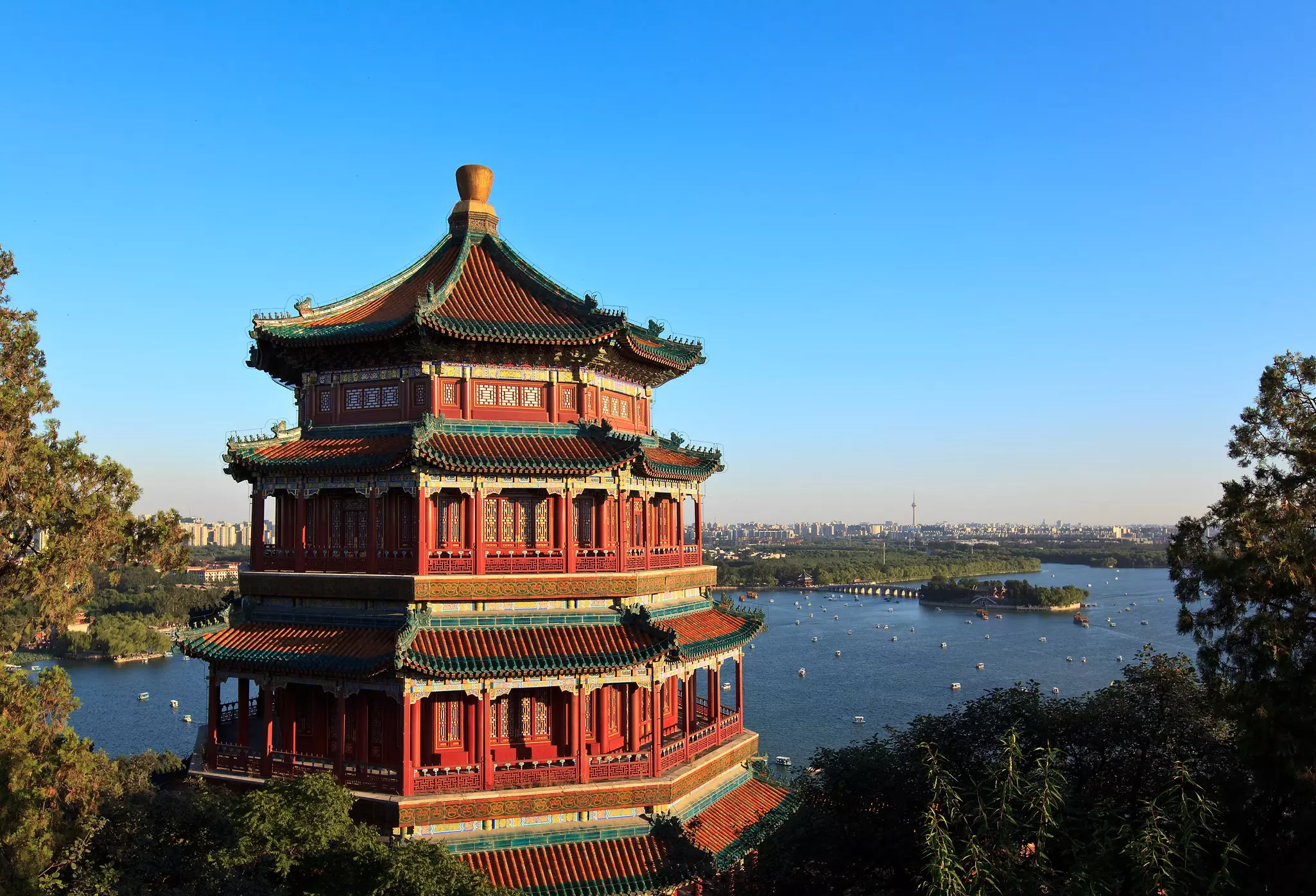
The Summer Palace's most compelling landmark, the octagonal Tower of Buddhist Incense, rises 41m above the slopes of Longevity Hill in four elegant tiers. It’s a commanding viewpoint for vistas of the lake, gardens and palaces.
At the summit, behind the pagoda, is the Hall of the Sea of Wisdom. Adorned with 1008 images of the Buddha, it's one of the loveliest buildings in the palace and has sensational views over Kunming Lake toward Beijing. At the foot of Longevity Hill is the Hall of Dispelling Clouds, built by the Qianlong Emperor for his mother on her 60th birthday.
More sights are north of Longevity Hill, including Suzhou Street, where emperors and their consorts would pretend to be common folk by “shopping” for trinkets, served by the palace eunuchs, who knew the benefits of indulging the whims of the imperial household – and the penalties for failing to do so.
West Causeway

The further west you venture in the Summer Palace, the lighter the crowds. The slender West Causeway runs for 2km across Kunming Lake, crossing six bridges. The highlight is the remarkably steep Jade Belt Bridge, which was built to allow the emperor’s dragon boat to pass underneath en route to the Yu River.
The willow-lined promenade offers some of the best spots for photographs of the Summer Palace. If you don't have the energy to circumnavigate the whole park, exit at the West Gate for the Xijiao Line, or return to catch the ferry by the Marble Boat.
Kunming Lake
It’s worth taking time to enjoy the views and reflections on expansive Kunming Lake, either by walking the lakeshore, taking the ferry to the northern shore or renting a boat to paddle over its surface and get away from the crowds.
On the lake’s northwest shore is the Marble Boat, a symbol of the feudal misrule that stymied China's modernization efforts for decades before the abolition of the monarchy. Empress Dowager Cixi's court allegedly embezzled funds earmarked for the Chinese navy to help renovate the Summer Palace gardens, leaving this stone and timber boat model as an ironic motif.
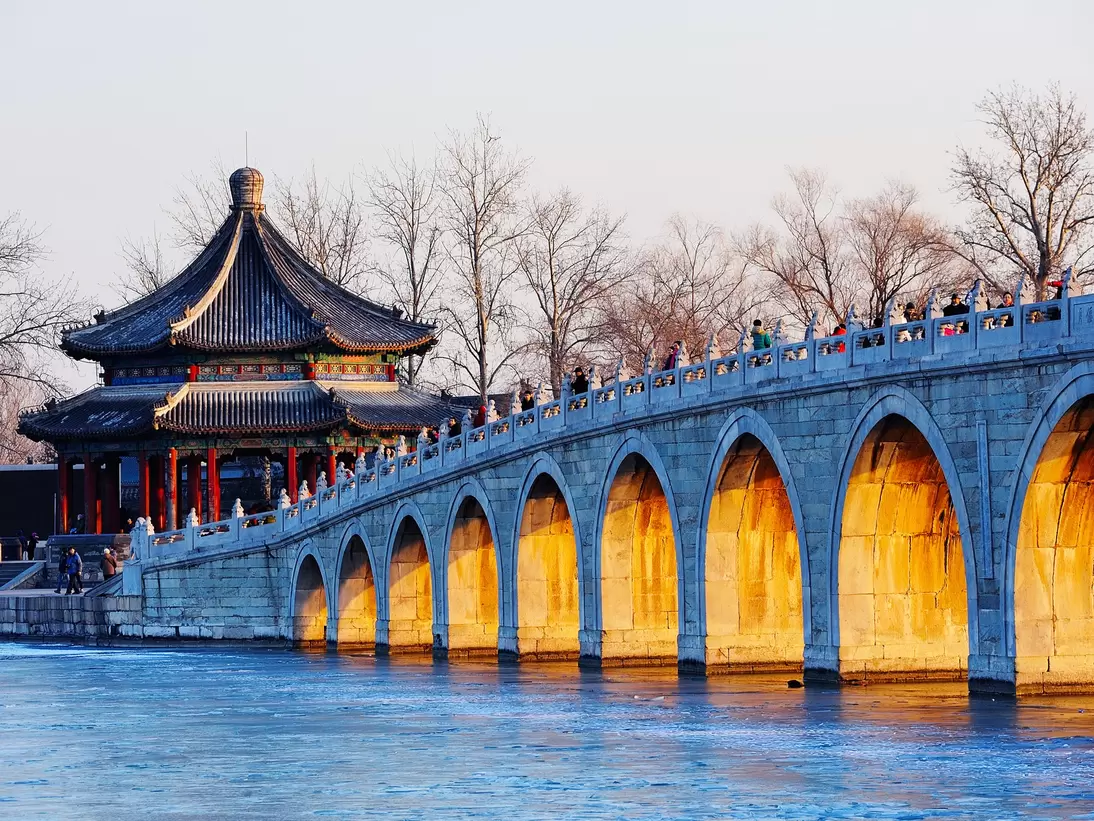
In the southern part of the lake are three islands, whose tripod arrangement was planned as a symbol of immortality. Close to the east shore of Kunming Lake, Nanhu Island can be reached via the Qianlong era 17-Arch Bridge, providing access to an 18th-century pavilion.
Old Summer Palace

Shattered ruins are all that remain of the Old Summer Palace (Yuanmingyuan), at one time the single most beautiful place in all of Beijing. Hundreds of Chinese-style buildings and jewel-box royal residences designed by Jesuit missionaries once dotted these 350 hectares of exquisitely landscaped royal gardens, creating a veritable vision of heaven on earth for the imperial household.
The entire compound was pillaged and then put to the torch by British and French troops in 1860 as one of many abuses during the Second Opium War. Only elaborate stone doorways and piles of toppled masonry remain today, but the Garden of Perfection and Light remains a singularly important place. Its destruction has been forever inscribed in Chinese history books as a low point in the nation's Century of Humiliation (1839–1945).
Fragrant Hills

If you need to escape the concrete jungle, the vast Fragrant Hills Park (Xiang Shan Gongyuan) is the capital's closest and most convenient green escape. Sprawling over a section of the Western Hills, the park was established by the Jin dynasty in 1186 but significantly expanded during the Yuan and Ming eras. In 1745, the Qianlong Emperor added new pavilions and gardens, renaming the park the Garden of Tranquility and Pleasure.
Grand villas occupied by foreign diplomats in past centuries dot the hillsides, alongside many memorable temples, including the imposing Buddhist Temple of Azure Clouds, which draws inspiration from the Mahabodhi Temple at Bodhgaya in India, where the historical Buddha attained enlightenment. Also impressive are the enormous Tibetan-style Temple of Brilliance and Xiangshan's iconic Glazed Tile Pagoda, both of which survived raids by European soldiers in the 19th and 20th centuries.
The park is at its busiest in the fall, when the maples are ablaze. On a clear day, you can see the skyscrapers of Chaoyang, some 20km distant, from the summit of Incense Burner Peak, at 557m, reached via a hike of around an hour from the park’s northern entrance or a thrilling cable car ride.
Alternatively, consider an organized hike. In operation for over two decades, Beijing Hikers has scouted all the best treks in the region and provides hikers with a shuttle bus and local guide to get them to the trailheads and back with minimum fuss. There are usually multiple trips each week, with varying levels of distance and difficulty; check its online calendar for upcoming trips.
Is the Summer Palace Accessible?
While the Summer Palace and the surrounding gardens and royal ruins sprawl across a series of green hills, many of the pathways and buildings in the compound are accessible to people with limited mobility. Wheelchair users can enter via the East Palace Gate, with two special loop routes that take in the most popular sights inside the park. Wheelchairs are available for loan at the site, and restrooms are wheelchair accessible.
However, with the age of the buildings and the varied terrain, some areas are more accessible than others. Reaching the Tower of Buddhist Incense, for example, involves steps and climbing a steep hill, while the ruins of the Old Summer Palace feature some uneven pathways.