Mysteriously never busy, the Museo Nazionale Romano: Palazzo Massimo alle Terme (closed Monday) is stuffed with wonders.
At the Palazzo Massimo alle Terme, you can sit in a room frescoed as an idyllic garden and imagine Livia, the wife of Augustus, enjoying the same view at her summer villa, see bronzes from Caligula's ceremonial ships and study the delicately portrayed scars of an ancient Grecian boxer.
Ground Floor: The Boxer & the Prince
There's something mesmerizing about the Boxer at Rest, which is the outstanding highlight on the ground level of the museum. This is a 2nd-to-1st-century-BCE Greek bronze, an extraordinary work: this is no idealized god, but a boxer who is weary, and has been through many rounds, with a cauliflower ear, knocked-out teeth and cuts and bruises on his face. He is muscular and powerful, but captured here as if resting between bouts, his muscles defined and tense. It's a uniquely realistic, arresting portrait of a boxer caught off duty. His bruises and cuts are vividly depicted through the use of inlaid copper.
It was excavated on the Quirinale Hill in 1885, and there is a wonderful photo of the statue at the time of its discovery, looking as if he is sitting waiting at the bottom of an excavated pit. The way it had been interred suggested that it had been purposefully hidden.
The Boxer shares the room with the 2nd-century heroic bronze statue of what is thought to be a Hellenistic Prince, an idealized nude, which was discovered on the Quirinale. It's a contrast in approach to the Boxer, while sharing the virtuoso artistry. These kinds of bronzes are incredibly rare, as often pieces would get melted down to reuse the metal.

Floor 1: Caligula's Barge Bronzes & Ancient Sculpture
Filling a roomful of glass cases, the bronze fittings from two ships recovered at the bottom of 30m-deep Lake Nemi in Lazio in the 1930s are perfectly preserved protemes, figurative heads that decorated the ends of the ships' beams, including lions, panthers and a Medusa. These incredible works indicate how lavish the barges must have been: less boats than floating palaces, built for the reputedly erratic Emperor Caligula.
In 1446, Cardinal Prospero Colonna, having heard rumors of a shipwreck at the bottom of the tiny, yet 30m-deep Nemi Lake, took boats out to investigate. He managed to confirm there was a wreck, but was unable to raise anything. Almost a century later, inventor Guglielmo de Lorena and his partner Francesco de Marchi used the newly invented diving bell to get closer to the wreck. They brought up some small sculptures, but they, and subsequent attempts, failed to bring up anything substantial. It was only in 1929, under Mussolini, that the boats were finally exposed. He had the whole lake drained through an ancient Roman drain, and discovered not one, but two ships. Pipework was inscribed with the name Caligula, proving that these two vast barges were floating imperial palaces. These perfectly preserved bronzes give a sense of the scale and splendor of the ships.
On the same floor are rare Roman copies of famous Greek works, such as two marble reproductions of the famous Discobolus of Myron, and the delicately sculpted intimacy of the Sleeping Hermaphroditus, who lies on their front, allowing a discreet peek at their male and female characteristics. Also fascinating are the portrait busts of Rome's movers and shakers of the ancient world, tracing the evolution of how they were portrayed.
During the time of Trajan and Nerva, statuary had a militaristic style, while Hadrian ushered in a fashion following the idealized sculpture of ancient Greece. Note the relief of tragic Antinous, rumored to be Emperor Hadrian's lover, who mysteriously drowned in the Nile aged 21. Afterwards, the distraught emperor flooded the empire with statues of his lost love, having first made him a god. He is depicted as Silvanus, god of woods and fields, harvesting grapes. A 2m-high sculpture of Augustus depicts the emperor as Pontifex Maximus, the head priest of the Roman Republic.

Floor 2: House of Livia & Villa Decoration
On the 2nd floor are the extraordinary frescoes from the House of Livia Drusilla (58 BCE–29 CE), which are the outstanding highlight of the entire museum. Livia was the wife of the Emperor Augustus, mother of Tiberius, and, if ancient sources are to be believed, an avid schemer and power behind the throne, as many powerful Roman women were depicted in sources written after their deaths. Her villa was called the House of the White Hen, as recounted by Pliny the Elder, a white hen dropped a laurel (bay) leaf on Livia's lap when she was first betrothed.
The villa was in the Roman suburb of Prima Porta, around 12km north of Rome, and in 1863, archaeologists uncovered these four incredible frescoes, covering the entire four walls of a subterranean triclinium (dining room). Sitting in the room genuinely feels like being immersed in an ancient, paradisiacal garden, with botanically accurate depictions of wild tangles of roses, pomegranates, oleander, strawberry trees, irises, camomile and of course, laurel: you can almost hear the birdsong. The clever lighting in this room mimics the modulation of light throughout the day and highlights the richness of the millennia-old colors. It's amazing to think that Livia also looked upon these walls.
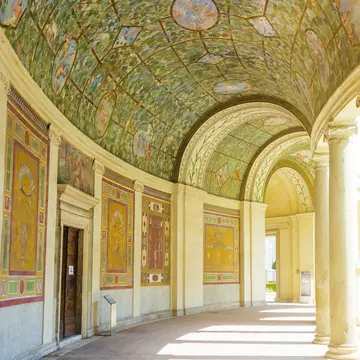
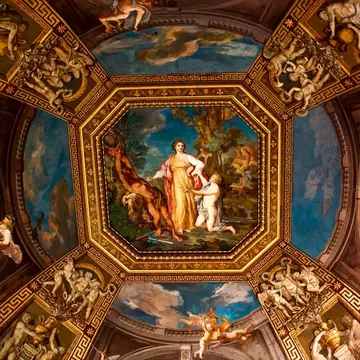
Recovered Roman frescoes are laid out in rooms, vividly showing the style of Roman interior decoration. There are intimate cubicula (bedroom) frescoes focusing on nature, mythology, domestic and erotic life, and delicate landscape paintings from a dark-painted winter triclinium to friezes of garland-carrying caryatids (sculpted female figures serving as an architectural support) and frescoed still lifes featuring masks from the theater.
Other decoration shows the splendor of high-end Roman villas, including intricate mosaics and inlay work.

Basement: Nusimetic Museum
In the ancient world, currency was a form of media – there was no other way that a leader's image could be disseminated other than the less portable means of statuary. In the basement, there are coins dating from the 9th century BCE, with examples of ancient image management, including Emperor Antoninus Pius (from 138 to 161 CE) showering money on a grateful subject. This section of the museum was closed at the time of research for renovations.