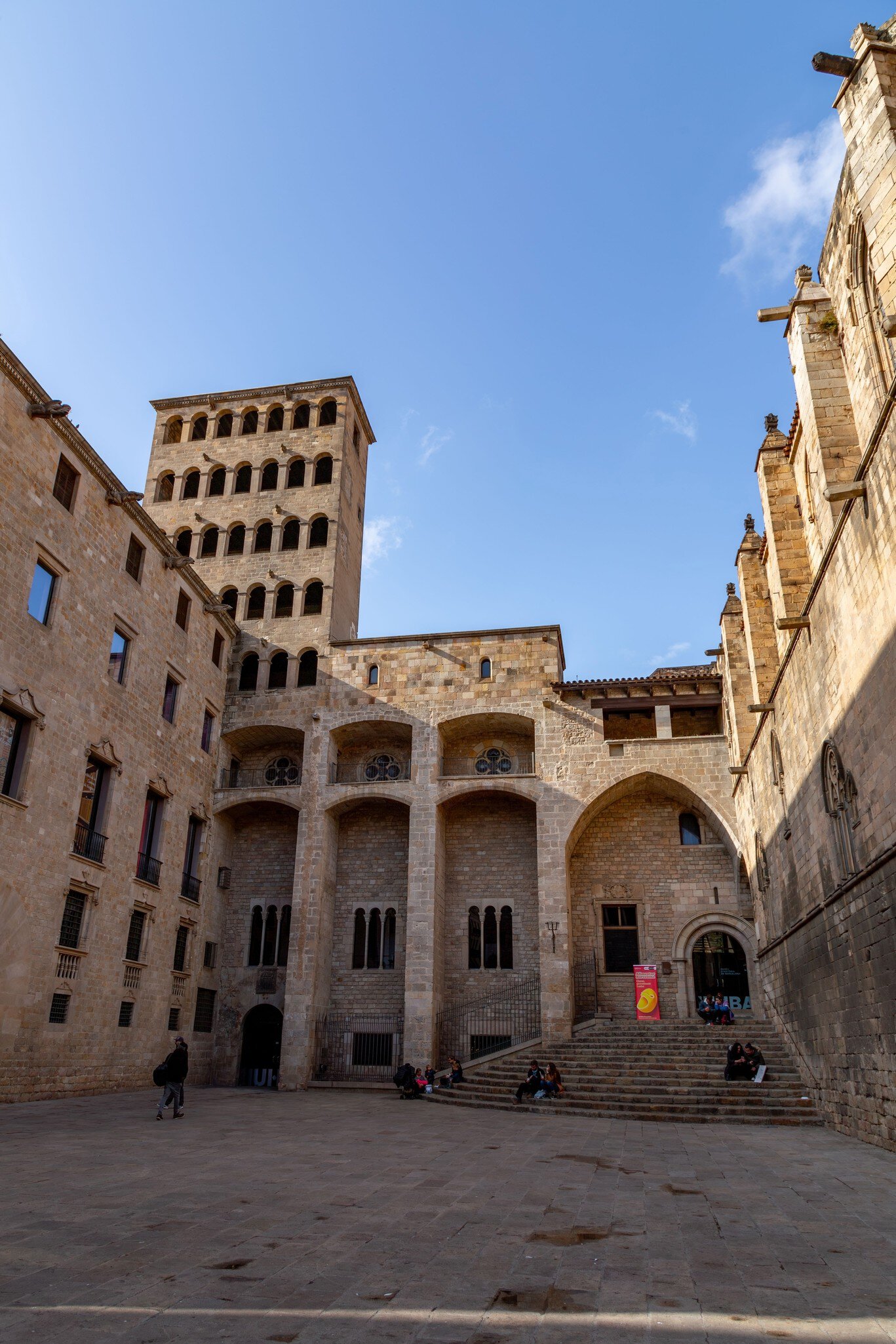
One of Barcelona's most fascinating museums travels back through the centuries to the very foundations of Roman Barcino. You'll stroll through 4 sq km of excavated Roman and Visigothic Barcelona, among the old streets, sewers, laundries, baths and wine- and fish-making factories that flourished here following the town's founding by Emperor Augustus around 10 BCE. Equally impressive is the building itself, which was once part of the Palau Reial Major (Grand Royal Palace) on Plaça del Rei, among the key locations of medieval princely power in Barcelona.
Originally built for a noble family on Carrer dels Mercaders, the grand Casa Padellàs was moved here, stone by stone, in the 1930s. It has a courtyard typical of Barcelona’s late-Gothic and baroque mansions, with a graceful external staircase up to the 1st floor. Today it leads to a restored Roman tower and a section of Roman wall (whose exterior faces Plaça Ramon de Berenguer el Gran), as well as a section of the house set aside for temporary exhibitions.
Below ground, under Plaça del Rei, lies a remarkable walk through 4 sq km of excavated Roman and Visigothic Barcelona. After a display on the typical Roman domus (villa), with mosaics and murals, you reach a public laundry, then pass dyeing shops, more laundries, fish-preserve stores, a 6th-century public cold-water bath and, as you hit the Cardo Minor (a main street), a factory dedicated to the making of garum (a popular paste across the Roman Empire, made of mashed-up fish intestines, eggs and blood).
Next come remnants of a 6th- to 7th-century church and necropolis and episcopal buildings, followed by winemaking stores, with ducts for allowing the must to flow off, and ceramic, round-bottomed dolia for storing and aging wine. Ramparts then wind around and upward, past remains of the gated patio of a Roman house and the medieval Palau Episcopal (Bishops’ Palace). Don't miss the 14th-century foundations of Barcelona's Gothic cathedral on the way up.
You eventually emerge at a hall and ticket office on the north side of Plaça del Rei. To your right is the Saló del Tinell, the banqueting hall of the royal palace and a fine example of Catalan Gothic (built 1359–70), with its broad arches and bare walls give a sense of solemnity. It's sometimes used for temporary exhibitions.
As you leave the saló you come to the 14th-century Capella Reial de Santa Àgata, the palace chapel. Outside, a spindly bell tower rises from the northeast side of Plaça del Rei. Inside, all is bare except for the magnificent techumbre (decorated timber ceiling) and 15th-century altarpiece, considered one of Jaume Huguet’s finest surviving works.