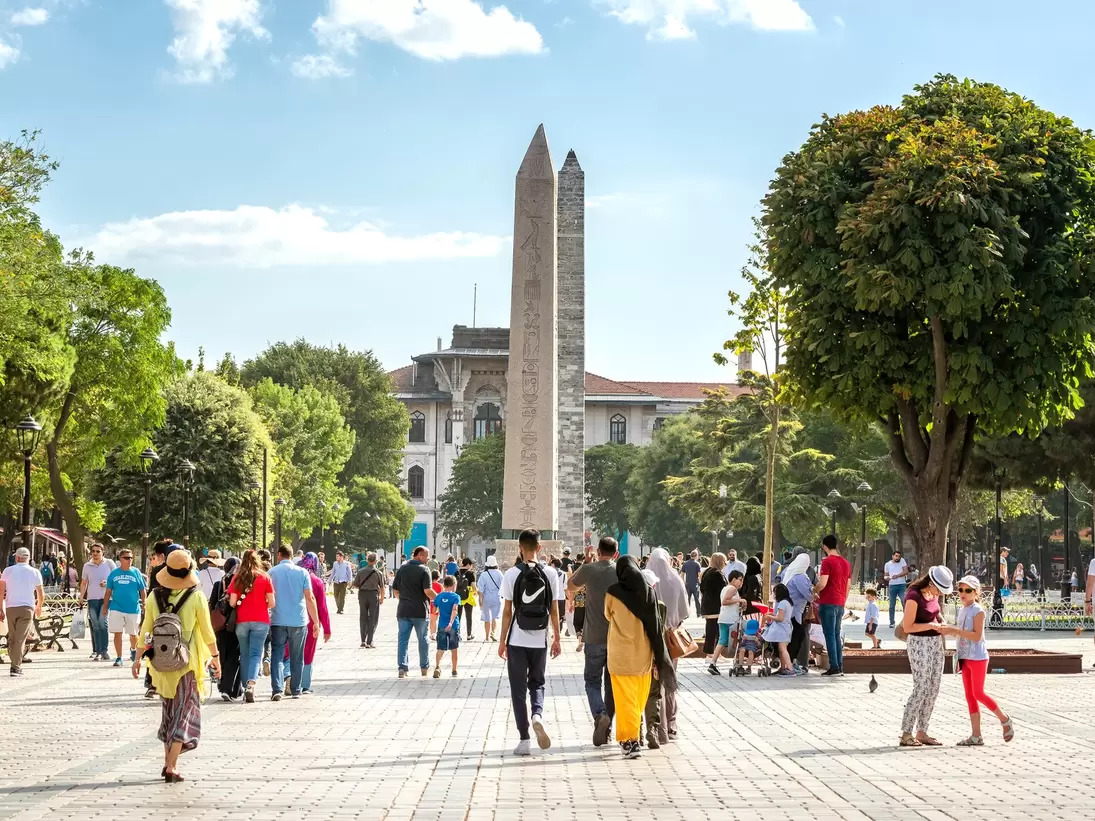
The Byzantine emperors loved nothing more than an afternoon at the chariot races, and this rectangular arena on the western side of the Blue Mosque was their venue of choice. Known as the Hippodrome (At Meydanı in Turkish), the arena originally consisted of two levels of galleries, a central spine, starting boxes and the semicircular southern end known as the Sphendone, parts of which still stand. The galleries that once topped this stone structure were damaged during the Fourth Crusade and ended up being totally dismantled in the Ottoman period; many of the original columns were used in the construction of the Süleymaniye Mosque. The Hippodrome was the center of Byzantium's life for 1000 years and of Ottoman life for another 400 years, and has been the scene of countless political dramas.
Near the northern end of the Hippodrome, the little gazebo with beautiful stonework is known as Kaiser Wilhelm's Fountain. It was presented to Sultan Abdül Hamit II by the German emperor in 1901. The monograms on the dome's interior feature Abdül Hamit's tuğra (calligraphic signature) and the first letter of Wilhelm's name, representing their political union.
Other monuments include the pink granite Obelisk of Theodosius in the center, which was brought here from its home in Karnak, Egypt, by Theodosius I in AD 390. The marble podium below the obelisk features carvings of Theodosius, his wife, his sons, state officials and bodyguards watching the chariot-race action from the kathisma (imperial box).
South of the obelisk is a strange column coming up out of a hole in the ground. Known as the Serpent Column, this stood in front of the Temple of Apollo at Delphi (Greece) from 478 BCE until Constantine I had it brought to his new capital city around 330 CE. It was once much taller and was topped by three serpents' heads, which survived until the early 18th century. Now all that remains of them is one upper jaw, which was discovered in a basement of Aya Sofya and is housed in the İstanbul Archaeology Museums.
Buildings lining the Hippodrome's western edge include the Museum of Turkish & Islamic Arts and the former Defter-i Hakani Nezareti (Land Registry Building) designed in the first decade of the 20th century by noted architect Vedat Tek, a leader of the First National Turkish Revival Movement. This now houses the multimedia Hagia Sophia History and Experience Museum (muze.gov.tr; €25). On the southern edge is the handsome late-19th-century Orman, Maadin ve Ziraat Nezaretii (Ministry of Agriculture, Mining & Forestry Building) designed by Raimondo D'Aronco, known for his art nouveau buildings in İstanbul. This is now used by İstanbul University.