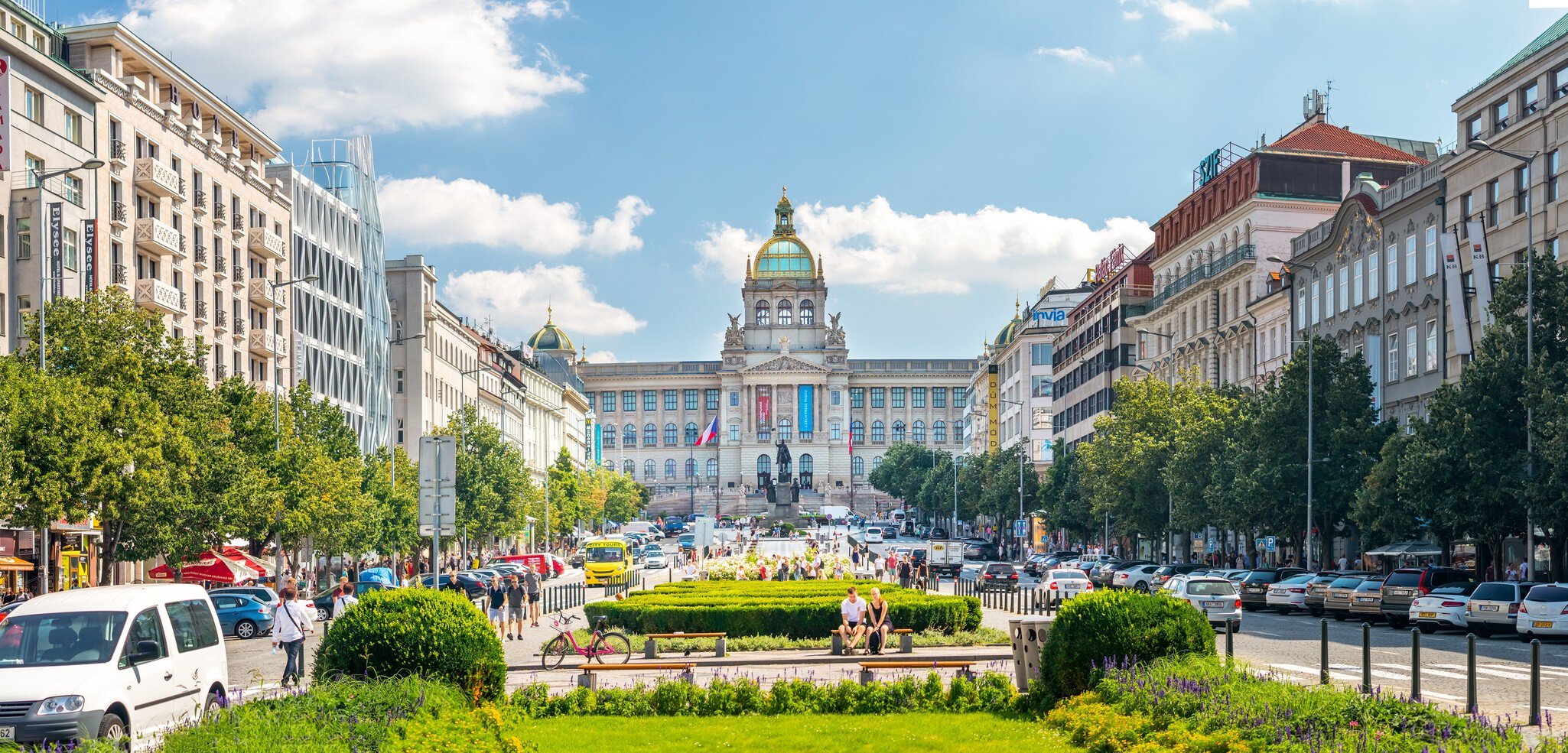
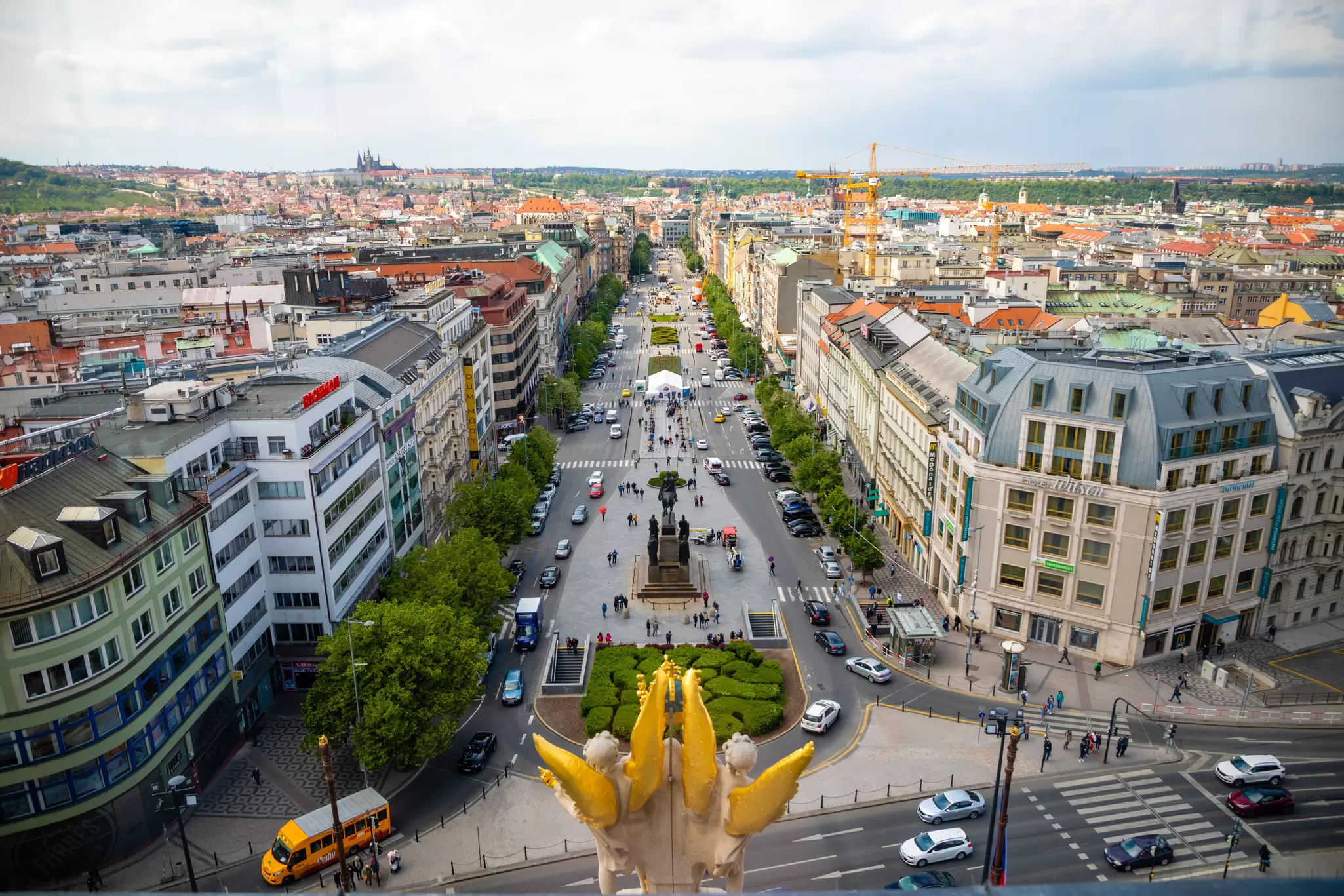
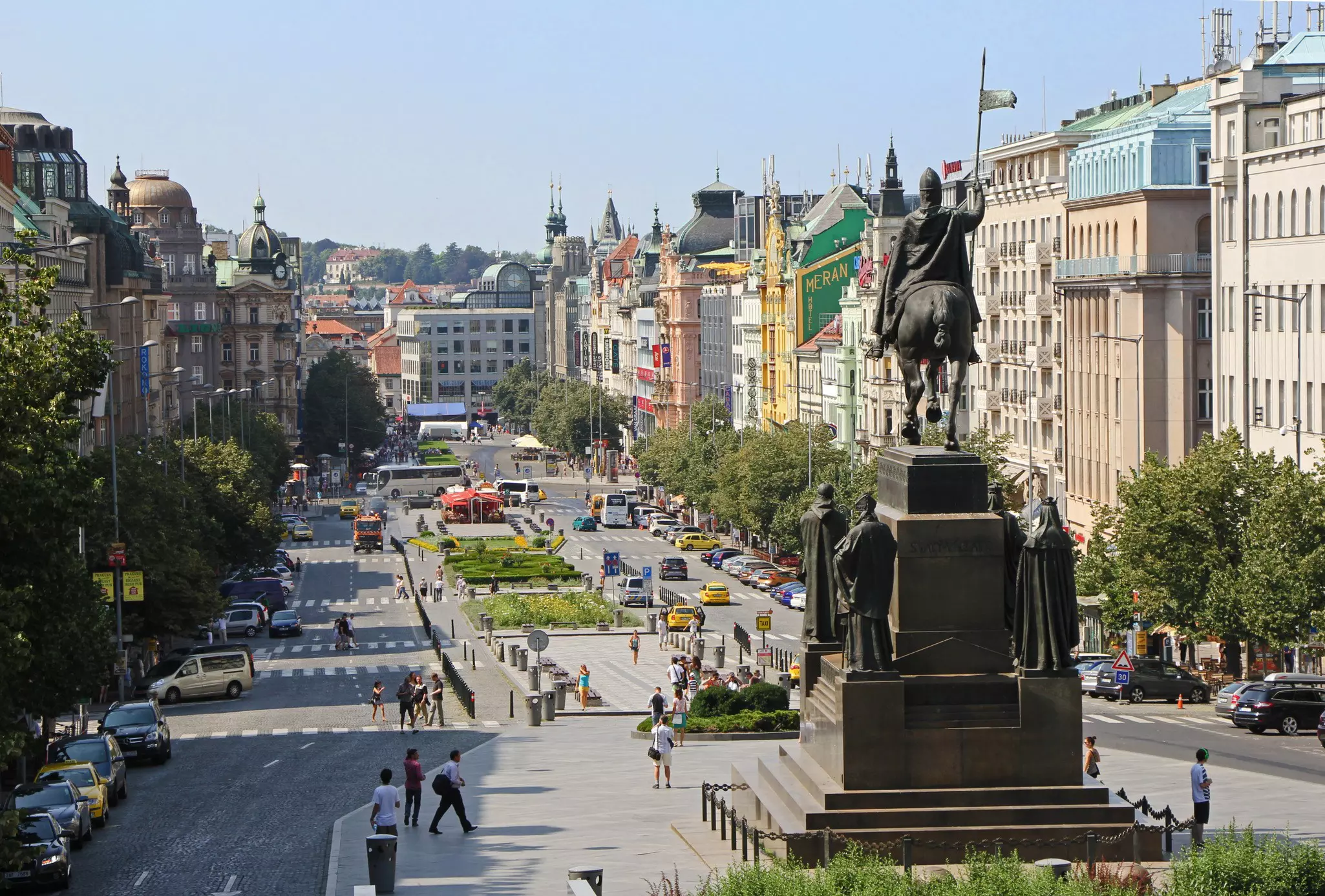
For centuries, Nové Město has been dominated by sloping Wenceslas Square (Václavské náměstí). This long rectangle started life as a horse market, but eventually evolved into the heart of Prague’s commercial life. It’s dominated at the top by the massive National Museum and along the sides by a patchwork of hotels, restaurants, hidden shopping passages and memorials to epic historic events.
Statues & Memorials
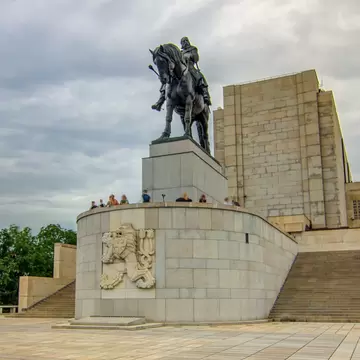
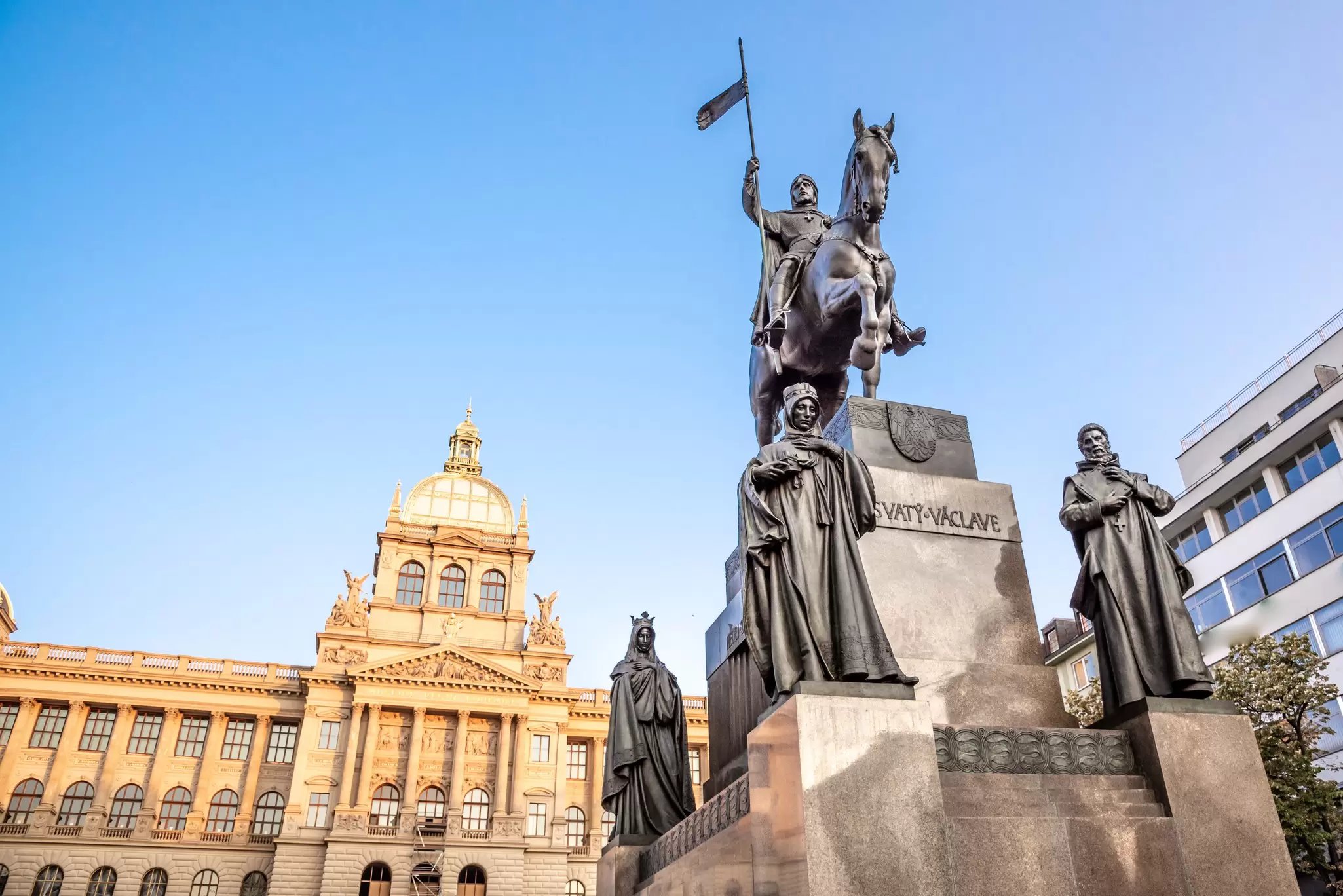
The upper (southeastern) end of the square is home to possibly Prague's best-known statue: Josef Myslbek’s 1912 equestrian statue of St Wenceslas, the 10th-century pacifist Duke of Bohemia and the "Good King Wenceslas" of Christmas carol fame. Flanked by other patron saints of Bohemia – Prokop, Adalbert, Agnes and Ludmila – he has been plastered with posters and bunting at every one of the square’s historical moments.
A few meters below the statue, find a more-modest memorial – often covered in flowers – to the "Victims of Communism," with images of two students who gave their lives to protest the 1968 Soviet-led invasion of Czechoslovakia. In January 1969, student Jan Palach set fire to himself and later died from his burns. He quickly became a national hero. A month later, a second student, Jan Zajíc, immolated himself near here as well. The exact spot where Palach fell stands just in front of the National Museum and is marked by a cross.
Site of Epic Events
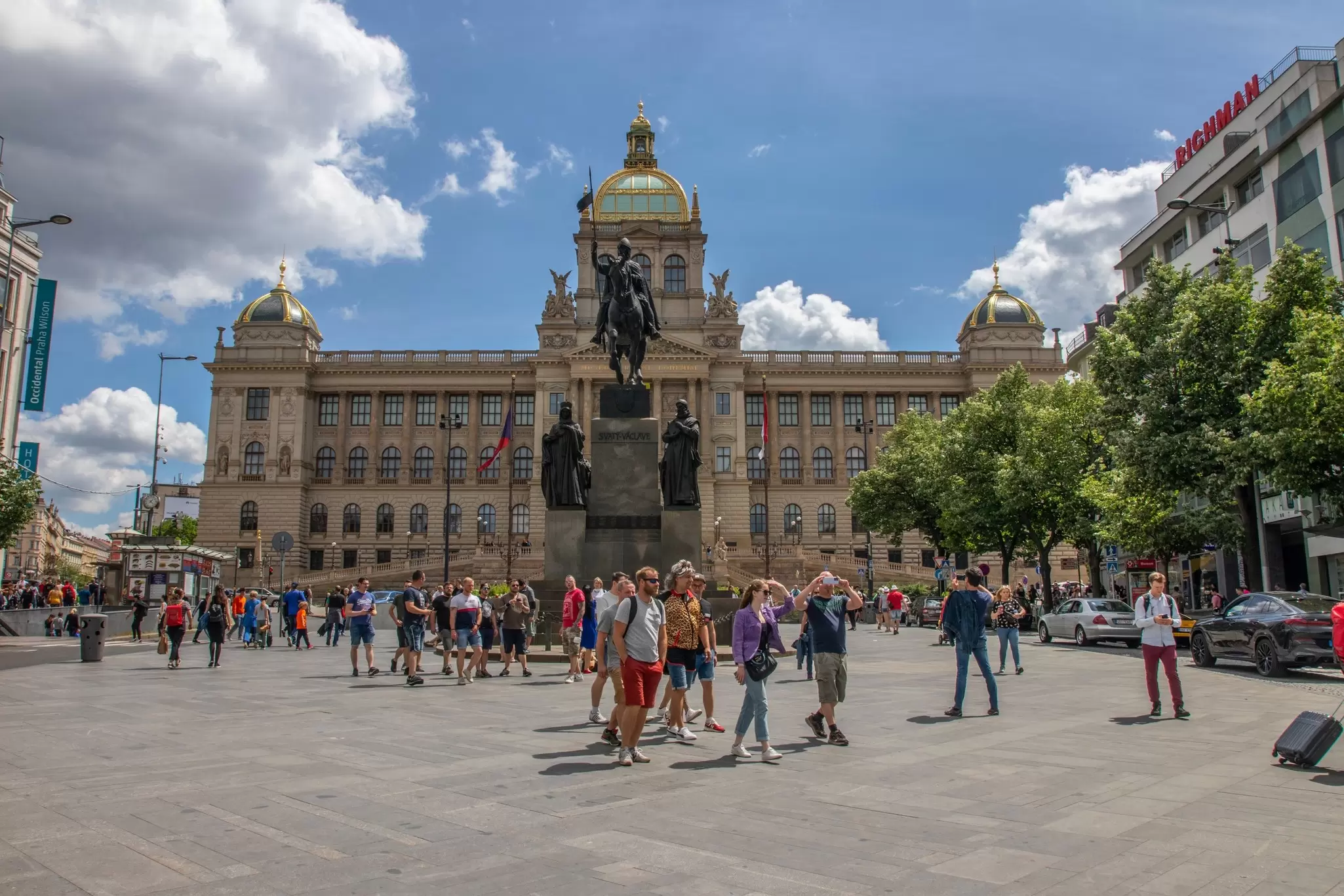
Wenceslas Square has witnessed a great deal of Czech history. In 1848, during the revolutionary anti-Habsburg upheavals of that year, a giant mass was held here. In 1918, at the end of WWI, thousands gathered to celebrate the creation of the newly independent Czechoslovakia from the ruins of the old Austro-Hungarian Empire.
For many Czechs (and Slovaks), Wenceslas Square will forever be linked to the 1989 Velvet Revolution. Not far from the square, on Národní street, find a memorial to the spot where demonstrators and riot police first clashed on 17 November. In the days afterwards, angry citizens gathered on the square night after night to protest and cheer on the efforts of dissident leader Václav Havel. Look carefully at the Melantrich Building (Václavské náměstí 36) to find a small balcony. This was the historic perch from where Havel and popular reform politician Alexander Dubček famously greeted hundreds of thousands of demonstrators in the square below.
Historical Architecture
The square is surrounded by important buildings representative of late-19th and early-20th century architectural styles. The Wiehl House (Václavské náměstí 34) from 1896 has a gorgeous facade decorated with neo-Renaissance murals by top Czech artist Mikuláš Aleš and others. Look for art nouveau at the newly remodeled (and dazzling) Grand Hotel Evropa (Václavské náměstí 25) and the Palác Koruna (Václavské náměstí 1), topped with a crown of pearls. The Lindt Building (Václavské náměstí 4), designed by Ludvík Kysela in 1927, is one of Czechia’s earliest examples of functionalist architecture.
Visit a Nuclear Bunker
One of the square's great secrets is this communist-era nuclear shelter that's hidden far beneath the 1950s Hotel Jalta (hoteljalta.com; adult/child 400/330Kč). The bunker is accessible to the public by guided tour. The highlight is the chilling communications room, which was used to listen in on the telephone calls and rooms of important hotel guests (including many foreign journalists in the runup to the 1989 revolution). Reserve tour spots on the hotel's website ; look for "fallout shelter."
Explore Lucerna Palace
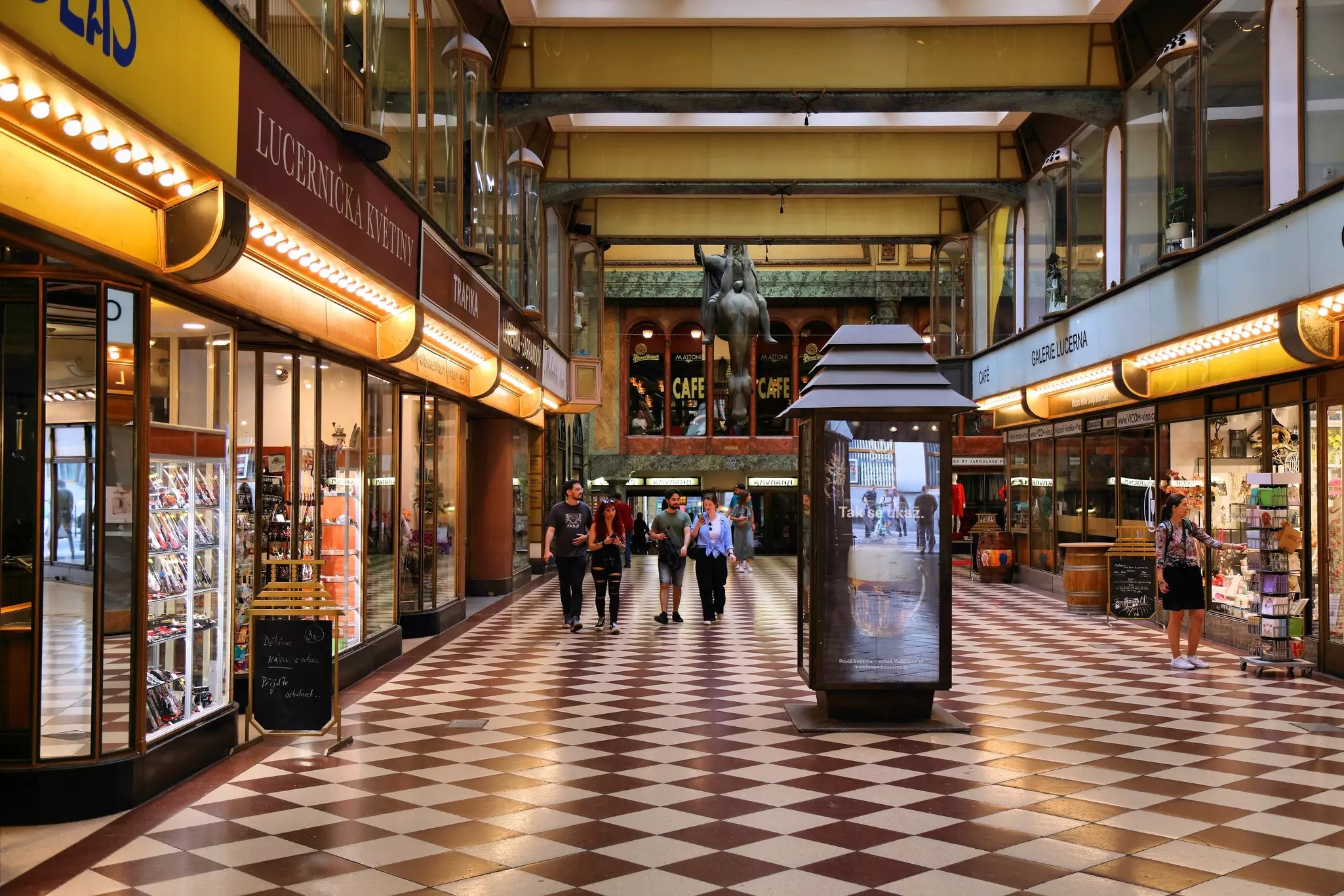
Find the entrance to Lucerna Palace, an elegant 1920s-era shopping arcade, just next to Václavské náměstí 36. It's a beautiful throwback space, with an arthouse theater, vintage cafe, music club and lots of delightful old camera and photography shops (and lots of other shops as well). It's also home to David Černý’s weird, shocking hanging-horse installation, Kůň (David Černý Sculpture).