It's easy to see why the Sheikh Zayed Grand Mosque is one of Abu Dhabi's defining landmarks. Vast in scale yet intricate in detail, this working mosque welcomes visitors of all faiths. The vision of the UAE’s founding father, His Highness the late Sheikh Zayed bin Sultan Al Nahyan, the mosque is also his final resting place.
Arrival & First Impressions
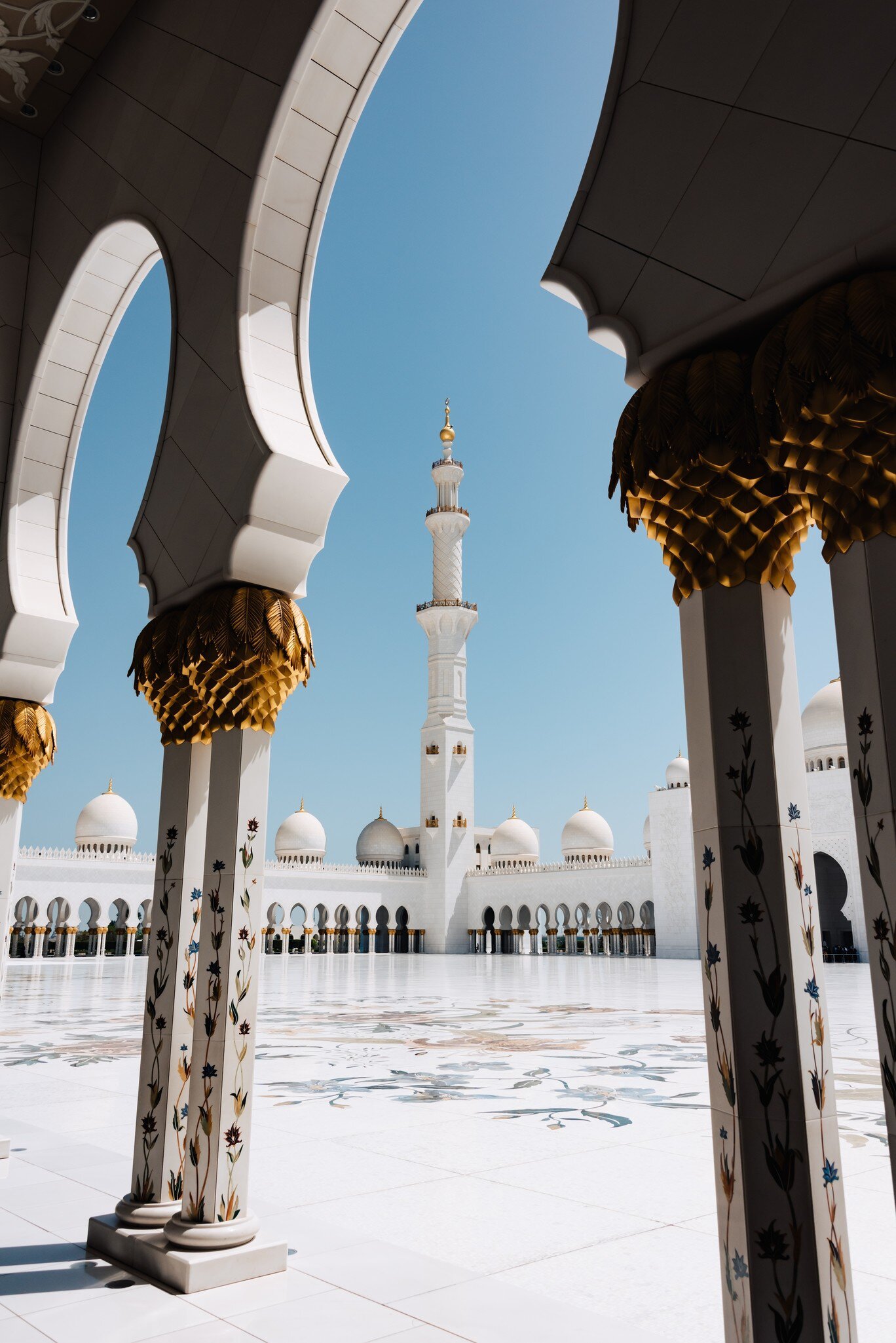
The Sheikh Zayed Grand Mosque is designed as a slow reveal. You enter through an underground visitor concourse that houses restaurants and shops, as well as exhibition panels explaining Islamic culture and mosque etiquette. The scale lands once you emerge outside and see the mosque's 82 marble domes, four minarets rising 106m into the air and gleaming white marble in every direction. Pause before you step into the courtyard to take it all in. The floor beneath your feet is comprised of a vast floral inlay – curling vines and blossoms across 17,400 sq meters – and can accommodate nearly 31,000 worshipers. This is one of the largest marble mosaics in the world.
Architecture
Integrating traditional Mamluk, Ottoman, Andalusian, Moorish and Fatimid influences with modern design, the mosque is one of the greatest examples of contemporary Islamic architecture in the world. Its 82 marble domes, the largest of which crowns the main prayer hall, are adorned with gold-glass mosaic finials. Each of the four 106m-high minarets combines three geometric shapes in a nod to the different Islamic architectural styles. The white Macedonian marble that dominates the exterior creates a sense of purity and reverence. External arcades are supported by 1096 marble columns featuring intricate floral designs inlaid with semi-precious stones, such as lapis lazuli, red agate, amethyst, abalone shell and mother-of-pearl. These are said to have been hand-carved by craftsmen descended from those who crafted the columns of the Taj Mahal, India’s legendary Mughal monument. A date-palm-inspired golden aluminum crown adorns each column.
Inside the Prayer Halls
The mosque houses three prayer halls. The main prayer hall has a capacity of over 7000 worshipers, while the two smaller prayer halls each have a capacity of 1500 worshipers. As you step into the main prayer hall in the interior of the mosque, expect to be dazzled by the sight of three chandeliers made of gilded stainless steel and gilded brass, and adorned with Swarovski crystals. The one in the center is the largest and weighs approximately 11 tonnes, while the ones on each side weigh approximately 7.26 tonnes each. Look carefully and you’ll realize their design is reminiscent of an upturned palm tree, their sparkling red, green and yellow crystal balls like clusters of dates.
Beneath your feet lies the world’s largest hand-knotted carpet, featuring a medallion design and floral motifs. Made of wool and cotton, this 5700-sq-meter masterpiece, which took two years to complete, was handcrafted by nearly 1200 artisans. Delicate mother-of-pearl vines adorn the 96 marble columns that support the three domes over the main prayer hall. The design of the gold-glass mosaic mihrab (a vaulted niche in a mosque wall indicating the direction of Mecca) is inspired by a reference in the Holy Quran to a river of honey and milk, among the abundant rivers of heaven. This wall, known as the Qibla Wall, is illuminated with the 99 names of Allah in the Kufic style of Arabic calligraphy. To its right is the minbar (pulpit) made of carved cedar wood inlaid with mother of pearl, glass mosaic and white gold.
Lunar Lighting
Return after sunset if you can. A cleverly designed lighting system of 22 light towers transforms the mosque into an ethereal sight, reflecting the phases of the moon. The light shifts gradually from blue to white according to the lunar cycle, reaching peak brilliance on the night of the full moon and turning deep blue to represent darkness.