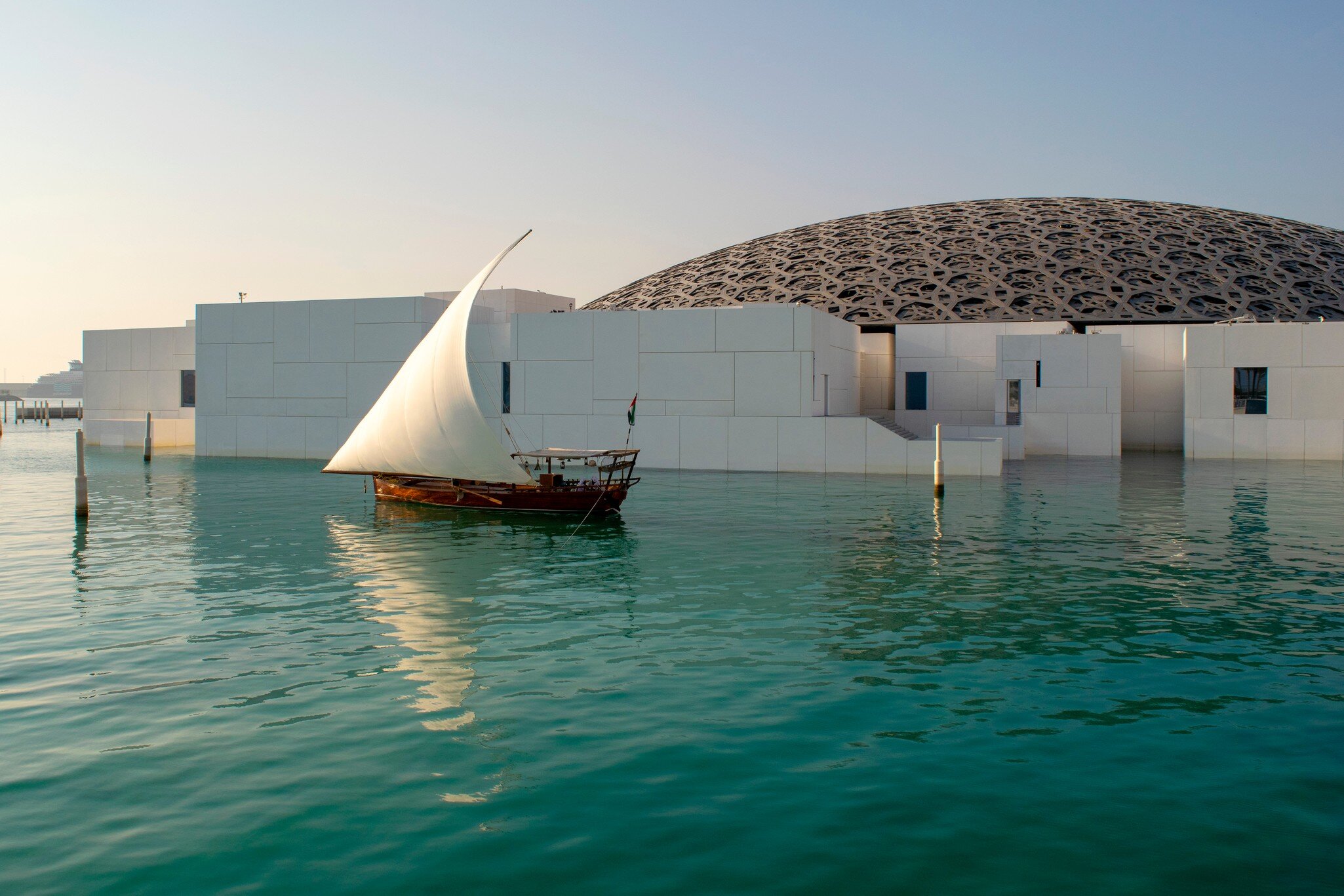
Louvre Abu Dhabi is the first museum of its kind in the region and an iconic work of contemporary architecture in Abu Dhabi. Inside, the museum’s 23 galleries showcase cultural achievements from around the world, featuring art, artifacts, sculptures and manuscripts that span thousands of years of human history.
Under the Dome
Before you step inside, pause at the museum's most arresting feature: the gleaming 7600-tonne geometric steel dome. Designed by Pritzker Prize–winning architect Jean Nouvel, this masterpiece appears to hover over a contemporary medina-like cluster of 55 low-rise buildings. Up close, its eight-layer lattice fractures sunlight into thousands of shifting stars, creating a "rain of light" effect that moves across courtyards and walkways throughout the day. The museum is surrounded by water on three sides, and the sea breeze – particularly in winter – makes the outdoor passages as compelling to explore as the galleries.
A Museum Without Borders
In acknowledgement of the world's shared humanity, the museum’s galleries are organized chronologically into 12 chapters from the prehistoric era up to the present day. Over 600 works of art are showcased, including statues, religious texts, pottery, paintings and other exhibits from the museum’s permanent collection, as well as pieces on loan from the Musée d’Orsay, Centre Pompidou and the Department of Antiquities of Jordan. The museum's ethos is exchange: ideas that traveled along trade routes, faiths that shaped empires and technologies that are reshaping societies.
Begin in the Grand Vestibule and follow the sequence, but don’t feel obliged to see everything. The early rooms explore the first settlements and the rise of kingdoms. The galleries in Wing 2 document the rise of religions such as Buddhism, Christianity and Islam over 2000 years, as well as the emergence of trade routes that fueled creativity, innovation and cultural exchange. The four galleries in Wing 3 are focused on navigation and cosmography; territorial, economic and military expansion; the early effects of globalization; and the impact of manufacturing on societies and cultures. The final wing turns to industrialization, colonialism and the reinvention of art in the modern era.
For those short on time, museum educators lead 45-minute guided express tours daily at noon.
Highlights
Standout works include a serene bodhisattva statue (c 100–300 CE) from Pakistan, a sculpture of Roman emperor Augustus (c 27 BCE–100 CE), an intricate 18th-century brass astrolabe by Muhammad ibn Ahmad Al-Battuti, Rembrandt’s intimate Study of the Figure of Christ, and Georges de La Tour’s 17th-century A Girl Blowing on a Brazier.
Children's Museum
If you’re visiting with children, don't miss the three-story Children’s Museum, which has interactive installations and immersive exhibitions for ages four to 10.
Pause, Eat, Continue
Museum fatigue is real. The shaded outdoor walkways are designed as breathing space between wings. Use them. At Aptitude Café, enjoy breakfast, salads, sandwiches and mains. The Museum Café is a decent choice, but pricier. The rooftop Art Lounge, open during cooler months, is a good place for a sundowner. At Fouquet’s Abu Dhabi, expect a Parisian brasserie–style fine-dining experience created in collaboration with chef Pierre Gagnaire. For a nightcap, head to the sleek Marta Bar.
Art Here & After Dark
The annual Art Here exhibition turns the dome’s outdoor plazas into a platform for large-scale contemporary installations spotlighting regional and international artists. The works respond to a changing theme, often reinterpreting light and shadow in dialogue with the museum's architecture. The museum also hosts house music and DJ-led events. Past sets have included Black Coffee, Peggy Gou and Adriatique.