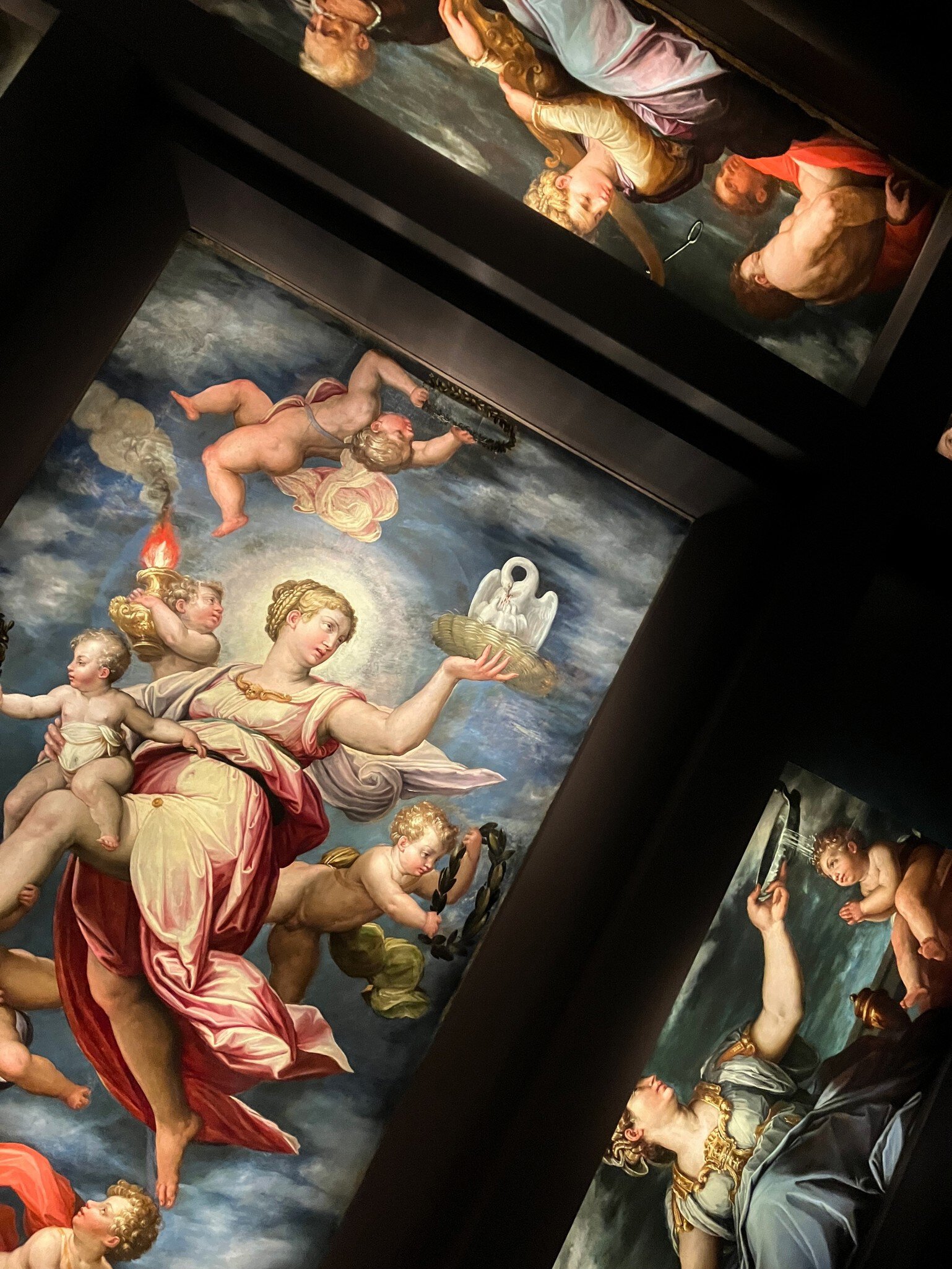
Hardly academic, these galleries contain more murderous intrigue, forbidden romance and shameless politicking than the most outrageous Venetian parties.
For centuries, the Scuola della Carità complex housed religious orders, including flagellants, but since Napoleon installed his haul of Venetian art trophies here in 1807 – mainly looted from various religious institutions – its rooms have thrilled art lovers.
First-Floor Galleries
From the entry hall, take the grand staircase up to the 1st floor, home to the bulk of the collection’s treasures. Room 1 is pure sensory overload as a swarm of angels flutter their golden wings from Marco Cozzi’s carved ceiling, gazing down upon a swirling polychrome marble floor. Competing valiantly for your attention are a collection of vivid 14th- and 15th-century religious works that show Venice's precocious flair for color and drama. Case in point: Jacobello Alberegno's late-14th-century Apocalypse polyptych shows the Whore of Babylon riding a hydra, with babbling rivers of blood from her mouth.
UFO arrivals seem imminent in the eerie, glowing skies of Carpaccio’s lively Crucifixion and Glorification of the Ten Thousand Martyrs of Mount Ararat in Room 2. But Giovanni Bellini's San Giobbe altarpiece shows hope on the horizon, in the form of a sweet-faced Madonna and Child enthroned beneath golden mosaics as angels play their instruments. The saints surrounding them include Roch and Sebastian, suggesting that this luminous, uplifting work dates from the dark days of Venice's second plague in 1478.
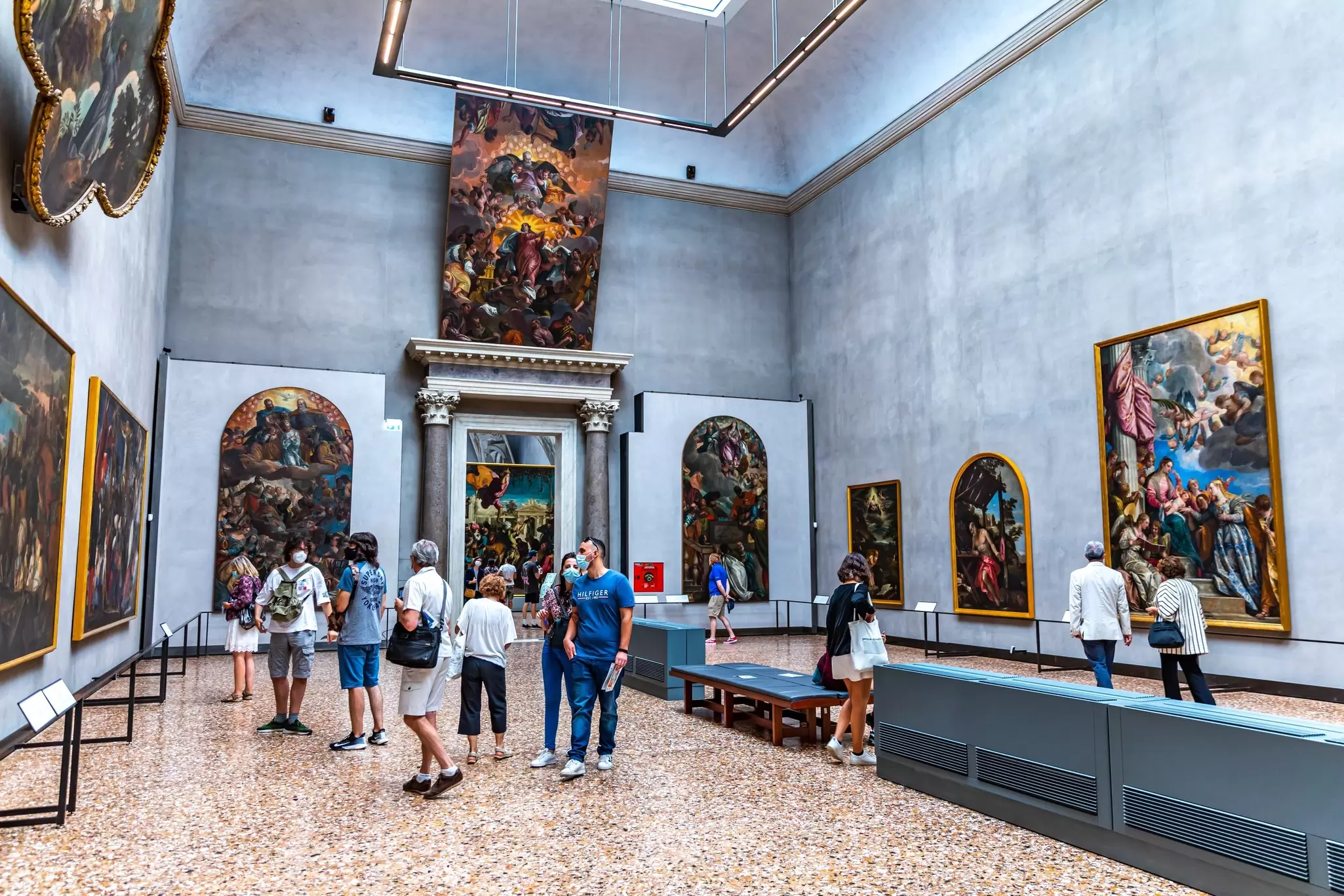
Meet a fascinating stranger in Room 4, where Hans Memling captures youthful stubble and angst with exacting detail in Portrait of a Young Man. Upstaging him in Room 5 is Giovanni Bellini's sublimely elegant Madonna and Child between Saints Catherine and Mary Magdalene. Large-format collaborations await in Room 6B, where a show-stopping cycle commissioned for the Scuola Grande di San Marco includes Martyrdom of Saint Mark by Giovanni Bellini and Vittore Belliniano, as well as Three Episodes from the Life of Saint Mark by Giovanni Mansueti and Paris Bordon. Take a seat and lose yourself in what are virtual Renaissance films, complete with huge casts, monumental sets and myriad unfurling scenes.
A short detour leads to Room 8, where Giorgione’s sad-eyed La Vecchia (Old Woman) points to herself as the words "with time" unfurl ominously by her arm. Keeping her company is another Giorgione masterpiece, The Tempest. The paintings are emotionally nuanced and their meaning obscure. Giorgione's influence on Titian is clear in the delicate rendering of The Archangel Raphael and Tobias nearby.
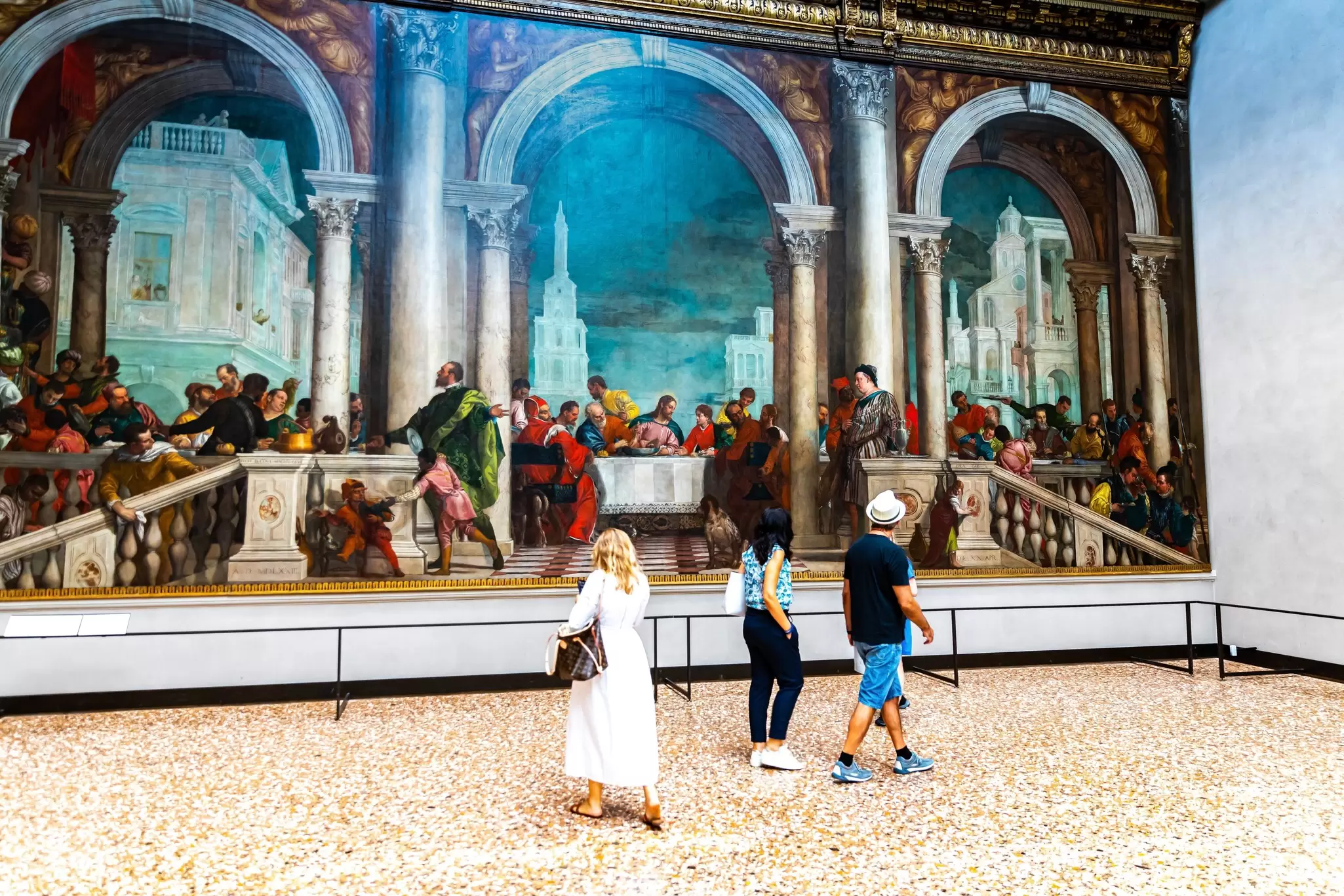
Room 10 stuns with Paolo Veronese’s monumental Feast in the House of Levi. The controversial painting was originally called Last Supper until Inquisition leaders condemned the Renaissance master for showing dogs, drunkards, dwarves, Muslims and Reformation-minded Germans cavorting with the Apostles.
In Room 11, Tintoretto's Saint Mark Rescues a Saracen (1562) is an action-packed blockbuster, with fearless Venetian merchants and an improbably muscular, long-armed saint rescuing a turbaned sailor. At the time of writing, this room also contained Tintoretto’s Saint Mark Saves the Slave from Torture. The work received high praise from influential intellectual Pietro Aretino upon its reveal in 1548, boosting the young Tintoretto’s profile. Also here is Titian’s 1576 Pietà, possibly finished posthumously by Palma il Giovane. Notice the smears of paint Titian applied with his bare hands and the column-base self-portrait, foreshadowing Titian's own funeral monument.
Lorenzo Lotto’s melancholy Portrait of a Young Man intrigues in Room 13. Lotto was well known for using highly symbolic props in his paintings, with the withered rose petals possibly alluding to a troubled or unrequited love. On our last visit, Room 16 featured beautiful canvases by the late-Mannerist and early-Baroque artist Padovanino, including his sensual depiction of Orpheus and Eurydice, while Rooms 18 to 24 were closed for restoration.
Normally, Room 20 is full of large canvases taken from the Scuola Grande di San Giovanni Evangelista. Among them is Gentile Bellini's recently restored Miracle of the Reliquary of the Cross at San Lorenzo Bridge, thronged with cosmopolitan crowds. The artist's Procession in Piazza San Marco offers an intriguing view of Venice's most famous square before its 16th-century makeover, while the former wooden version of the city's most famous bridge appears in Vittore Carpaccio's Miracle of the Reliquary of the Cross at Rialto Bridge.
The former church (Room 23) is a serene showstopper fronted by a Bellini altarpiece. Sharing the space is Giorgione’s highly charged The Storm. Art historians still debate the meaning of the mysterious nursing mother and passing soldier with a bolt of summer lightning – is this an expulsion from Eden, an allegory for alchemy, or a reference to Venice conquering Padua in the War of Cambria?
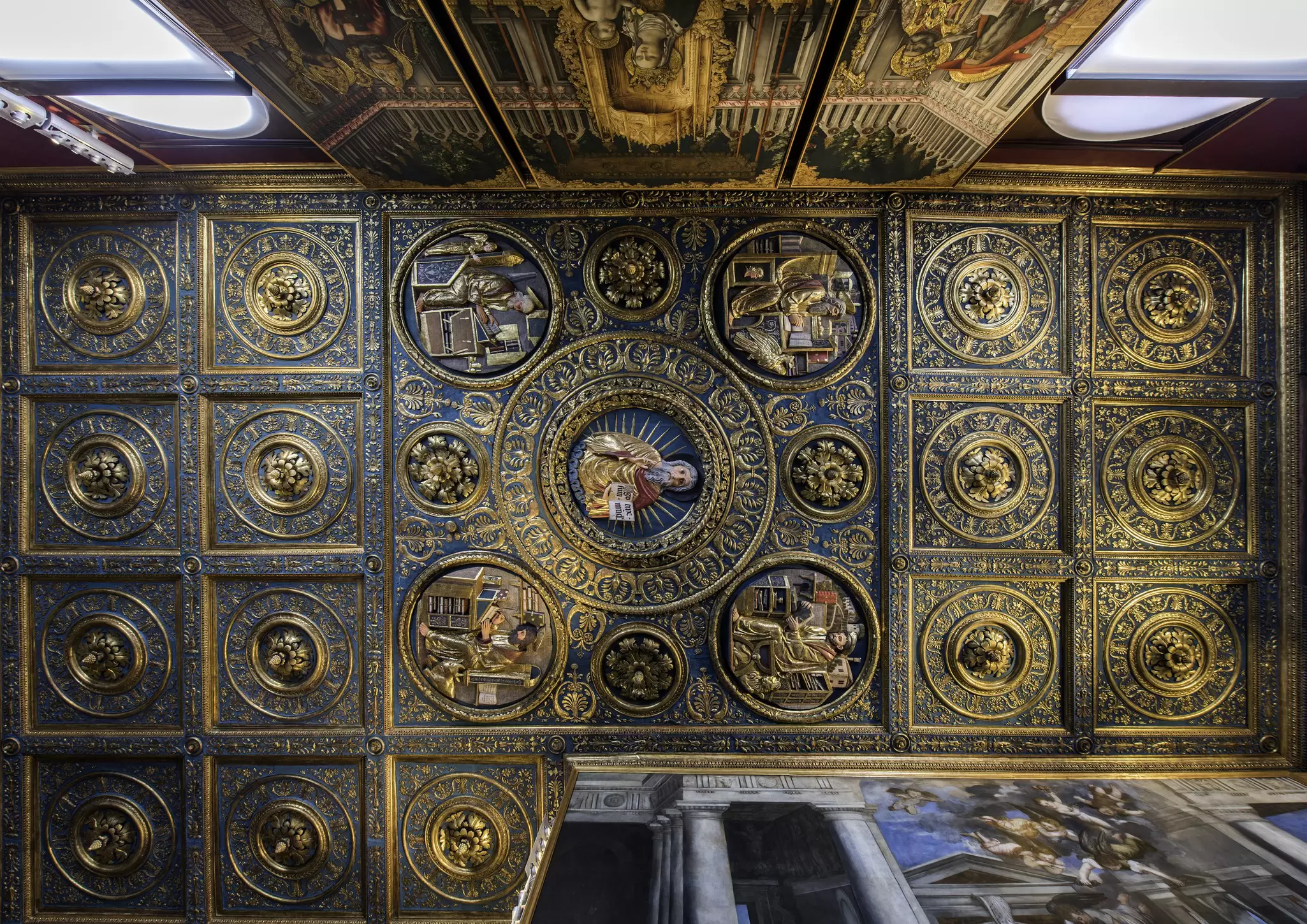
The final 1st-floor space, Room 24, has been left untouched from when it was the Scuola della Carità's boardroom, the Sala dell’Albergo. Board meetings would not have been boring here, under a lavishly carved ceiling and facing Antonio Vivarini's Madonna Enthroned with Child in the Heavenly Garden, filled with fluffy-bearded saints. Titian closes the 1st-floor circuit with his touching Presentation of the Virgin. Here, a young, tiny Madonna trudges up an intimidating staircase while a distinctly Venetian crowd of onlookers points.
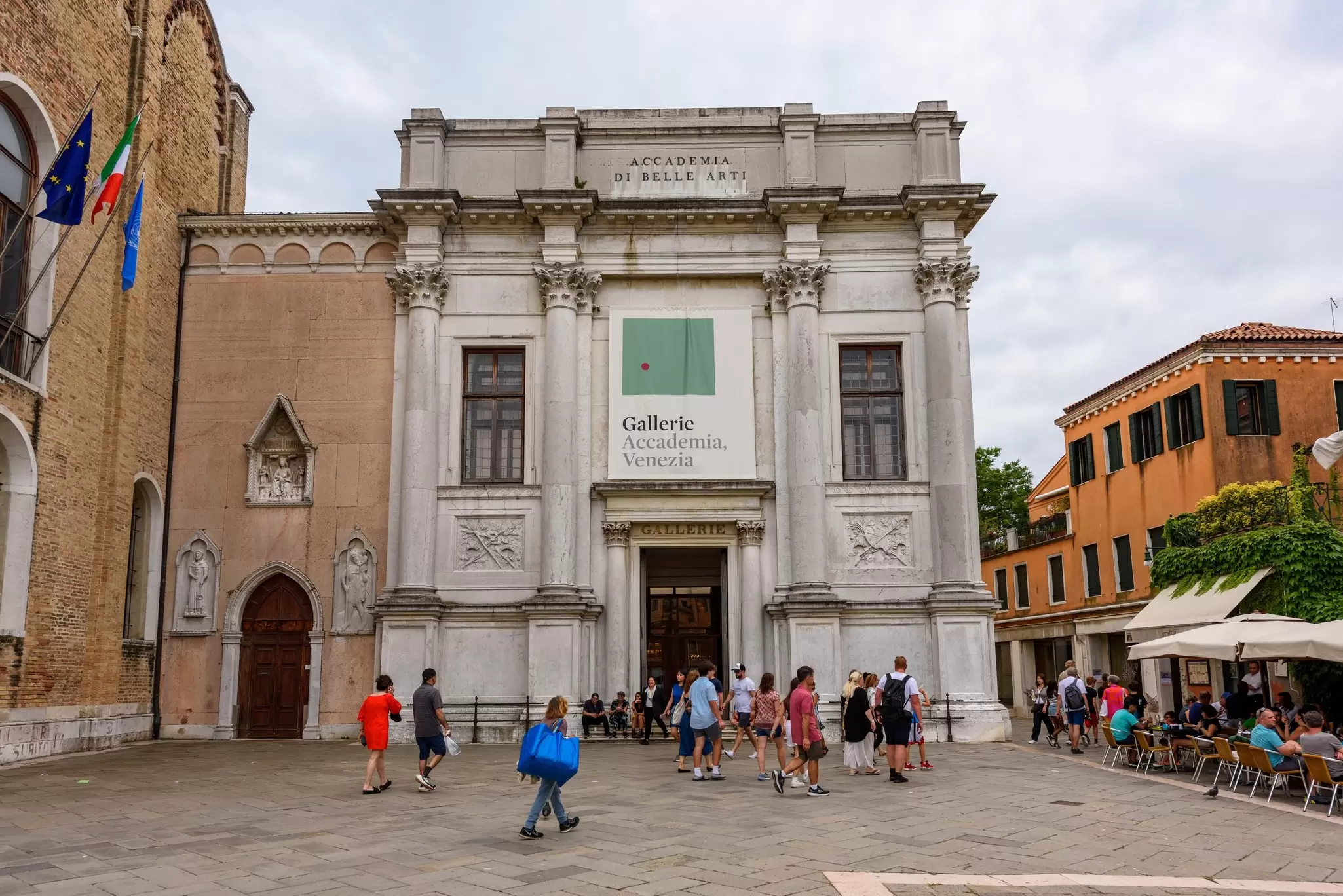
Ground-Floor Galleries
Stairs lead down to the ground-floor galleries, from where you can glimpse a striking oval staircase designed by Andrea Palladio in 1560. The ground-floor collection itself focuses mainly on paintings from 1600 to 1880, with a smattering of works by the Veneto’s most famous sculptor, Antonio Canova, including funeral steles, classical figures and sycophantic effigies of La Serenissima’s new French overlords, the Bonapartes. Despite playing second fiddle to the blockbusters upstairs, there are some worthy Venetian highlights.
Following the museum route, Room 9 claims Perspective with Portico, one of very few Canaletto paintings on public display in Venice, while Room 8 includes a self-portrait pastel of Rosalba Carriera, the best known of the city’s 18th-century female artists.
Giandomenico Tiepolo was paid 116 gold sequins for his splendid The Three Angels Appearing to Abraham in Room 6, in which a panicked Sara denies having mocked God’s news of her impending pregnancy. Close by, you can almost hear the terror in Giambattista Tiepolo’s nightmarish Scourge of the Serpents, an extraordinary, 13m-long work depicting Moses saving his people from God’s reptilian wrath. In sharp contrast is a suite of delightful works by 18th-century satirist Pietro Longhi, as well as Giambattista Piazzetta’s crowd-pleasing The Fortune Teller.
High-stakes drama resurfaces in Room 5 with Sebastiano Mazzoni’s dizzying Massacre of the Innocents, originally commissioned for the Chiesa di San Trovaso. Removed from the church in the mid-19th century, the painting’s whereabouts remained unknown before reappearing in a private collection in recent years. Your museum trawl ends triumphantly in Room 2, where Giambattista Tiepolo’s luminous fresco The Exaltation of the Cross and Saint Helen makes for a soul-stirring epilogue.