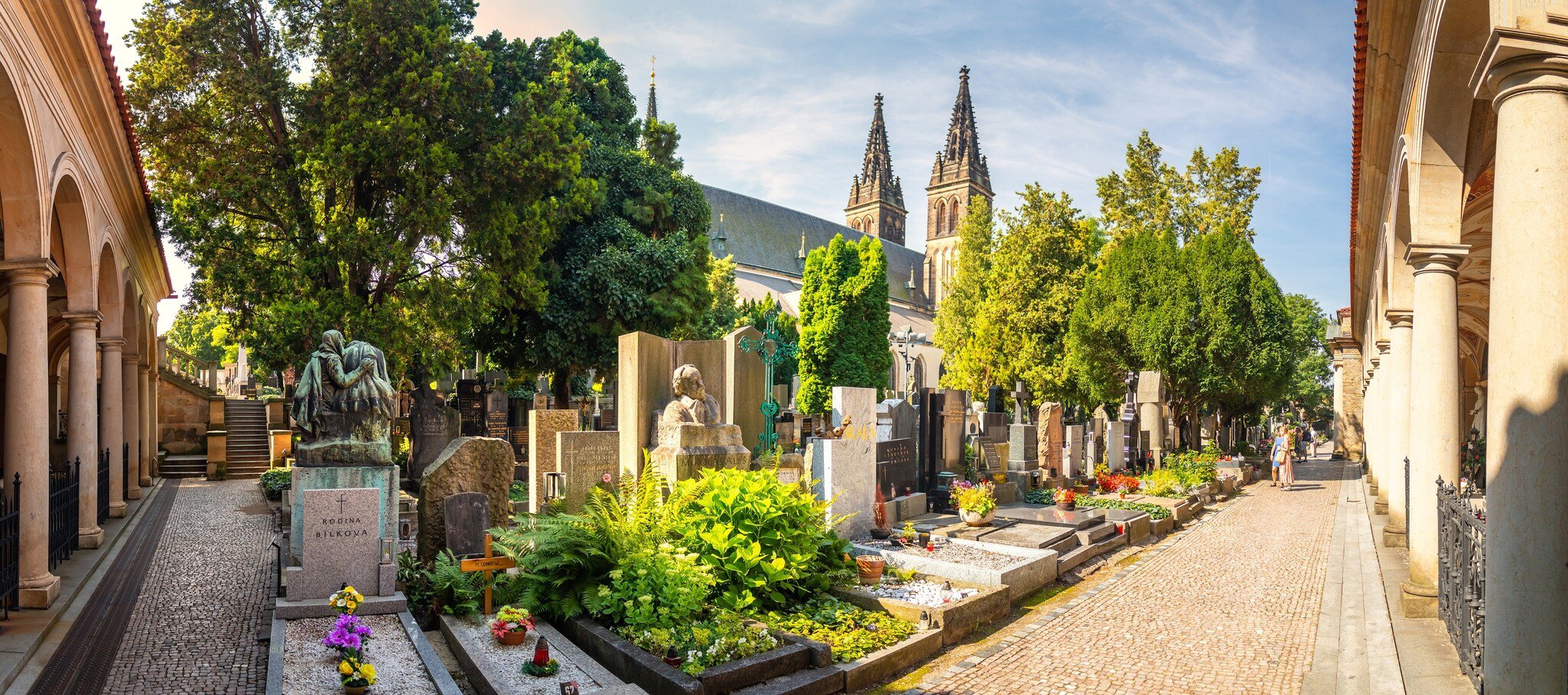
Much like London’s Highgate or Paris’ Père Lachaise, Vyšehrad Cemetery is more than a burial ground. The cemetery was conceived in the mid-19th century as a place to honor the very best Czech composers, writers, poets and artists of their day. The grounds themselves are lovely; many tombstones are works of art themselves, created in daring, eye-catching Cubist and art-nouveau styles.
Spot the Household Names
Vyšehrad Cemetery is the final resting place for dozens of Czech luminaries, including many names that will be familiar to visitors who might not otherwise know much about Czech culture. Some of the famous graves here include the composers Antonín Dvořák and Bedřich Smetana, as well as the art-nouveau artist and illustrator Alfons Mucha and artist Max Švabinský (and many others). Dvořák’s grave is marked by a striking bust of the composer – the work of sculptor Ladislav Šaloun, the artist who created the Jan Hus monument in Old Town Square.
Don't Miss the "Slavín"
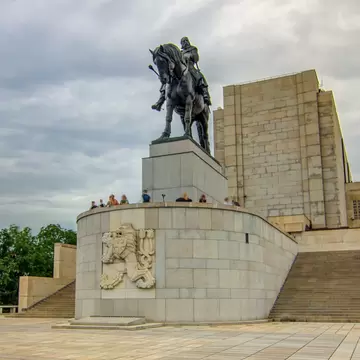
The eastern end of the cemetery is dominated by the "Slavín" (Pantheon), designed by Antonín Wiehl in the 1890s to feature noteworthy Czech writers and artists. The names may not be quite as renowned worldwide as in the general cemetery (though Mucha is interred here); they nevertheless demonstrate the importance Czech culture has attached to artistic achievement. In addition to Mucha, the pantheon holds the remains of Cubist architect Josef Gočár, opera singer Ema Destinnová, sculptor Bohumil Kafka, creator of the giant equestrian statue of Jan Žižka at the National Monument at Vítkov, and many others.