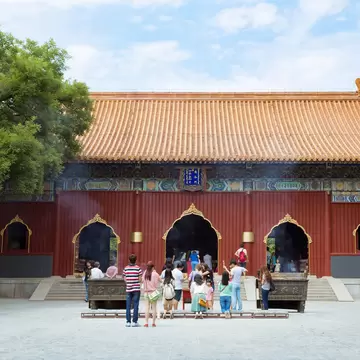
The sprawling residence of Prince Gong (1833–1898), half-brother of the Xianfeng emperor, is most notable for its marvelous gardens, which feature artificial hills, ponds, rocks that mimic mountain ranges, whimsical pavilions and even a Great Wall folly. The architectural highlights of this fantastical royal playground are the Western-style Gate (西洋门; Xīyáng mén), a marble portal built in the Jesuit style, and the wisteria-adorned Grand Theatre House (大戏楼; Dàxì Lóu), where tour groups (lots of them) are treated to short Peking opera performances.
Prince Gong's grandson mortgaged the property to the Catholic Church in 1921, and it became a university annex. In the 1950s, the residence housed leaders of the CPC security services, and later served as the Beijing Air Conditioning Factory. The main residence was largely rebuilt in the lead up to the 2008 Olympic Games.
Prince Gong's Mansion is reputed to be the model for Chinese writer Cao Xueqin's 18th-century masterpiece Dream of the Red Chamber, though it could also be the reverse that is true.