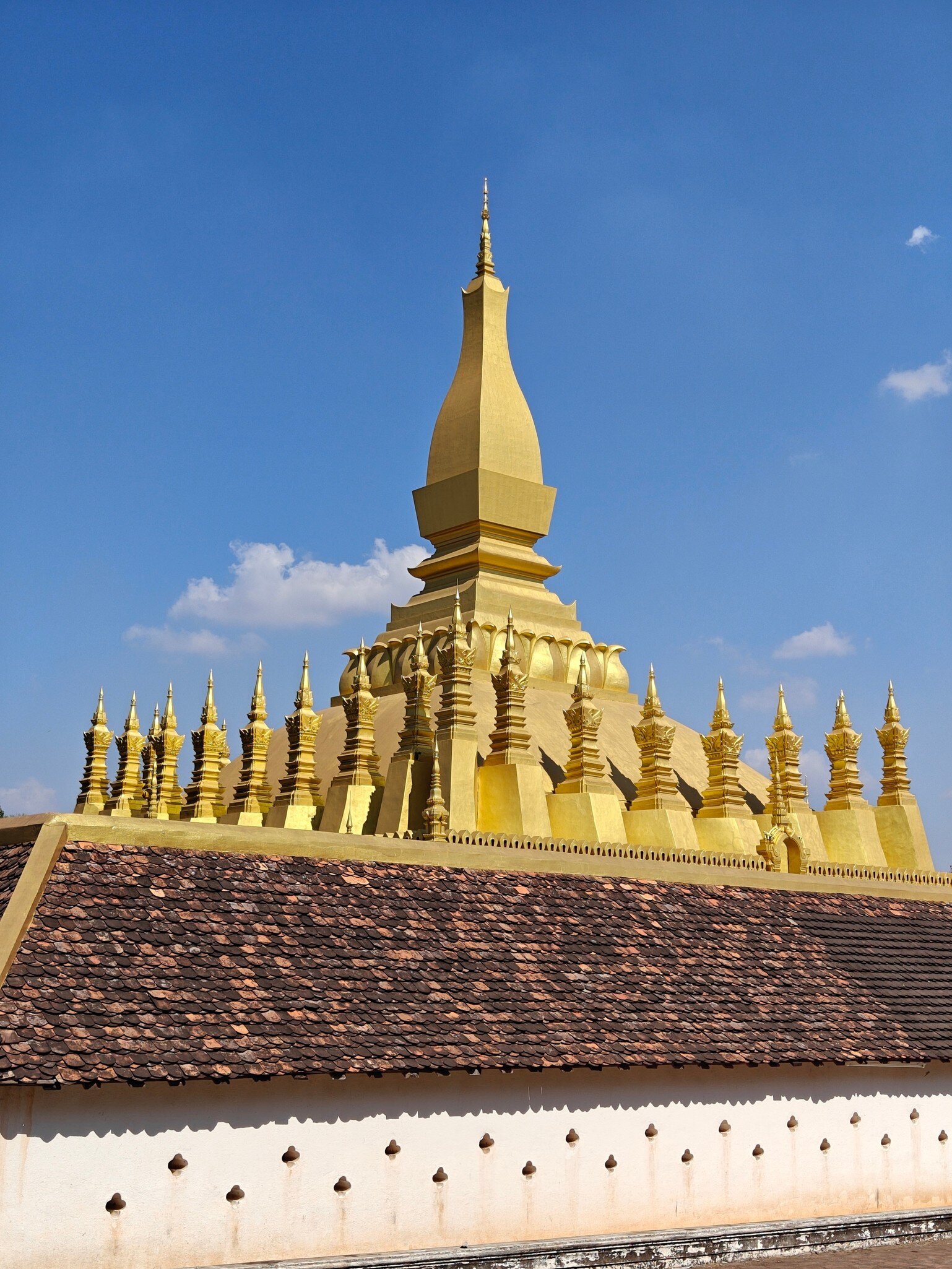
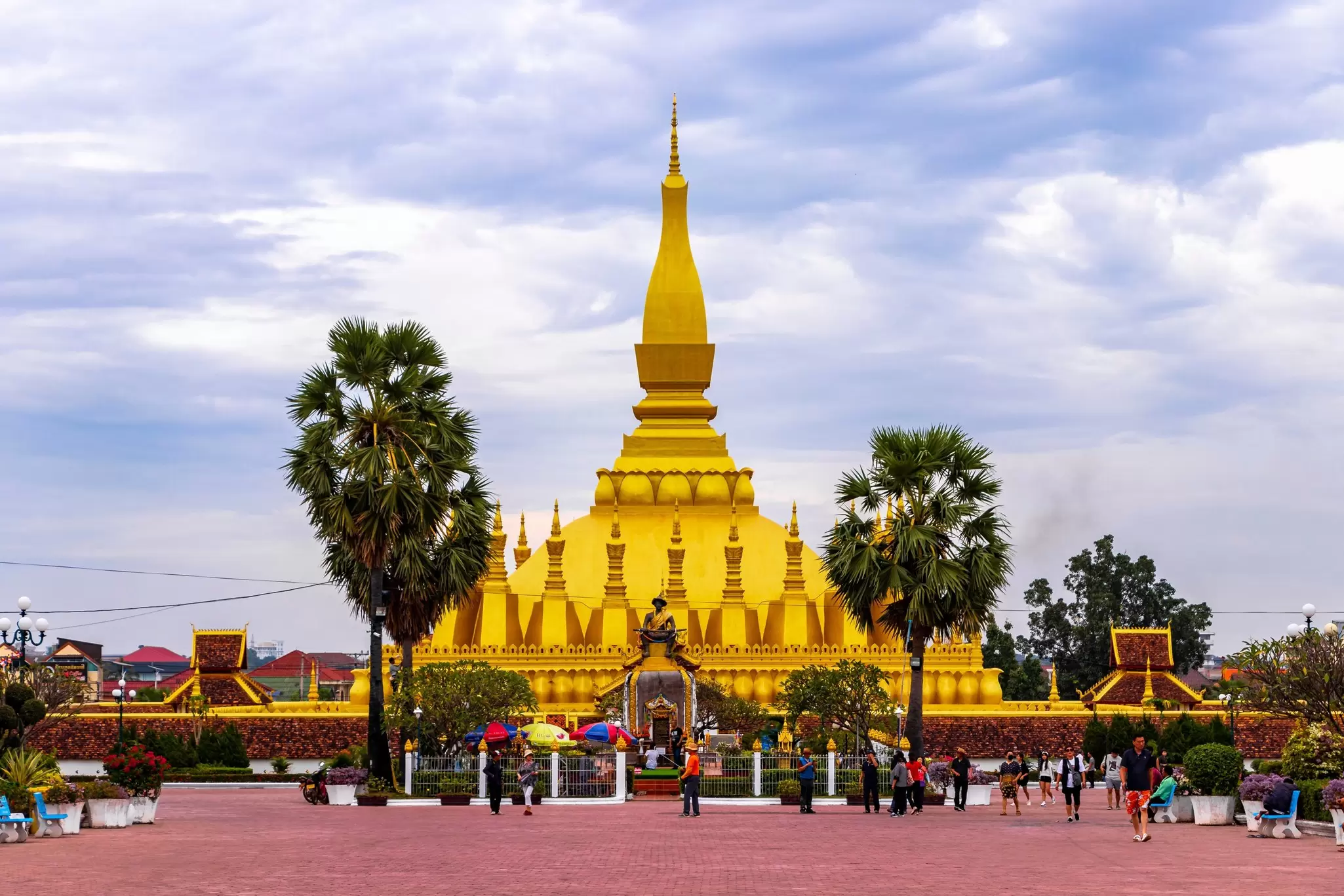
The golden spires of Pha That Luang, meaning Great Stupa, are the spiritual symbol of Lao Buddhism, the most important national monument in the country and a statement of Lao sovereignty. It is best seen around sunrise or sunset when the soaring stupa is glimmering in the soft light of golden hour and contrasts dramatically with the bold blue skies.
Did You Know?
That Luang was badly damaged by successive Burmese and Siamese invasions in the 18th and 19th centuries and was abandoned until an amateurish French restoration effort in 1900. Fortunately, French explorer Louis Delaporte had made some detailed drawings of the original temple in 1867 and a French and Laotian team was able to reconstruct it to its former glory between 1931 and 1935, gifting the nation the iconic symbol we see today.
Statue of Jayavarman VII
A high-walled cloister with tiny windows surrounds the 45m-high stupa and was added by King Anouvong in the early 19th century, possibly as part of sturdy defenses for archers against marauding invaders. The cloister measures 85m on each side and contains various Buddha images, including a serene statue of Jayavarman VII, the great Angkor-era king who converted the state religion of the Khmer empire to Mahayana Buddhism in the late 12th century. Excavations around the stupa suggest that an Angkor-era Khmer monastery was located here between the 11th and 13th centuries. When King Setthathirat moved the capital of Lan Xang from Luang Prabang to Vientiane in 1566, he chose this auspicious site for his state temple.
Interpreting the Architectural Features
Although the monument can resemble a cluster of golden missiles from a distance, each level of Pha That Luang has different architectural features in which Buddhist doctrine is encoded. Visitors are supposed to contemplate the meaning of these features as they walk around. The first level is an approximately square base measuring 68m by 69m that supports 323 sĕe máh (ordination stones). It represents the material world, and also features four arched hŏr wái (prayer halls), one on each side, with short stairways leading to them and beyond to the second level.
Buddhist Stupas
The second level is 48m by 48m and is surrounded by 120 lotus petals. There are 288 sĕe máh on this level, as well as 30 small stupas symbolizing the 30 Buddhist perfections (báhlamée săhm-síp tat), beginning with almsgiving and ending with equanimity. The original stupas contained smaller pure gold stupas but these were looted by Chinese raiders when That Luang was abandoned in the late 19th century.
Indian Influences
Legend has it that Ashokan missionaries from India erected a tâht (stupa) here to enclose a piece of Buddha's breastbone as early as the 3rd century BC. Arched gates again lead to the next level, a 30m by 30m square. The tall central stupa, which has a brick core that has been stuccoed over, is supported here by a bowl-shaped base reminiscent of India's first Buddhist stupa at Sanchi in Madhya Pradesh State which was originally built by King Ashoka, in the 3rd century BC, to protect a relic of the Buddha. At the top of this mound, the superstructure, surrounded by lotus petals, begins.
The Golden Lotus
The curvilinear, four-sided spire resembles an elongated lotus bud and is said to symbolize the growth of a lotus from a seed in a muddy lake bottom to a bloom over the lake's surface, a metaphor for human advancement from ignorance to enlightenment through Buddhist rituals. The entire tâht (stupa) was regilded in 1995 to celebrate the 20th anniversary of the Lao People's Democratic Republic (Lao PDR), and is crowned by a stylized banana flower and parasol. From ground to pinnacle, Pha That Luang is 45m tall.