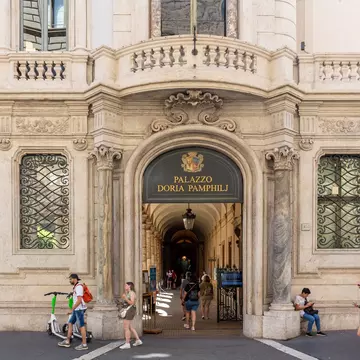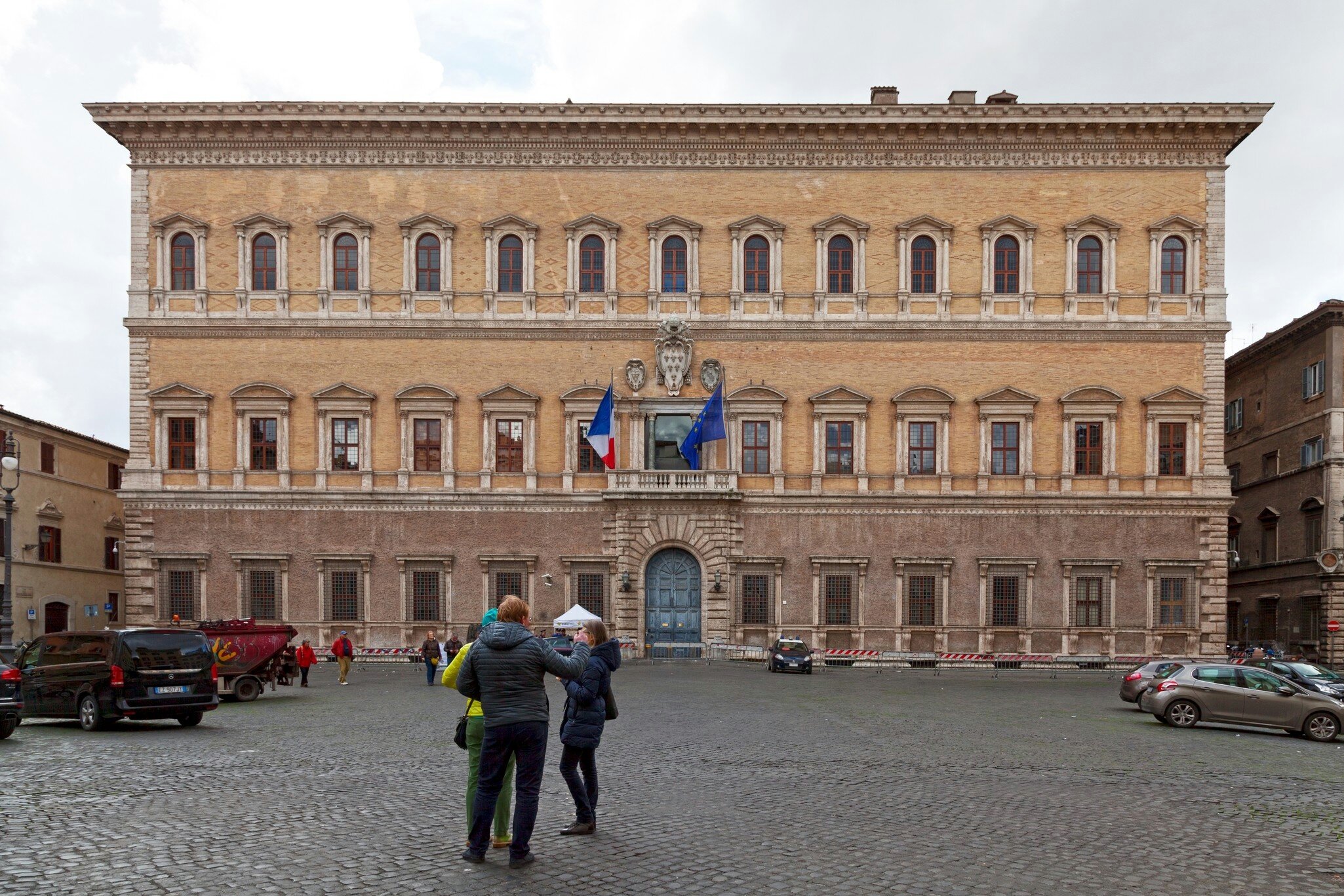
Home to the French embassy, Palazzo Farnese is one of Rome’s finest Renaissance palaces.
As a passing visitor, you can’t do more than admire the stately facade of the Palazzo Farnese, but book a guided tour and you can access its opulent interior, which culminates in a series of frescoes that are said by some to rival Michelangelo’s in the Sistine Chapel.
The Palazzo
Michelangelo was one of a group of four Renaissance starchitects who worked on the mighty palazzo. Antonio da Sangallo the Younger kicked things off in 1514, but after his death in 1546, Michelangelo took over, adding the facade cornice and a second story to the main courtyard. Construction work then continued for another four decades, first under Vignola and then Giacomo della Porta, until the palace was finally completed in 1589.
Artistic Highlights
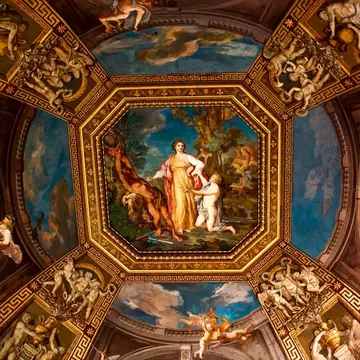
As a working embassy, large parts of the palazzo are off-limits, even to the official guided tour. But there’s still plenty to take in. Highlights include the 18m-high Salone d’Ercole with 17th-century tapestries inspired by Raphael frescoes and the Camerino d’Ercole with the first Roman work by Annibale Carracci.
However, it’s Annibale Carracci’s ceiling fresco in the Galleria Carracci that’s the real star turn. Painted between 1597 and 1608, the Amori degli Dei (The Loves of the Gods) is considered the Bolognese artist’s crowning achievement and one of the great works of the age. Annibale was assisted by his brother Agostino while the gallery’s walls were mainly painted by apprentices of the Carraccis, including a young Domenichino.