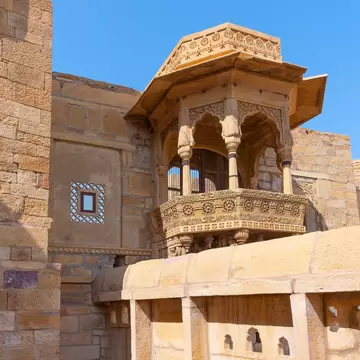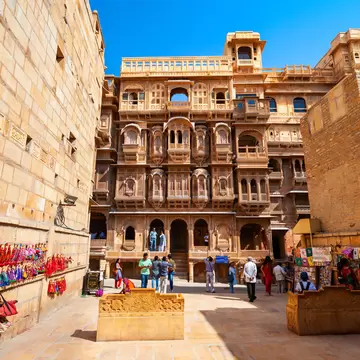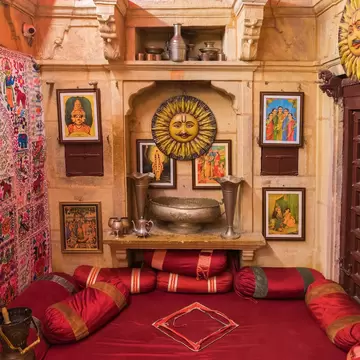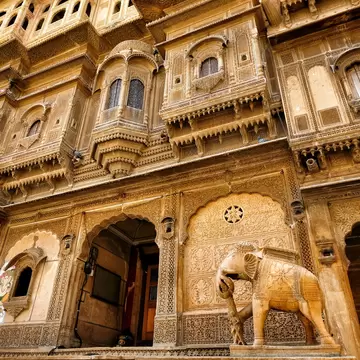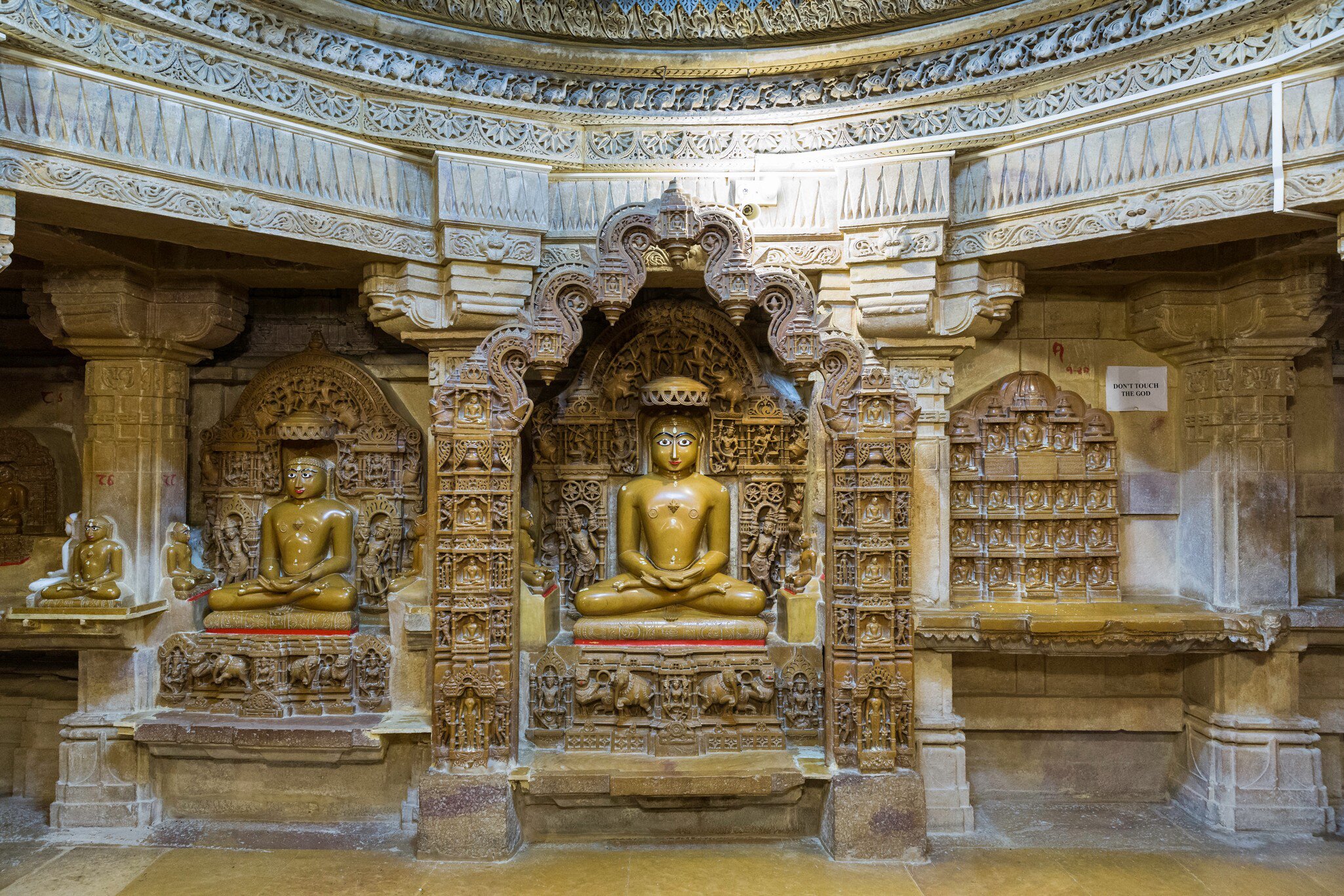
What many visitors remember most from a trip to Jaisalmer is not the palaces or the desert, but the lavishly adorned Jain temples hidden away inside the fort's sandstone walls. Carved from threshold to spire with deities and mystical beasts and filled with images of the Jain tirthankars (teachers), these seven mandirs represent a high point of the Rajasthani mason's art.
Rishabhanatha Temple
Arriving from the east, the first temple you'll come to is the tranquil Rishabhanatha Temple, with fantastically detailed mandala-like sculptures around its walls, protected by glass panels, and pillars encrusted with apsaras (celestial nymphs) and Jain and Hindu deities. On the outer walls of the sanctum are musicians, dancers, deities and warriors battling wild beasts.
Chandraprabhu Temple
Next door is the grand, multi-spired Chandraprabhu Temple, dedicated to the eighth tirthankar, whose symbol is the moon. The temple was built in 1509 and its mandapa (forechamber) features a lavish, layered, deity-studded ceiling and intricately sculpted pillars and toranas (arched gateways) that conjure up a sense of clouds climbing to heaven. The quality of the stone-carving here rivals the carved marble in the famous Jain temples at Ranakpur and Mt Abu.
Parshvanath Temple
Three more temples are reached via a doorway on the same side of the alley. The grandest is the Parshvanath Temple, accessed through a beautifully carved torana, topped by an image of the 23rd tirthankar. Inside, the deity-ringed ceiling is painted in bright colors and the temple sanctum contains a marble statue of Parshvanath. Flanking shrines contain images of the 24 Jain tirthankars.
Shitalnath Temple
A doorway to the right leads to the smaller, less ornately decorated Shitalnath Temple, dedicated to the 10th tirthankar, represented in the inner sanctum by a striking image made of eight precious metals.
Sambhavanth Temple
Follow the doorway to the left to reach the dimly lit Sambhavanth Temple with eye-catching fretwork windows featuring Jain and Hindu symbols and sandstone and marble statues of the 24 tirthankars with disconcertingly staring inlaid eyes. In the temple courtyard, Jain priests grind sandalwood in mortars for devotional rituals.
Gyan Bandar
Below the temple, steps lead down to the Gyan Bhandar, an underground library of illustrated medieval manuscripts, founded in 1500. Whether it is open to visitors depends on the temple attendants.
Kunthunath & Shantinath Temples
The remaining Kunthunath & Shantinath Temples were built in 1536, one on top of the other in a courtyard on the south side of the alley.
The lower Kunthunath Temple features sensual carvings of deities, along with a spout shaped like a makara (combining features of an elephant and crocodile). Despite the peaceful doctrine of Jainism, many of the figures bristle with weapons, symbolizing the struggle against ignorance and ego that is required to reach moksha (liberation).
Upstairs, linked to the Parshvanath temple compound by a walkway, the Shantinath Temple features some fine deity-thronged panels on its walls, and a striking gilded statue of the 16th tirthankar in its inner sanctum. Look up through the metal grille to view the carvings of wild animals on the temple spire.
Jaisalmer Stone
Like the vast majority of houses and hotels in Jaisalmer, the fort's Jain temples are constructed from mustard-yellow "Jaisalmer stone." Composed of more than 50% quartz, this versatile, fine-grained material can be chiseled into intricate designs or polished to a buttery sheen. As you'll see from the city's many ornate new-builds, the stone-carving skill used to produce Jaisalmer's historic havelis is very much a living art.