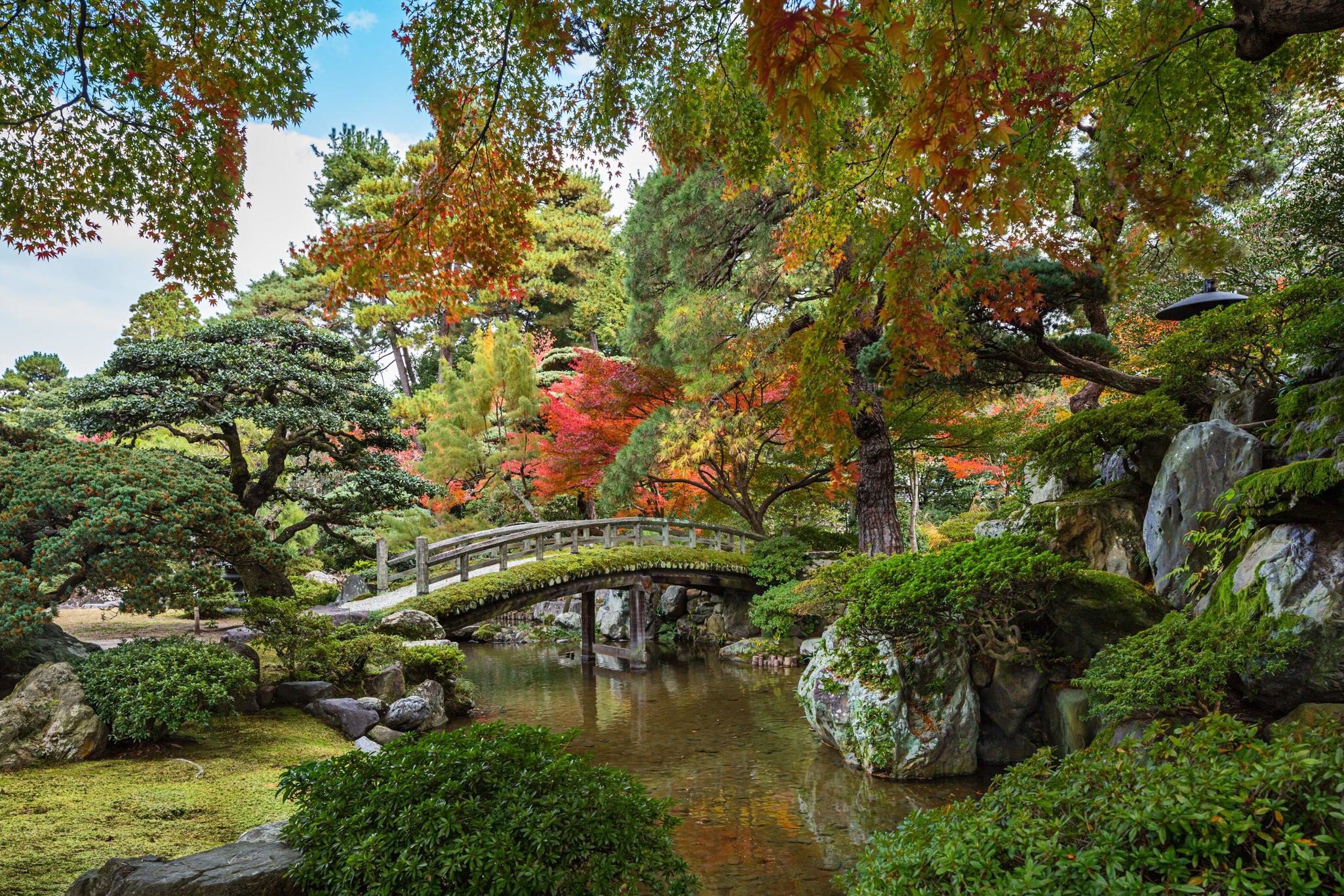
Kyoto Imperial Palace Park (京都御苑; kyotogyoen.go.jp/en), home to the Kyoto Imperial Palace and Sentō Imperial Palace, is a huge green space in the middle of the city. Despite its historic significance as the emperors' residence until the capital moved to Tokyo in 1868, the palaces themselves don't rate highly in comparison with other attractions in Kyoto, but hey, they're free and surrounded by a pretty park, so why not?
At the Kyoto Imperial Palace (Kyoto Gosho; kyoto-gosho.kunaicho.go.jp), visitors can wander around the marked route in the grounds where English signs explain the history of the buildings. Free English guided tours run at 10am and 2pm.
At the Sentō Imperial Palace (Sentō Gosho; kyoto-gosho.kunaicho.go.jp), originally built in 1630 as the residence of retired emperors, admission is for 18 and over only by one-hour tours pre-booked through the Imperial Household Agency (kyoto-gosho.kunaicho.go.jp/en). It's essential to bring a passport for this. The structures, repeatedly destroyed by fire, are not particularly grand, but the gardens, laid out in 1630 by renowned landscape designer Kobori Enshū, are excellent.
The park itself is great for picnics: check out the plum arbour about midway along the park on the west side and the large shidare-zakura ("weeping" cherry trees) at the north end during cherry blossom season. If you happen to be there Thu-Sat between 9.30am and 3.30pm, check out the beautiful two-storied Shusui Tei (¥300; fng.or.jp/kyoto/en/place/history) teahouse overlooking the Kujō Pond at the park's southern end.