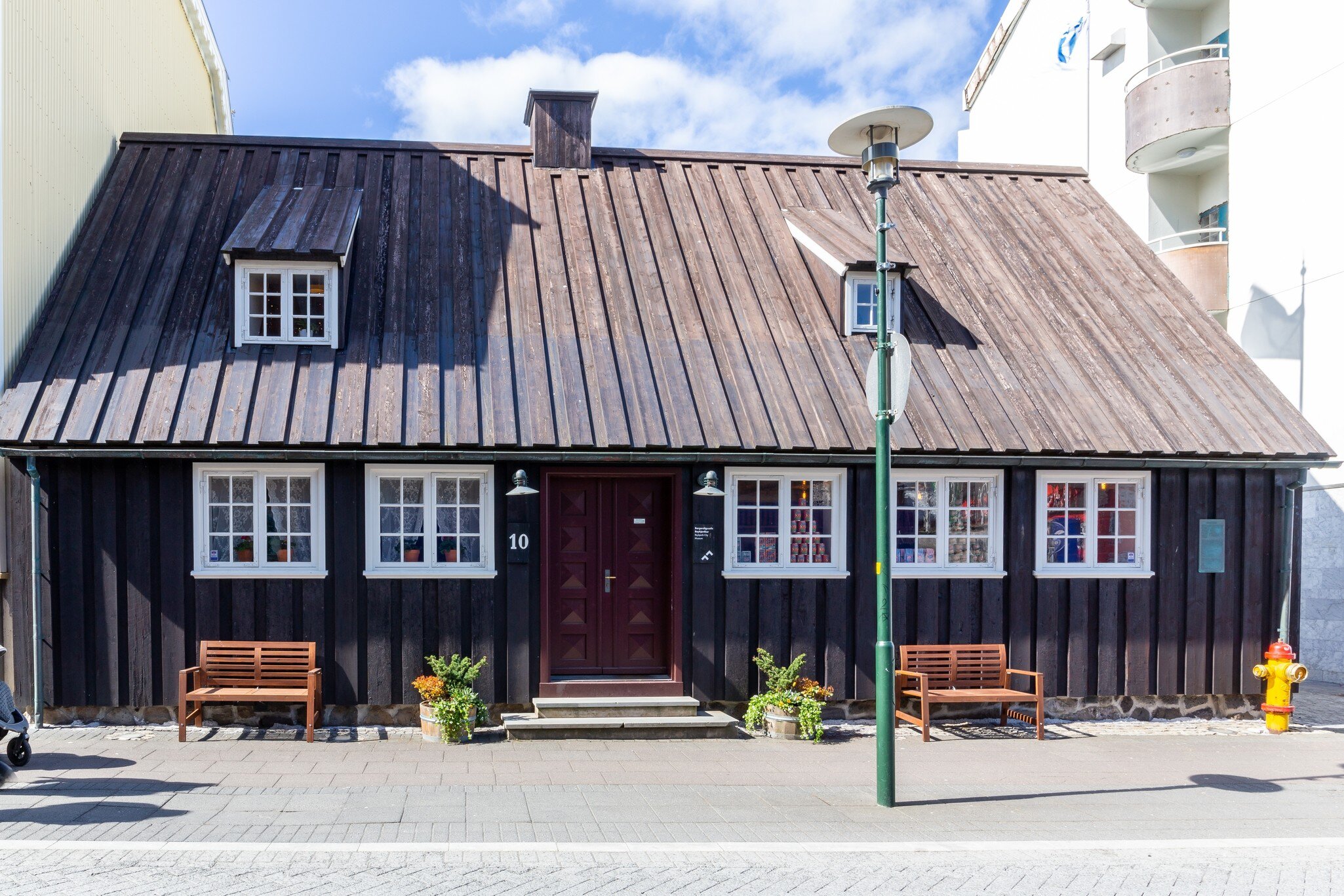
This is one of those museums kids visit on school field trips and for good reason. The Aðalstræti Settlement Exhibition, a fascinating archaeological ruin-museum spanning Aðalstræti 10 and 16, is based around a 10th-century Viking longhouse and other Settlement Era finds from central Reykjavík, and reconstructs how the city came to be with fascinating multimedia displays.
Viking Longhouse
The Aðalstræti complex is constructed around a 10th-century Viking longhouse unearthed here in 2001–02. Mainly a series of foundation walls now, it was thought to be inhabited for only 60 years. Look for areas of the longhouse with animal bones deliberately built into the structure (for good fortune, perhaps) and for the old spring.
Tephra Layers & the Significance of 871 CE
Tephra layers are the layer of fragments from a volcanic eruption, and they are used to date sites around Iceland.
According to the 12th-century Íslendingabók (a historical narrative of the Settlement Era), Ingólfur Arnarson fled Norway with his blood brother Hjörleifur, landing at Ingólfshöfði (southeast Iceland) in 871 CE. They continued around the coast, and Ingólfur was then led to Reykjavík by a pagan ritual: he tossed his high-seat pillars (a symbol of authority) into the sea as they approached land. Wherever the gods brought the pillars ashore would be the new home of the settlers. Ingólfur named Reykjavík (Smoky Bay) after the steam from its thermal springs. Hjörleifur settled near the present town of Vík, but was murdered by his slaves shortly thereafter.
The Aðalstræti longhouse was built on top of the 871 tephra layer, but don’t miss the fragment of boundary wall at the back of the museum, which was below the tephra layer, and is thus older still. It’s the oldest human-made structure in Reykjavík, predating even Ingólfur Arnarson.
Ancient Artifacts
Fine exhibitions imaginatively combine technological wizardry and archaeology for a glimpse into early Icelandic life. Through a series of interactive exhibits, the museum tells the story of how Reykjavík evolved from rugged farmstead to modern capital.
Arcing around the side of the exhibit, softly lit niches contain artifacts found in the area, from great auk bones (the bird is now extinct) to fish-oil lamps and an iron axe. More recent finds from ancient workshops near the current Alþingi include a silver bracelet and a spindle whorl (for making thread) inscribed with runes (reading "Vilborg owns me").
High-Tech Displays
Among the captivating displays are interactive multimedia tables explaining the area’s excavations, which span several city blocks. Don’t miss the wrap-around panorama showing how things would have looked at the time of the longhouse and a space-age-feeling panel that allows you to steer through different layers of the longhouse’s construction.
Aðalstræti 10 Shop
This quaint, dark-brown wooden building is the area’s oldest and has been incorporated into the museum. Take your time to follow exhibits and photographs illustrating Reykjavík through time, and wander through a replica of an old general store.
Rise of Reykjavík
After being settled in the late 800s CE, Reykjavík was just a simple collection of farm buildings for centuries. It expanded in the 1700s when local sheriff Skúli Magnússon, the "Father of Reykjavík," created factories to bypass a Danish monopoly. WWII was another boom period, and the city's architecture and cultural offerings have exploded once again with the recent rise in tourism to Iceland.