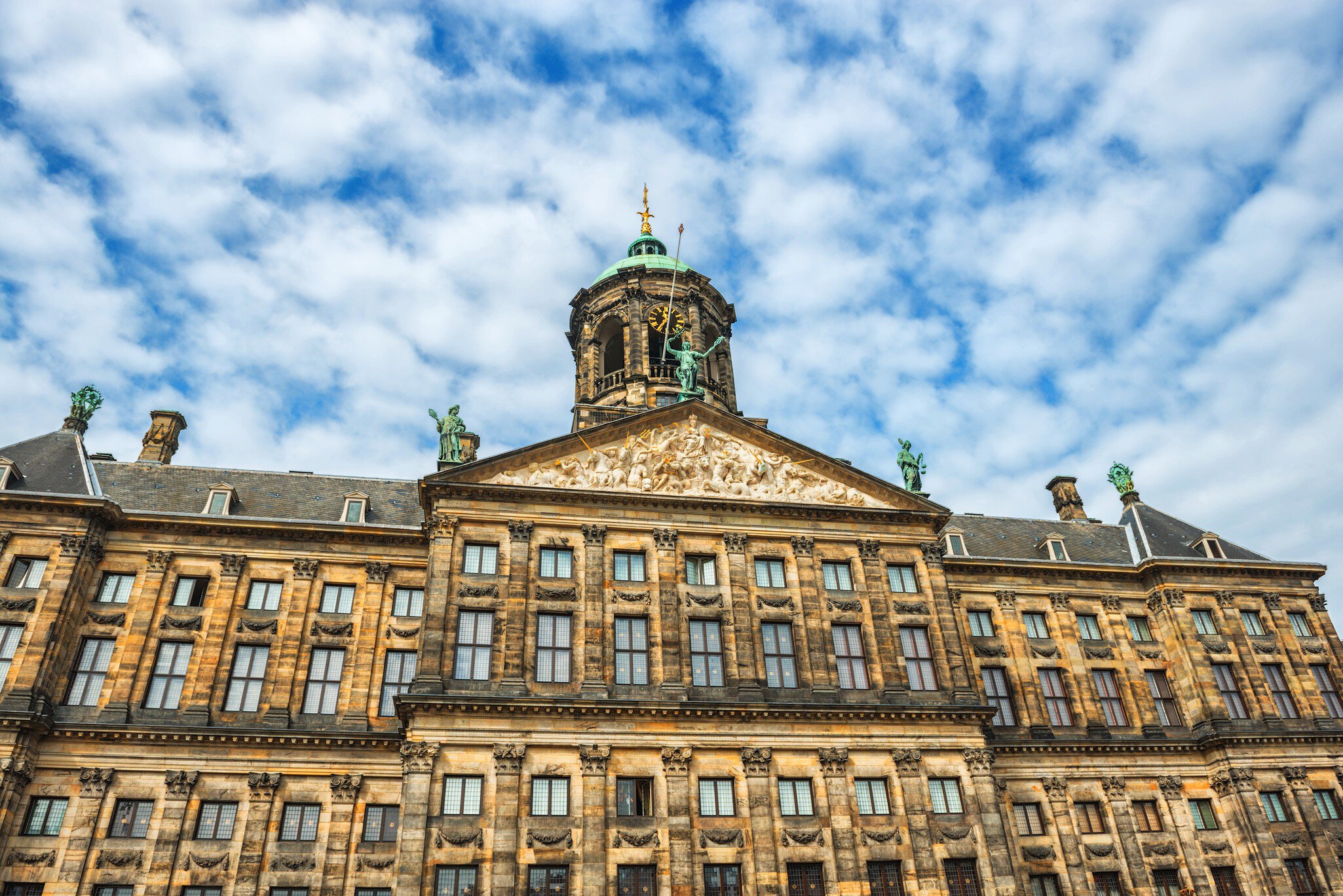
Amsterdam's grandest building, the Royal Palace began life as a glorified town hall. Dutch royalty has never resided here – though Louis Bonaparte (Napoleon's brother) did briefly. Today, it's the monarchy headquarters for ceremonies and dignified visits, and also a stunning historical backdrop for mass gatherings on Dam square. When the royal calendar's free, pop inside and explore a most riveting history.
Palace History
Today’s Royal Palace (Koninklijk Paleis) began life as a glorified town hall and was completed in 1665. Its architect, Jacob van Campen, spared no expense to display Amsterdam’s wealth in a way that rivalled the grandest European buildings of the day. The result is Dutch Baroque–designed opulence on a big scale. It’s worth seeing the exterior at night, when the palace is dramatically floodlit.
Civic council played hard and fast here during the "Golden Age," but only for about 150 years until the French Revolution. Without much resistance, Le Petit Caporal ("Little Corporal") took over and appointed his brother, Louis Bonaparte, King of Holland in 1806. Enacting sovereign "squatting rights," Louis eventually moved in, making 1 million guilders worth of renovations (about €11.5 million today) to transform the Stadhuis (city hall) into his royal abode.
The "other Bonaparte" reigned and claimed residence here for only two years before abdicating. He allegedly found it damp and uncomfortable, and Dutch merchant nobility less than enchanting. In 1813, the Dutch served France a formal eviction notice coinciding with the Napoleonic Empire’s collapse. Prince William Frederick of Orange-Nassau returned from exile, and the Kingdom of the Netherlands was established. Dutch royalty have never resided here, preferring their palace in Den Haag, making the younger Napoleon the palace in Amsterdam’s first and only occupant.
King Willem-Alexander uses the palace only for ceremonies; when royal appointments aren’t happening, go inside for a self-guided tour.
Inner Opulence
Marvel at how the interiors gleam, especially the marblework – at its best in the burgerzaal (citizens’ hall) at the heart of the building. Sculptures and ceiling paintings depict "Justice, Prudence, and Strength," harking back to the hall's civic origins. Floors are inlaid with world maps: envisioned as a world schematic, with Amsterdam positioned at the center, they depict the eastern and western hemispheres and a 1654 celestial map.
Most rooms are spread over the first floor. Counting all 51 of its sparkling chandeliers, damasks and gilded clocks makes an excellent treasure hunt. Spectacular paintings by Dutch masters, including Ferdinand Bol and Jacob de Wit, adorn the walls.
Empire-Style Decor
In 1808 the building became the palace of King Louis, Napoleon Bonaparte’s brother. In a classic slip-up in the new lingo, French-born Louis told his subjects here that he was the "rabbit" (konijn) of Holland, when he actually meant "king" (koning, which had the old spelling variation konink). Napoleon dismissed him two years later. Louis left behind about 1000 pieces of Empire-style furniture and decorative artworks. As a result, the palace now holds one of the world’s largest collections from the period.
Palatial Workplace
Officially, the Dutch king, King Willem-Alexander, lives in this landmark palace and pays a symbolic rent, though his actual residence is Palace Huis ten Bosch in Den Haag. Notably, in 2025 when Queen Máxima made a much-discussed facial expression while meeting US President Donald Trump, the headline-making moment took place in Den Haag and not Amsterdam's Royal Palace.