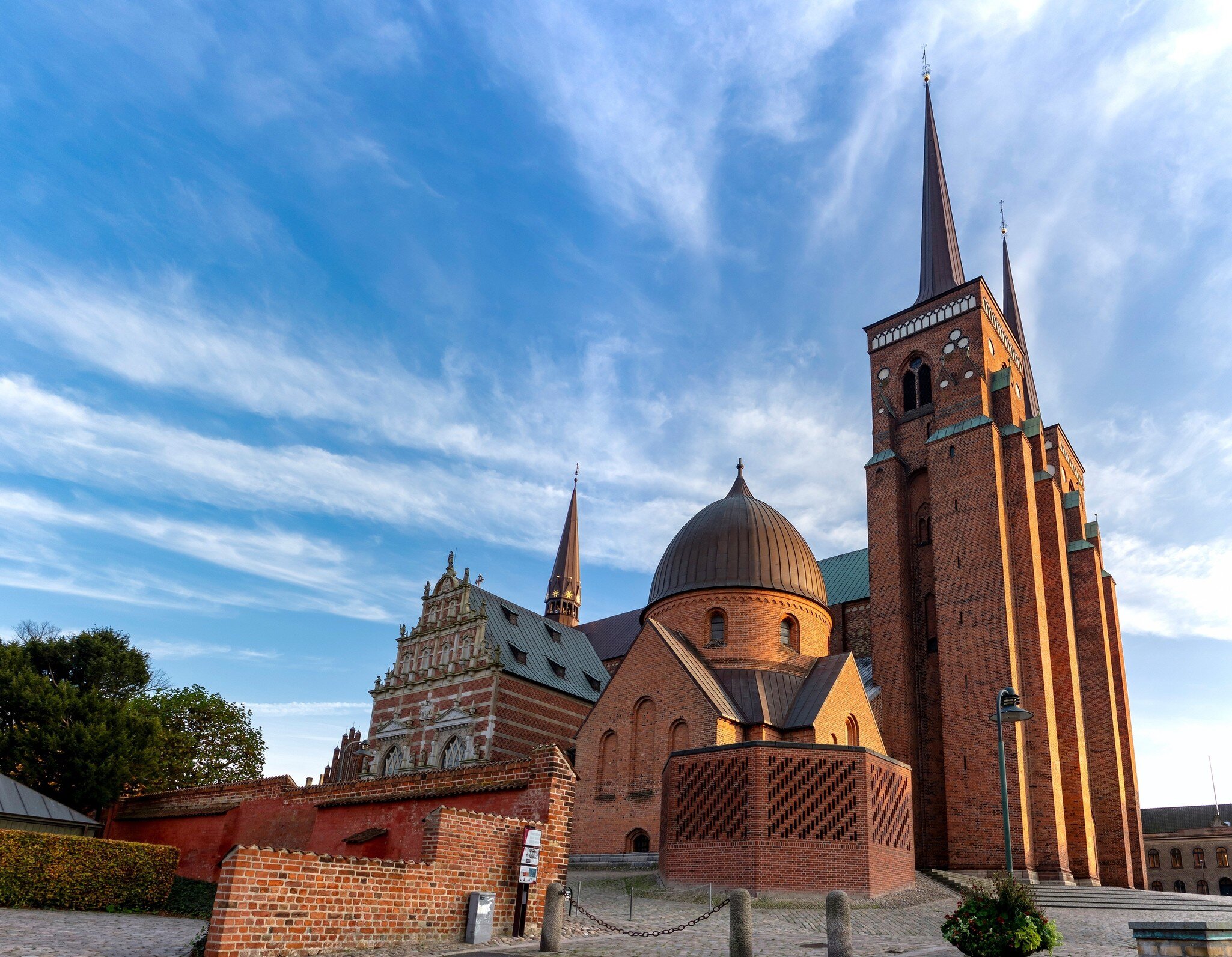
The ultra-fine Gothic spires of UNESCO-listed Roskilde Domkirke (Roskilde Cathedral; roskildedomkirke.dk; adult/child 70kr/free) pierce the sky in the city center. Bishop Absalon laid the first bricks in 1170, building upon a previous wooden church, but the intervening centuries and a series of fires, renovations and the Reformation saw it rebuilt to take the form you see today.
This magnificent building is as much a religious and historical site as it is a living document of 850 years of Danish history, architecture and leadership. It's a regal cemetery, with 21 kings and 18 queens buried here. With your ticket, you get a pamphlet with information about all the tombs so that you can navigate.
No fewer than 11 spectacular chapels and crypts sprout from the main body of the cathedral. Each chapel has a completely different style, from the cold, elegiac neoclassical tomb of Frederik V (d. 1766) to the baroque trompe l'oeil and wrought-iron one of Christian IV (d. 1648) and the organic-feeling fresco and marble of the Magi. Look out also for the three-sided 1560 altarpiece from Antwerp, the 15th-century carved choir stalls, the 1500 mechanical clock (every hour, St George kills the dragon and it lets out a death wail), and the strikingly elegant marble tomb of Margrete I (d. 1412), who was the first monarch to be buried here after her body was controversially taken from Sorø Abbey. A tomb designed by artist Bjørn Nørgaard has already been prepared in one of the cathedral’s 11 chapels for Queen Margrethe II, who celebrated 50 years on the throne in 2022. (The tomb will remain covered until it's needed.)
Free concerts on the 16th-century baroque pipe organ are usually held in summer. See the website for timetables and for upcoming closures – it’s not unusual for the cathedral to shut for special events, especially on Saturdays for weddings.