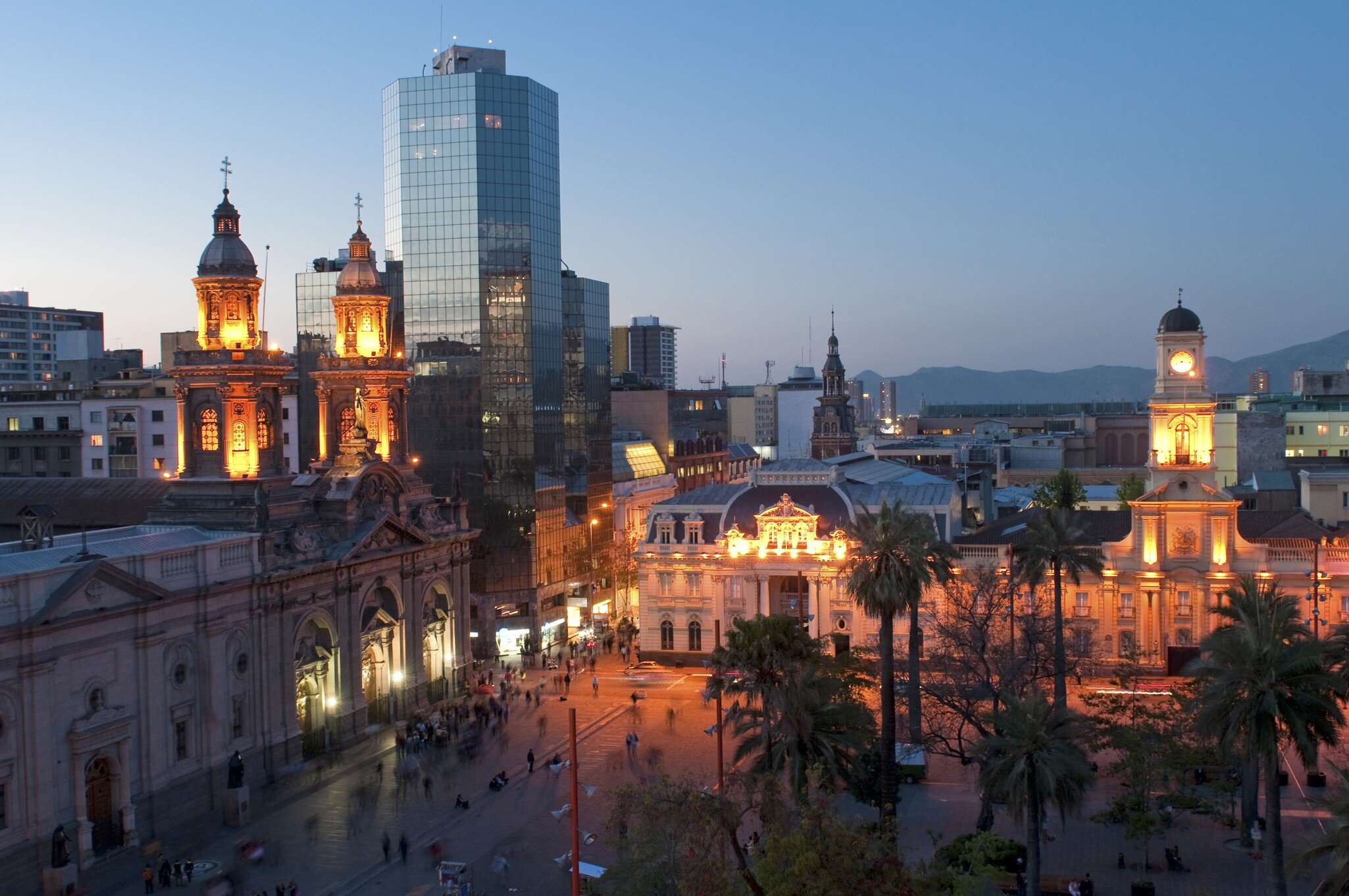
With architectural treasures now restored and the plaza perimeter made vehicle-free, Lima’s 16th-century historic main square is entering a new era.
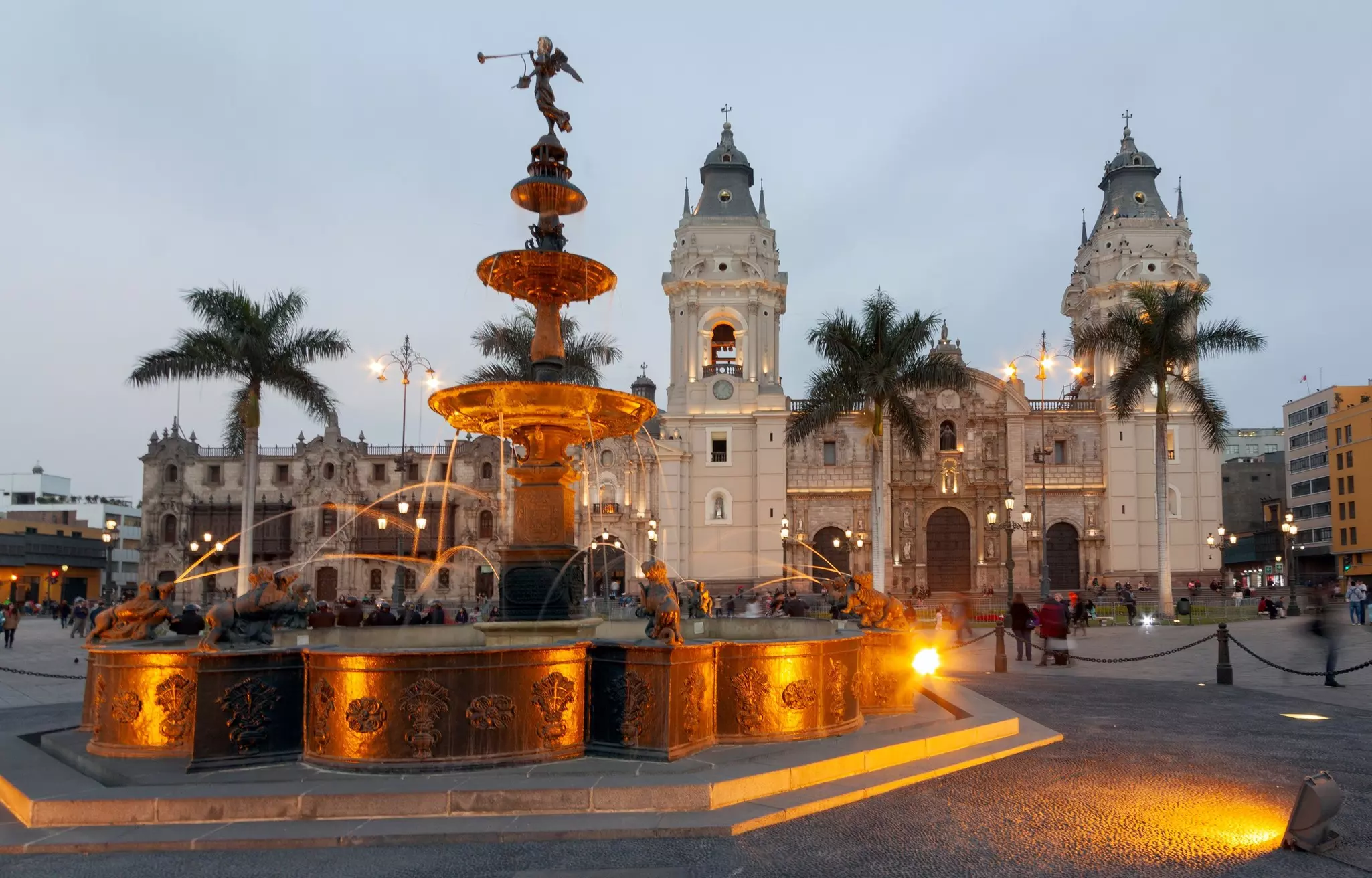
Central Fountain
Inaugurated in 1578 and later replaced in 1651, the bronze fountain remains the oldest element in the main square and functions to this day.
At the rim of a tiled pool, water spews from the mouths of eight lions, each dominating a dragon and facing what many assume to be an angel but is in fact Pheme, Greek goddess of fame and original gossip girl. Upon National Pisco Day (the fourth Sunday of July) the central fountain typically spews grape brandy.
Government Palace
On a clear day the outline of Lima’s tallest hill, Cerro San Cristobal, backdrops what was once the site of Francisco Pizarro’s home. The Palacio de Gobierno has historically served as the nation’s hub for political decision-making and governance since 1535 and, before the turn of the 21st century, was the official residence of Peru’s sitting president.
After numerous earthquake-induced reconstructions, the current version is a mix of Spanish colonial and neoclassical and was completed in 1937 by Polish-Peruvian architect Ricardo de Jaxa Malachowski.
Book a few days in advance for a free one-hour tour of selected interior spaces of the Government Palace (jturismo@presidencia.gob.pe, 9am and 9:45am Saturday and Sunday).
Changing of Guards
The drab Government Palace courtyard is spruced up by the red and blue uniforms of the Hussar of Peru, a regime created by Simon Bolívar. Arrive at the northern side of the square a few minutes before 11:45am to catch the first portion of the hour-long changing of guards ceremony, backed by a live brass band.
Cathedral Basilica of Lima
Two conjoined architectural icons take charge of the square’s eastern side, demonstrating religion’s stronghold on Lima’s history: the La Catedral de Lima (catedraldelima.org.pe; cathedral & palace adult/child S30/15) and Palacio Arzobispal.
The Cathedral that stands today is an outspoken mix of neoclassical (as seen in symmetrical bell towers with slate spires), baroque (intricately carved facade) and Gothic (vaulted ceilings), nothing like its humble adobe beginnings as Peru’s main church.
Minimal signage inside this massive cathedral can be disheartening. Step through the Door of Forgiveness, the main entryway, for a clockwise tour of 14 side chapels, beginning with the tomb of Pizarro. Don’t miss the museum of religious art, to the right of the final chapel, St Joseph, patron saint of carpenters.
Archbishop’s Palace
Reconstructed in 1924 under the guidance of Malachowski, the neocolonial Palacio Arzobispal serves as the administrative headquarters of the Roman Catholic Archdiocese of Lima.
Distinctive cedar box balconies frame a central statue of St Toribio of Mogrovejo, one of the most important – and persuasive – religious figures in Peru’s history. As the second archbishop of Lima (1579–1606), Mogrovejo overcame storms, beasts and language barriers in his pursuit to convert Indigenous peoples to Catholicism. Head inside but watch your step up the red carpet staircase as you gawk at a massive stained-glass ceiling.
Historic Municipal Library
Cedar staircases spiral up and down the small yet striking gem that is the Biblioteca Histórica de Palacio Municipal (miniwebs.snb.gob.pe/division-de-biblioteca-y-archivo-historico-bml/presentacion/956). An estimated 18,000 vintage and historical books line well-dusted shelves, including the original "Charter Foundation of Lima" signed by Pizarro. Located inside the City Hall, the library entrance is found just around the corner.