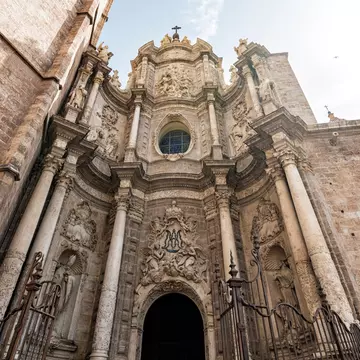
You get two exceptional museums in one here. The building is the Palacio del Marqués de Dos Aguas, a former aristocratic residence whose flamboyant decoration, furnishings and artworks make it arguably the finest baroque/rococo palace in Spain. And the top floor houses a top-class collection of Spanish ceramics, with an emphasis on Valencian work, from medieval Islamic pieces to Picasso. The building's entrance, a baroque extravaganza featuring two contorted figures symbolising rivers, is undoubtedly Valencia's most head-turning doorway.
The entrance portal was carved by Ignacio Vergara to the design of Hipólito Rovira, who was commissioned around 1740 by Giner Rabassa de Perellós, the third Marqués de Dos Aguas, to transform a relatively modest medieval mansion into a baroque palace proclaiming the marquis's aristocratic prestige. The same Rovira-Vergara team created the splendiferous Carroza de las Ninfas which is the star of the museum's ground-floor carriage collection.
It was the sixth marquis, Vicente Dasí Lluesma, who gave the palace interior much of its present character with a mid-19th-century makeover in an eclectic mix of rococo, Empire and Chinese styles. On the 1st floor you pass from one sumptuously decorated room to another, with entirely antique furnishings, many of them original 18th- or 19th-century pieces from the palace itself. The splendid ballroom is an obvious highlight but the artisanry and its detail throughout are truly superb. The Pinazo room displays paintings by the Valencian Impressionist Ignacio Pinazo.
Valencia has long been one of Spain's top ceramics centers and the building's top-floor ceramics displays are based on the collection of Valencians Manuel González Martí (the museum's founder), and his wife Amelia Cuñat. The exhibits start with early Muslim work and end with pieces made by Picasso for the museum in 1955. In between you can see how a fusion of Muslim and Christian artisanry yielded some of Valencia's most attractive styles, notably the shiny lustreware from Manises which became a luxury item across Europe in the 15th century. Other typical Valencian styles to admire include socarrat (unglazed tiles painted with iron oxides and manganese, usually used for ceilings) and the colorful tile paintings which became popular in the 19th and early 20th centuries.