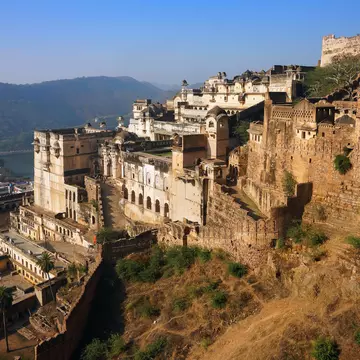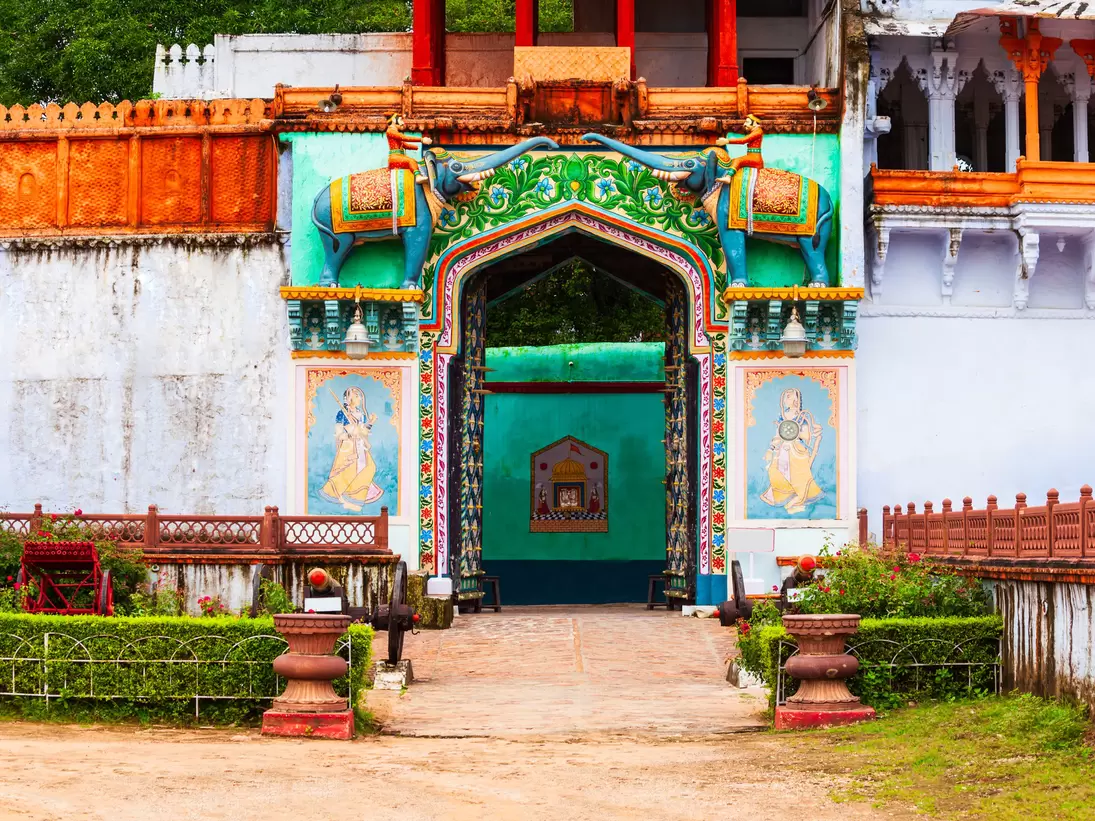
Rising beside the Chambal River, Kota's 17th-century City Palace Garh (kotahgarh.com; ₹500) was one of the largest royal complexes in Rajasthan in its day. This was the royal residence and center of power, housing the Kota princedom’s treasury, courts, arsenal, armed forces and state offices. Today, several wings have been taken over by private schools, but the fascinating Rao Madho Singh Museum displays everything required for a respectable royal existence, from silver furniture, howdahs and hunting trophies to photos of royal relatives meeting dignitaries from the British Empire.
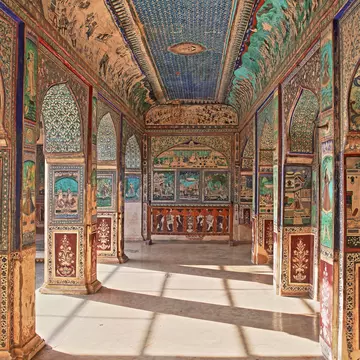
The oldest part of the palace dates from 1624. Downstairs is a grand durbar (royal court) decorated with lavish mirror work, while upstairs are the elegant royal apartments, adorned with beautifully preserved murals, including the hunting scenes for which the Kota school of painting is renowned.
The throne hall and royal bedchamber in the Bada Mahal are extraordinarily lavish spaces, decorated from floor to ceiling with scenes of nature, deities and royal life, and delicate portraits painted on glass mirrors.
In the armory, look out for the katar dagger mounted with hidden pistols, and a lethal "scissors katar," with a blade that spreads to widen wounds, operated by a mechanism in the handle.
Spare a few minutes to wander the lanes outside the palace gates, dropping by some of Kota's oldest temples.
To get here, it’s around ₹100 in an autorickshaw from the bus stand, and at least ₹150 from the train station.