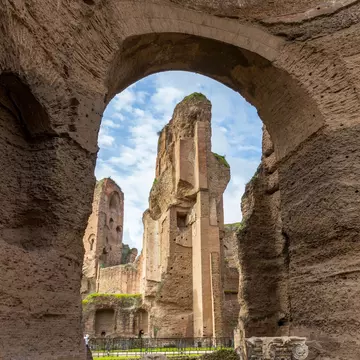
Only a 25-minute train trip from Rome, imagine daily life as you wander millennia-old streets at ancient Roman port, Ostia Antica. Over centuries, the town was abandoned as the River Tiber silted up and the buildings became buried, ensuring their survival. It has echoes of Pompeii, though Ostia continued to develop beyond the fall of the Roman Empire, until around the 9th century.
Gates & the Main Road
From the entrance you can see that this was once a substantial city. It grew up to be a city with a population of around 50,000, a multicultural melting pot that encompasses Mithraic temples, churches and a synagogue.
Decumanus Maximus is the site's central drag, running straight through the city for over 1km to Porta Marina, the city's original sea-facing gate. There are tombs at the start of the road, as, whatever your faith, burials took place outside the city walls.
Terme di Nettuno
On Decumanus, the 2nd-century Terme di Nettuno is a huge baths complex of around 67 sq meters, one of 20 that originally stood in town. Climb the tower to get a superb view of the baths' dramatic black and white mosaics, including one of Neptune (hence the name) riding a seahorse chariot, accompanied by other sea creatures: dolphins, tritons and Nereids. A room just south has mosaics depicting Amphritrite, Neptune's wife, again with seahorse transport, and accompanied by Hymenaeus (Eros), who holds a flaming torch, which symbolizes marriage. Other mosaics show naked athletes boxing and sparring. In the center of the complex are the remains of an arcaded palaestra (gym), where you can see travertine blocks in the floor; they have holes where the gymnasium equipment was once attached. On the horizon check out the row of Mediterranean pines – these were planted during the fascist era, but mark the former course of the River Tiber.
Theatre, Forum & Business Centre
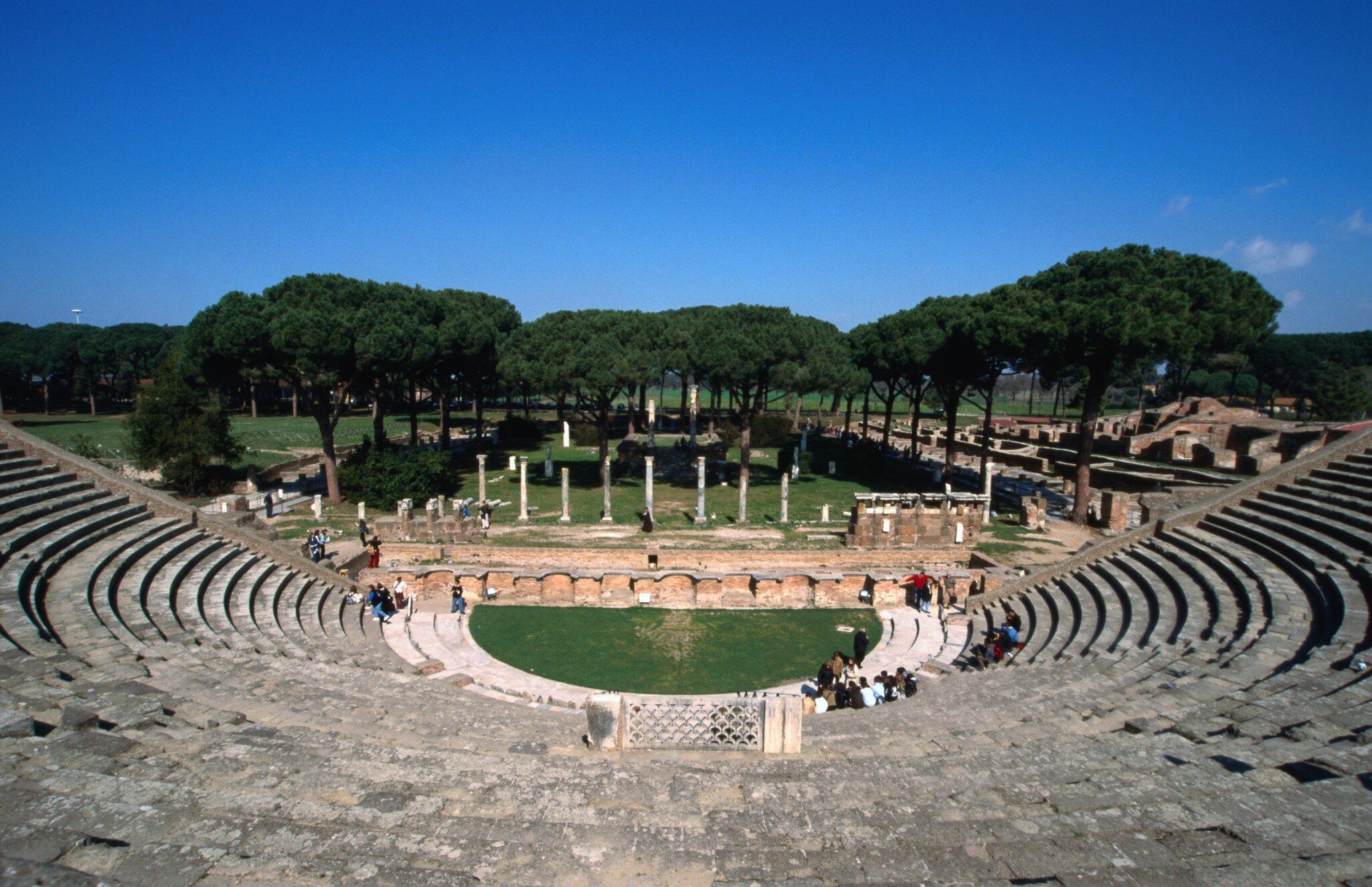
Near Terme di Nettuno you can walk around the well-preserved, much-restored Teatro, an amphitheater built in the 1st century BCE by Agrippa and later enlarged to hold 4000 people. An inscription says the later work was by Septimius Severus and Caracalla, but brick stamps show that the reworking was begun under Commodus. The stucco on the arched former entrance to the theater depicts Hercules, who was associated with Commodus. The seating would have once been covered in marble. A later renovation saw an upgrade that meant the stage could be flooded by hidden cisterns, allowing aquatic displays. The restored theater is in excellent shape, and still hosts performances during Rome's arts festivals.
Walk beyond the amphitheater to circuit the Piazzale delle Corporazioni (Forum of the Corporations), home to the offices of Ostia's merchant guilds. This is a unique site, an ancient commercial district, with businesses identified by the immaculate mosaics around the perimeter. Ships and dolphins are thought to indicate shipping agencies, while elephants probably indicated the ivory trade.
Further down Decumanus, the Forum, Ostia's main square, is overlooked by the towering, stripped-bare remains of Capitolium, a temple built by Hadrian and dedicated to Jupiter, Juno and Minerva. Here Decumanus crosses with Cardo, the town's other major street.
Ancient Cafe & Apartment Block
Seek out the Thermopolium on Via di Diana, an ancient cafe, complete with bar, its original frescoed menu and a small courtyard where customers would have relaxed around a fountain. Almost opposite are the fascinating multistorey remains of an insulae (apartment block), which would have housed the town's poorer residents. The remains provide an insight into the cramped lives of so much of the population of the cities of ancient Rome.