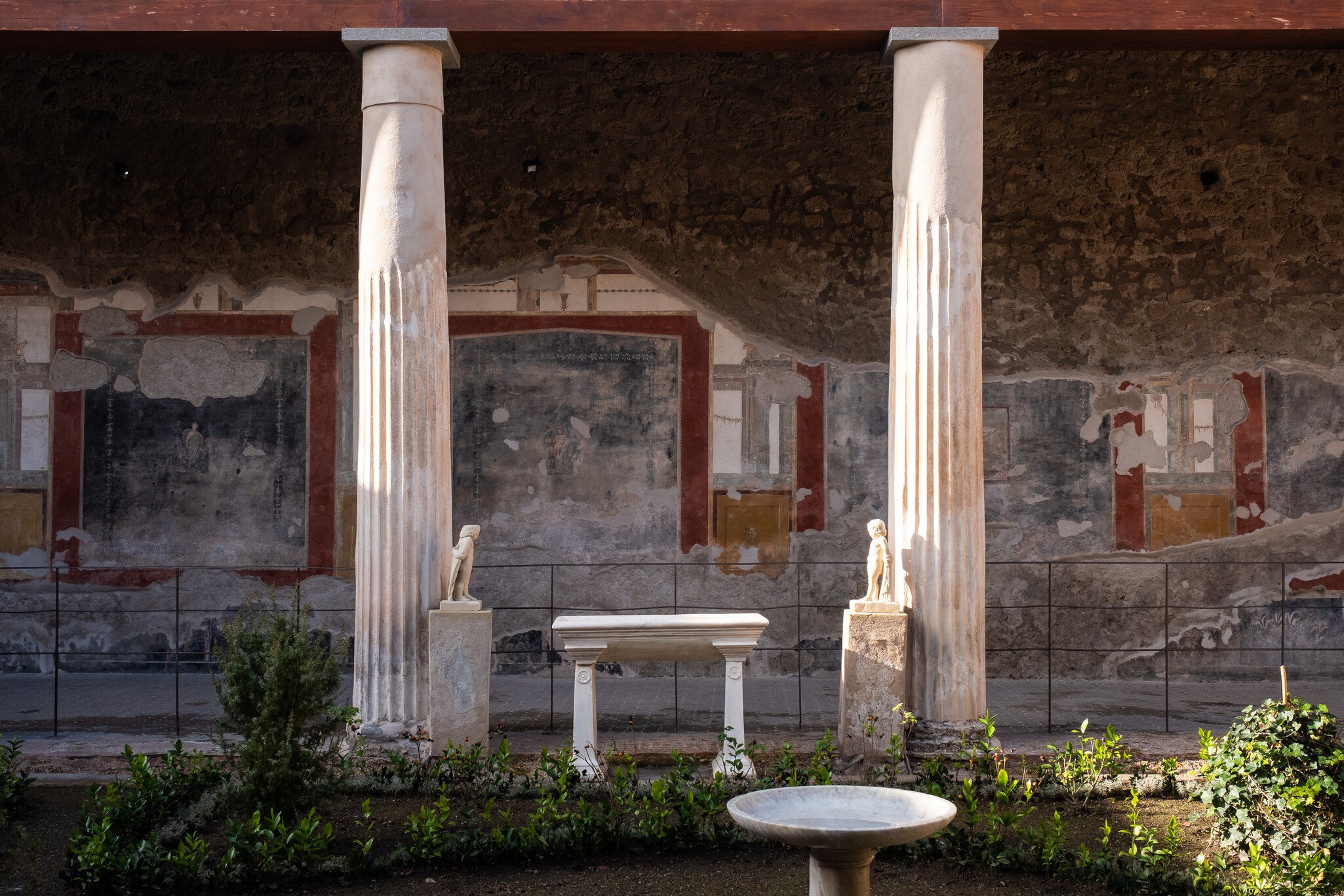
There is no place in the world quite like Pompeii. The once-thriving city was bowed by the eruption of Vesuvius in 79 CE, but not unbroken. As you walk the streets you can still imagine life as it would have been: thriving and dynamic, filled with smells and sounds not unlike our own. Pompeii isn't about satisfying a morbid curiosity, its about celebrating what we manage to preserve when the dust settles. So let the rest of the crowds scurry off in search of the tragedy, we're here to look for life, and there's plenty to find.
Pompeii is one of the most accessible and well-equipped tourist sites in Italy, and with a new change in administration, there is only more to come in advances that will make it easier to visit for everyone. If you're able to dedicate more than a day to it, you'll be rewarded with magnificent archaeological finds and a rotating selection of exhibitions and educational resources. Rushing through it is tough, especially if you've got bags with you and its anytime close to the high season. However, if you do have just a small window, make sure that you enter the park at the amphitheater and work your way towards the Forum rather than the other way around. It's cooler, and you're much less likely to hit a crush of large groups. If you come to a particularly crowded house, don't bother waiting in line: walk one block in any direction and you're bound to find something else to treasure. Many of Pompeii's more well-known areas now have caps on how many people can enter at one time, so be aware that you may be asked to wait.
The Ampitheatre
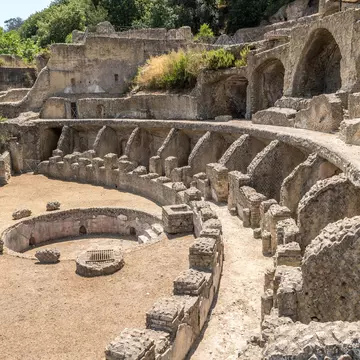
The Romans were nothing if not entertainers, and the 20,000-seat amphitheater on the eastern end of the park is proof of their love for the stage. It’s one of the oldest known Roman theaters and hosted nobility, politicians and spectators from neighboring towns, all of whom came to marvel at the battles. But it's all fun and games until a riot breaks out, and after the ruckus of 59 CE the theater was shuttered until 62, when a deadly earthquake struck. Frescoes of gladiatorial battles are visible on the parapet and it's one of the best places in Pompeii to get a little retreat from the heat on sunny days. Plus, the theater is still in use for performances: the OG Gladiator Russell Crowe even returned for a concert. Don't miss the Palestra, an exercise facility that Russell probably didn't use on his last visit.
Pompeii was a pretty wild place in its day, and nowhere tells this better than the amphitheater. In 59 CE cheers from the crowds led to widespread fisticuffs between spectators from Pompeii and nearby Nocera. As a result of these riots, the Senate of Rome actually closed the arena in Pompeii for 10 years! But the edict was withdrawn after the tragic earthquake in 62 CE, when people wisely decided it was probably time to let off some steam. One of the earliest structures to be unearthed, the amphitheater was excavated for the first time in 1748.
The Forum
The magnificent rectangular Foro (Forum) with its limestone columns was Pompeii’s main piazza, the seat of religious, commercial and political life. Visit the Tempio di Giove, a temple dedicated to Jupiter, Minerva and Juno, and thoughtfully (though in hindsight, ironically) designed to line up with Mt Vesuvius. You’ll also find the Tempio di Apollo, the Macellum (produce market) and the granai (ex-granary), now home to more than 9000 recovered household items, including amphorae and pots, and the magnificent baths. This is the spot that most people identify with Pompeii, and its certainly the most photographed. However, it isn't the only spot to see by far. It's best to end your day here or at least wait until the sun is not as high overhead, because even when it isn't summertime, the sun still bakes here.
Villa dei Misteri
The grand domus (homes) in Pompeii, often given nicknames like "House of the Boar" when the owner is unknown, are revered for their elaborate frescoes and mosaics. A spectacular example is the 90-room seaside Villa dei Misteri (Villa of the Mysteries). Its magnificent Dionysiac frieze, a massive fresco covering three walls of the dining room, depicts Dionysus and his wife Ariadne as they welcome a young girl into his cult via ritual flagellation. The fresco is all the more memorable for its startling red background. Miniature Egyptian-inspired paintings can be found in the tablinum (study). The villa also includes an area that would have been used to produce wine, and features a rebuilt wooden press.
The complex dates to the 2nd century BCE but would have undergone renovations to its current floor plan around 80 to 70 BCE, when the friezes of the Mysteries would have been added. Although you may have to wait a while to get inside, it is worth it. Indeed, this is the site within Pompeii that has inspired poets, artists and budding archaeologists for centuries.
Insula dei Casti Amanti
For the first time since the opening of the park, visitors can observe excavations of an ancient block in real time via an elevated path suspended over the Insula dei Casti Amanti (House of the Chaste Lovers), the house of the Painters at work and the house of the colonnaded Last Supper. The site was first uncovered in 1912 but recent discovered include a room decorated with mythological figures, charcoal drawings made by children in a service courtyard, and an entrance hall where two skeletons of victims of the eruption were found.
You can watch the process of bringing Pompeii to life as well as an innovative effort to bring photovoltaic panels onto the site on this fully accessible platform, which was designed as part of the Pompeii for All initiative. Interestingly, in 2023 two skeletons were discovered in the Insula which were analyzed to belong to two males whose deaths would likely have been the result of multiple traumas due to falling debris. However, they were not victims of the pyroclastic flow and pumice that is traditionally thought to be the cause of most destruction in Pompeii. Instead, they are believed to have died in an earthquake that accompanied the eruption and were discovered beneath a wall that had collapsed between the final phase of the deposition of pumice and prior to the arrival of the pyroclastic flows that buried Pompeii for centuries. Finds like this show how much we still have to learn about this place.