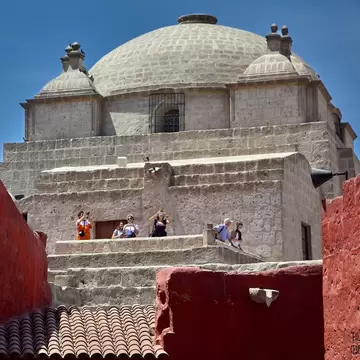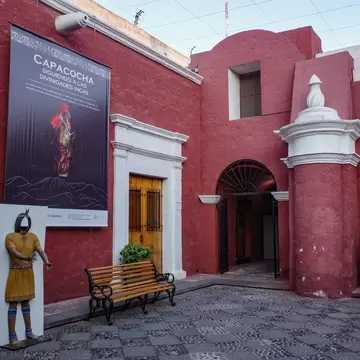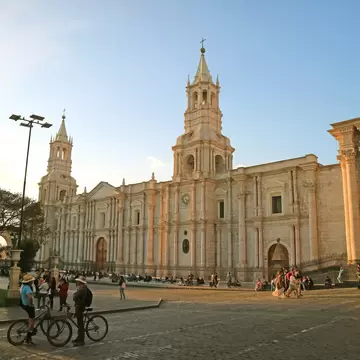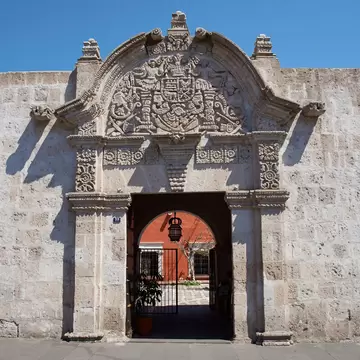
A must for visitors who want to see more of La Catedral, the included 45-minute bilingual tour of this 'museum' is actually a peek at the inner workings of the basilica, with an explanation of the impressive 1000-pipe church organ and the symbology and colors employed in religious paintings and ornaments. The rooftop views of Arequipa and its sillar buildings are a bonus.
On Tour
Offered in English and Spanish, this tour is one of the most interesting in the city. The guides are well trained and know the history backward and forward. Visitors to the cathedral get to view only the main altar room, but if you join a tour, you can take a deep dive into the nave, the organ, the ceilings and the bell tower.
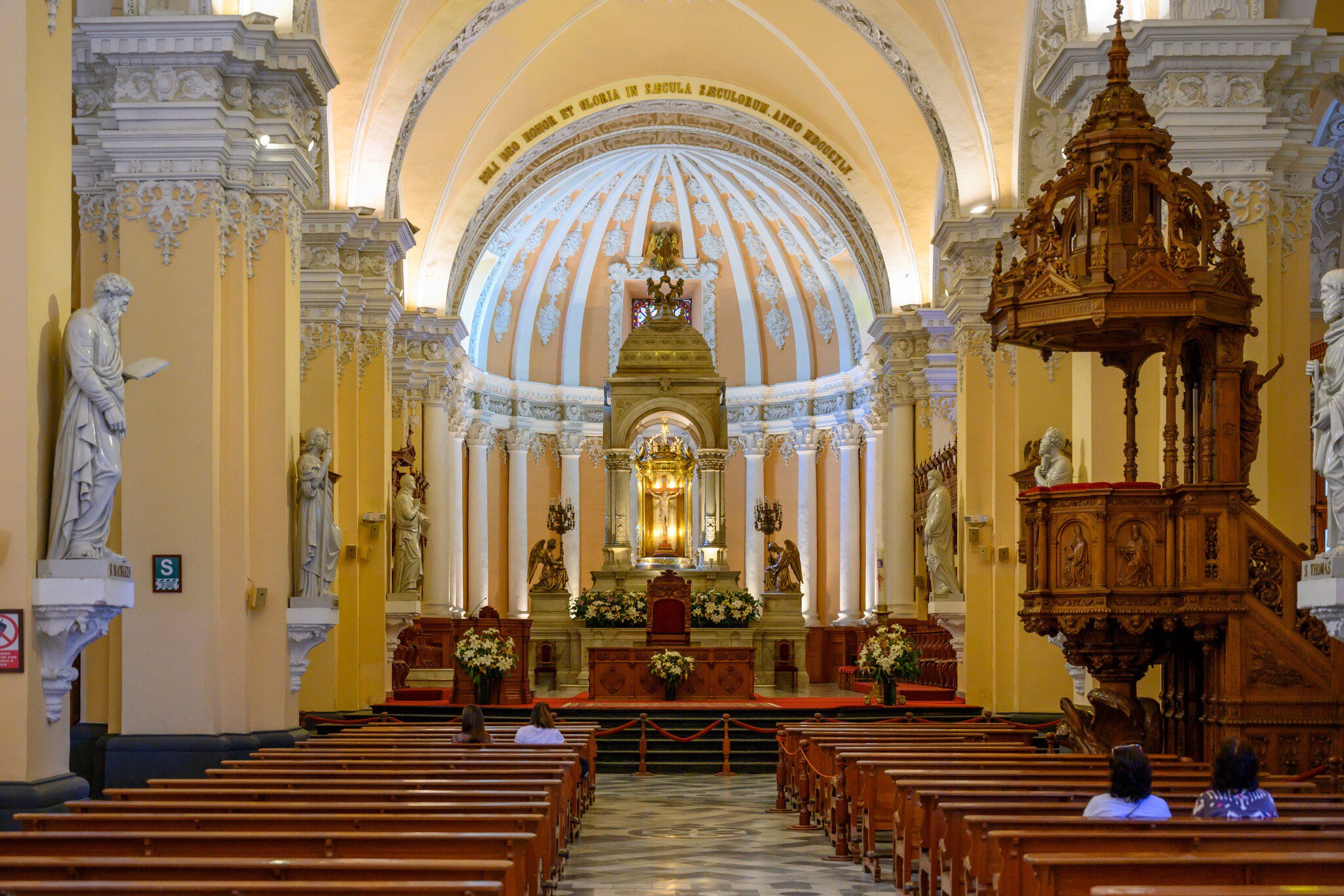
The interior is simple and airy, with a luminous quality, and the high vaults are uncluttered. The cathedral is one of fewer than 100 basilicas in the world entitled to display the Vatican flag, which is to the right of the altar. Both the altar and the 12 columns (symbolizing the 12 Apostles) are made of Italian marble. The huge Byzantine-style brass lamp hanging in front of the altar is from Spain and the pulpit was carved in France. In 1870, Belgium provided the impressive organ, said to be the largest in South America, though damage during shipping condemned the devout to wince at its distorted notes for more than a century.
The bell tower has the highest and best view of the city. Along the way, you learn insider details on history, terrifying earthquakes and reconstruction. Another treat is being able to see the bishop’s clothing and the beautifully made and ordered garments worn during services.
King of Kings
La Catedral is a Roman Catholic church. During the tour, you will see incredible jewels, ornaments and artifacts made of gold, many of which are more than 400 years old. The opulence of the largest Catholic church in the city is intentional. Paintings, elaborate stained glass, and statues of saints and angels are used to communicate the stories of the faith to the onlooker through symbols.
"La Moratilla" is a monstrance made by goldsmith Francisco Moratilla, who was the chamber silversmith of Spain's Queen Isabella II. Monstrances are vessels made of precious metals, and some are used to house relics, such as the bones, teeth or hair of saints. Intricate and lifelike wooden sculptures of 10 of Jesus' 12 apostles are also noteworthy and are of Belgian origin.
Lazo Room
The Lazo Room is dedicated entirely to the work of gifted Peruvian painter and portrait artist Francisco Lazo. Lazo’s father was one of Peru’s founding fathers, and Francisco was thus born into the aristocracy, leading to an illustrious international career stretching from Peru to Paris. He originally went to Lima to study law but ended up at the Academy of Drawing and Painting. His work is known for being a precursor of the indigenismo movement, which incorporates indigenous themes into painting and portraiture.
Like the majority of work in the museum, some of the paintings in the Lazo Room were created to evangelize, so they have Christian themes. However, some works in the museum are in the Baroque and Mannerist styles. The escuela cuzqueña (Cuzco School), colonial artists who combined Spanish and Andean artistic styles, was popular in the 16th, 17th and 18th centuries and is also heavily represented.
From the Ashes
The original 16th-century structure was gutted by fire in 1844, rebuilt and then flattened by an 1868 earthquake. Most of what you see now has been rebuilt since then. An earthquake in 2001 toppled one enormous tower and made the other slump precariously, but by the end of the next year, the cathedral looked as good as new.