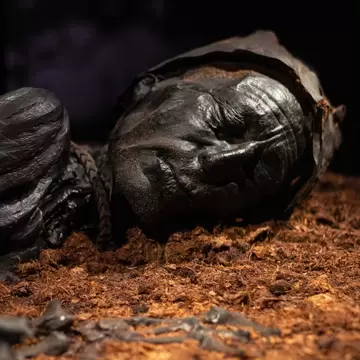
Around 10km south of Aarhus, the Moesgaard Museum is a dramatically modernist museum that slopes into a grassy hillside. The exhibitions are just as spectacular: atmospherically lit, hands-on, interactive and thoughtfully bringing prehistory to life. Most thrillingly, they contain the Graubelle Man, who lay in a bog for over 2000 years before his secrets began to be revealed.
I Am the Bog Man
Stealing the show is the Graubelle Man, whose body was found in a peat bog near Aarhus in 1952, still looking much like he did when he died (albeit a bit more leathery) over 2000 years ago. The superb display is part history lesson, part true crime investigation. Was he a sacrifice to Iron Age fertility gods, an executed prisoner or a victim of murder? The broken leg and gaping neck wound suggest his death, around 290 BCE (give or take 50 years), was a violent one. His body and skin, tanned and preserved by the unique chemical and biological qualities of the peat bog in which he was found, are remarkably intact, right down to his hair and fingernails. As testing develops, more information has come to light about his health, even his last meal.

The Haul from Illerup Ådal
Another highlight is some of the 15,000 weapons, shields and armor found in the boggy valley – a former lake – at Illerup Ådal, dating from 200 to 500 CE. It's thought they were thrown there after victory in battle. A hoard of Roman silver coins, depicting Emperor Commodus, helps date the event.
Prehistoric Bling
The museum has some fabulously decorative, mind-bogglingly ancient finds, beautifully lit. Look for an exquisite, ornamental vessel dating to 3200 BCE, and a collection of 2800-year-old ornaments, including the Dancing Ring, a crown, so-called as it shows nine people holding hands and on the other side with fabulous half-horse, half-bird animals.