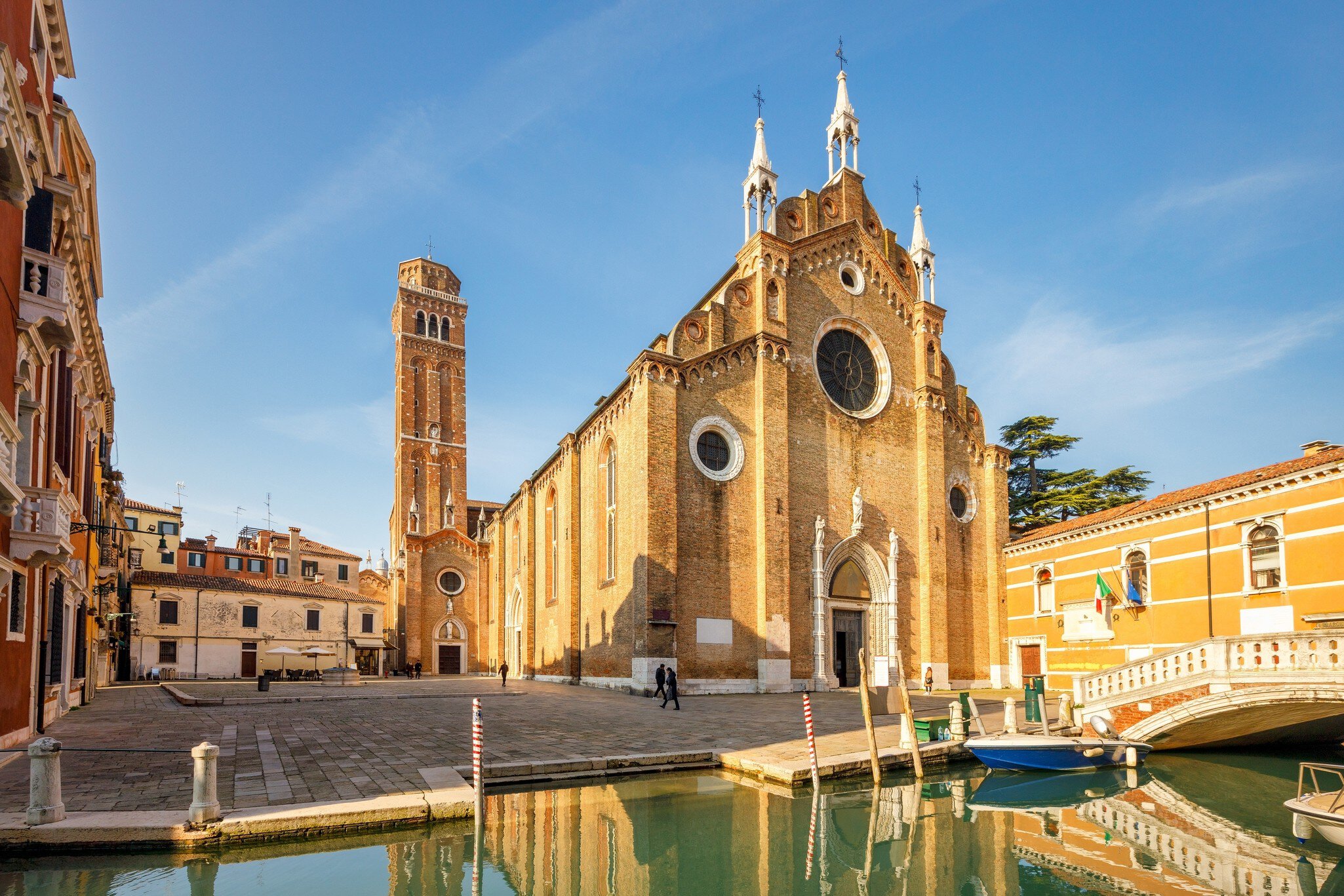
As you’ve no doubt heard, there’s a Titian – make that the Titian – altarpiece at I Frari. But this 14th-century Gothic church is itself a towering achievement, with a heaven-scraping ceiling, intricate marquetry choir stalls and a succession of grandiose monuments lining its high brick walls.
Architectural Details
Built of modest brick rather than stone for the Franciscans in the 14th and 15th centuries, the Frari has none of the flying buttresses, pinnacles and gargoyles typical of international Gothic, but its vaulted ceilings and broad, triple-nave, Latin-cross floor plan give this minor basilica a grandeur befitting the masterpieces it contains.
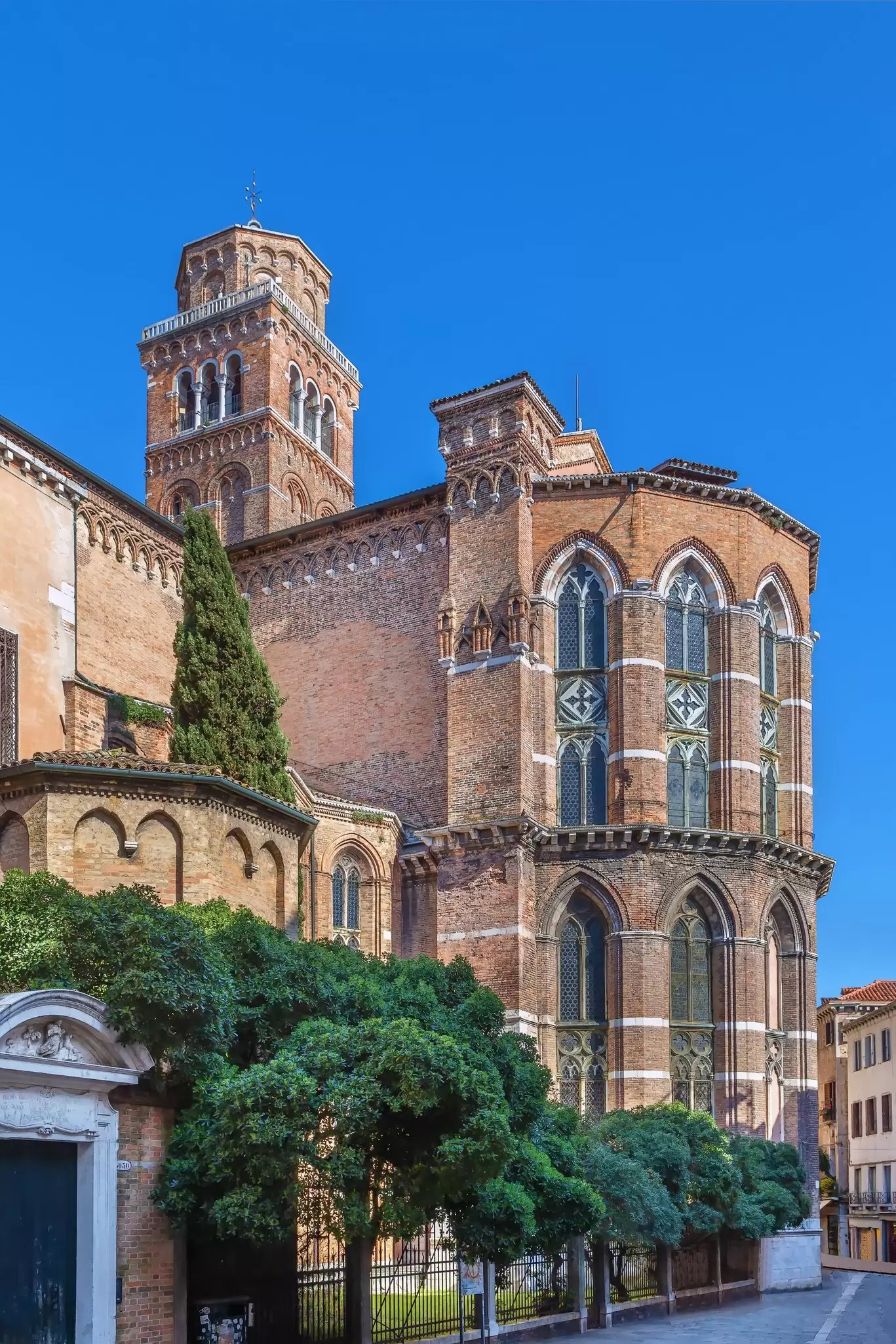
The gingerbread facade facing the canal has delicate scalloping under the roofline, contrasting red-and-white moldings around windows and arches, and a repeating circle motif of oculi (porthole windows) around a high rosette window. Crowning the main portal is Alessandro Vittoria’s 16th-century sculpture Risen Christ, flanked by Bartolomeo Bon’s 15th-century The Virgin and Saint Francis. The bell tower has remained upright since 1386 – a rare feat, given the shifting barene (shoals) of Venice.
Nave Monuments
Step inside and I Frari’s vastness immediately sinks in. Before you, 12 colossal pillars soar heavenward, each representing an apostle. On the left-hand side of the nave, mourners ascend the stairs past a disconsolate winged lion on the pyramid-shaped Canova Monument (1827), erected in honor of Venice's most famous sculptor but originally designed by Canova as a monument to Titian. The great painter was lost to the plague at the age of 90 in 1576, but legend has it that, in light of his contributions, Venice’s strict rules of quarantine were bent to allow Titian’s burial near his masterpiece.
In 1838, Austrian emperor Ferdinand I commissioned the Titian Monument (positioned directly opposite Canova's), featuring bas reliefs of some of his most famous works, including the Assunta.
Commanding attention to the right of the Canova monument is Baldassare Longhena’s dubious Doge Giovanni Pesaro Funereal Monument (1669). It’s held aloft by four black giants who channel the subjection of the Ottomans enslaved during the war of Candia (Crete) – a shocking piece of propaganda as Crete was lost in 1669, the year the monument was completed.
Ahead is one of Titian’s early masterpieces, the 1526 Pesaro Altarpiece, depicting the Madonna and Child and members of Venice’s powerful Pesaro family. The work was commissioned by Jacopo Pesaro, in part to commemorate his role in defeating the Turks at Santa Maura in 1502.
Monks’ Choir
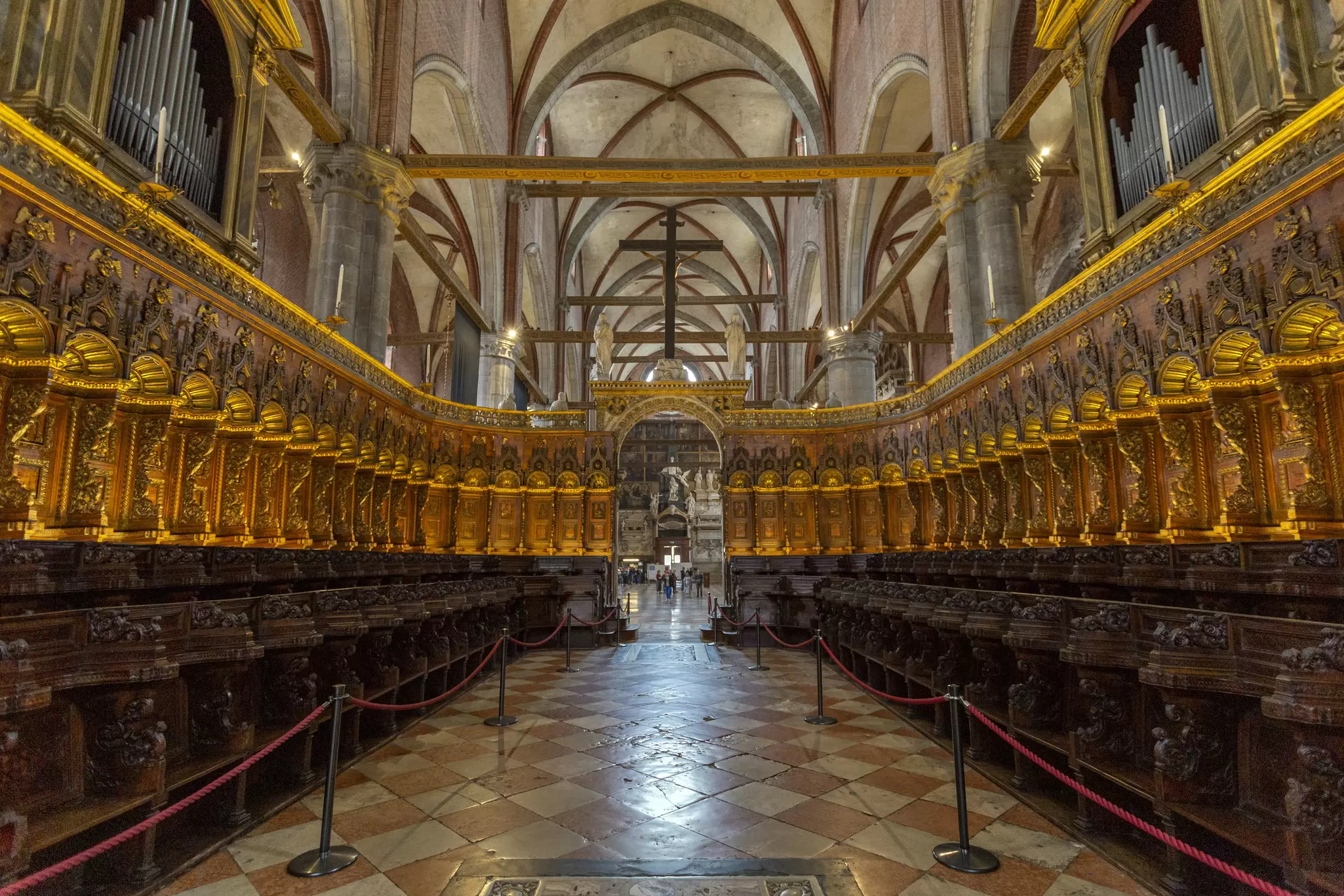
In the center of the nave is the monumental Monks’ Choir, one of few left in Venice. Built in 1468, its 124 gilt-edged choir stalls are lavishly decorated with carvings and marquetry scenes of an "ideal city," as imagined by Renaissance minds. Both are the work of Marco Cozzi, creator of the carved gold ceiling crowning Room 1 of the Gallerie dell’Accademia. The choir stalls are separated from the nave by a carved marble tramezzo (screen), completed in 1475 and attributed to the workshop of Pietro Lombardo. Designed to keep the caroling friars out of sight, the elegant screen is one of few surviving tramezzi in Italy.
Titian's Assunta
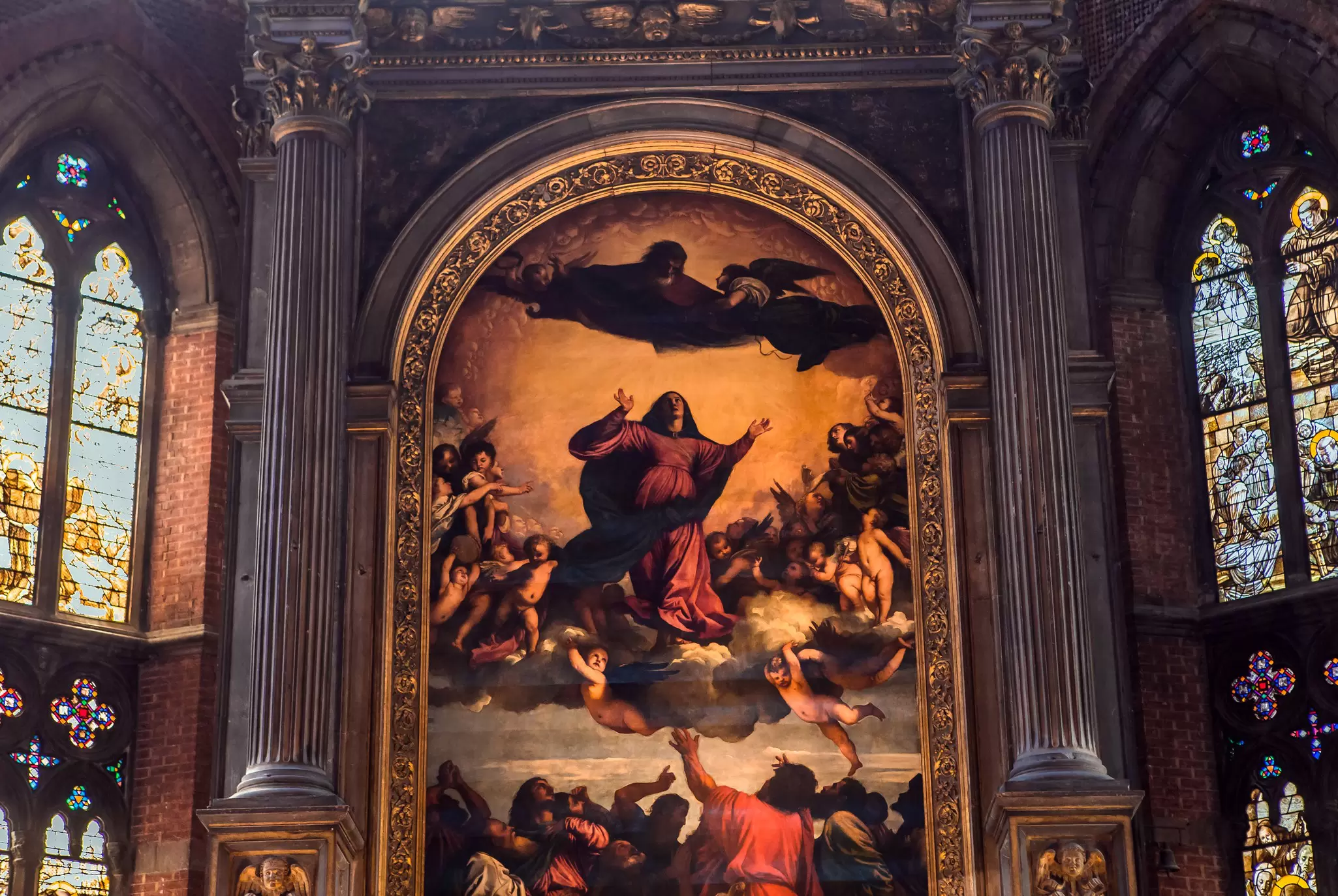
I Frari’s undisputed star is Titian’s 1518 altarpiece Assunta (Assumption), capturing the moment the radiant Madonna reaches heavenward, finds her footing on a cloud and escapes this mortal coil in a dramatic swirl of red and blue robes. One of Italy’s greatest Renaissance artworks, it’s also the world’s largest wood-panel painting, executed on 22 horizontal poplar planks and soaring almost 7m. The artwork was meticulously calibrated for the site, with Titian taking into consideration everything from the position of the monks’ choir tramezzo to the backlighting from the apse windows. He even collaborated on the design of its Istrian-stone frame, attributed to siblings Lorenzo and Giambattista Bregno. A major restoration of the Assunta was completed in 2022, restoring its warm, intense glow and landing Venetian conservator Giulio Bono the prestigious Marino Grimani Prize for his efforts. Take a pew and let its radiance wash over you.
Other Highlights
To the left of the main altar, the Cappella dei Milanesi harbors the tomb of Italian composer Claudio Monteverdi and an early 16th-century altarpiece depicting St Ambrose. Started by Alvise Vivarini and completed by Marco Basaiti after Vivarini’s death, the altarpiece was the largest in Venice before Titian debuted his Assunta.
In the adjoining Cappella Corner, Vivarini’s uncle Bartolomeo executed St Mark Enthroned (1474), a striking triptych depicting the city’s patron saint flanked by – from left to right – St John the Baptist, St Jerome, St Peter and St Nicholas. John the Baptist is the subject of Sansovino’s delicate marble statue (also in Cappella Corner), as well as Donatello’s wooden iteration in the Cappella di San Giovanni Battista to the right of the main altar.
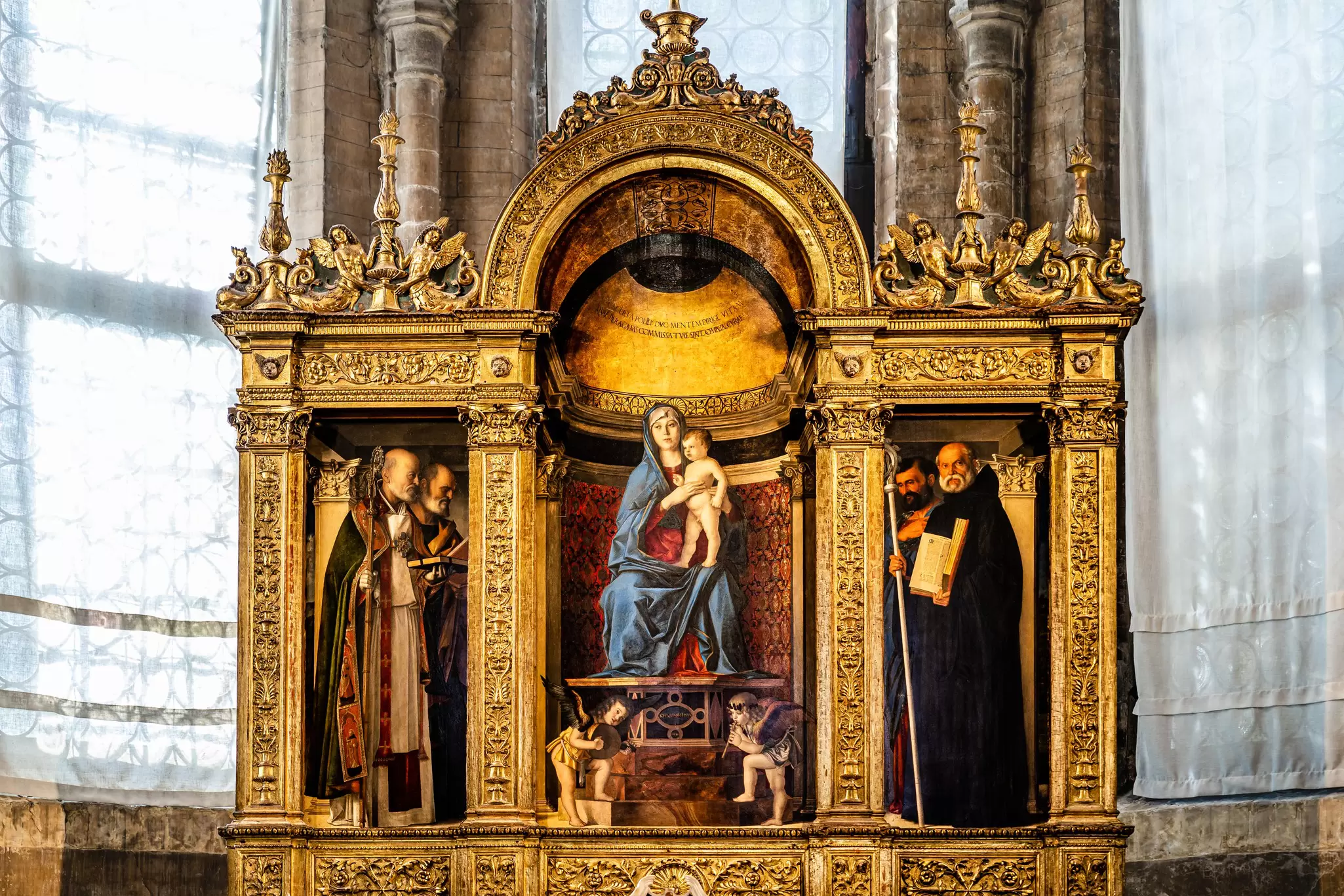
Waiting in the Sacristy is Giovanni Bellini’s achingly sweet and startlingly 3D triptych Madonna with Child (1488), a calming counterpoint to Titian’s kinetic protagonist. The sacristy also houses Francesco Cabianca’s sumptuous, red-marble reliquary altar (1711), its centerpiece relic said to be the blood of a crucified Christ.
From the sacristy, slip into the Chapter House to glimpse Veneziano’s golden, 14th-century votive painting of Doge Francesco Dandolo and his wife, Elisabetta Contarini, venerating the Madonna and Child in the presence of St Francis and St Elizabeth. The work is believed to be the earliest painted portrait of a doge. The room's windows offer a peek of the elegant Chiostro della Trinità, the largest of I Frari’s two cloisters.