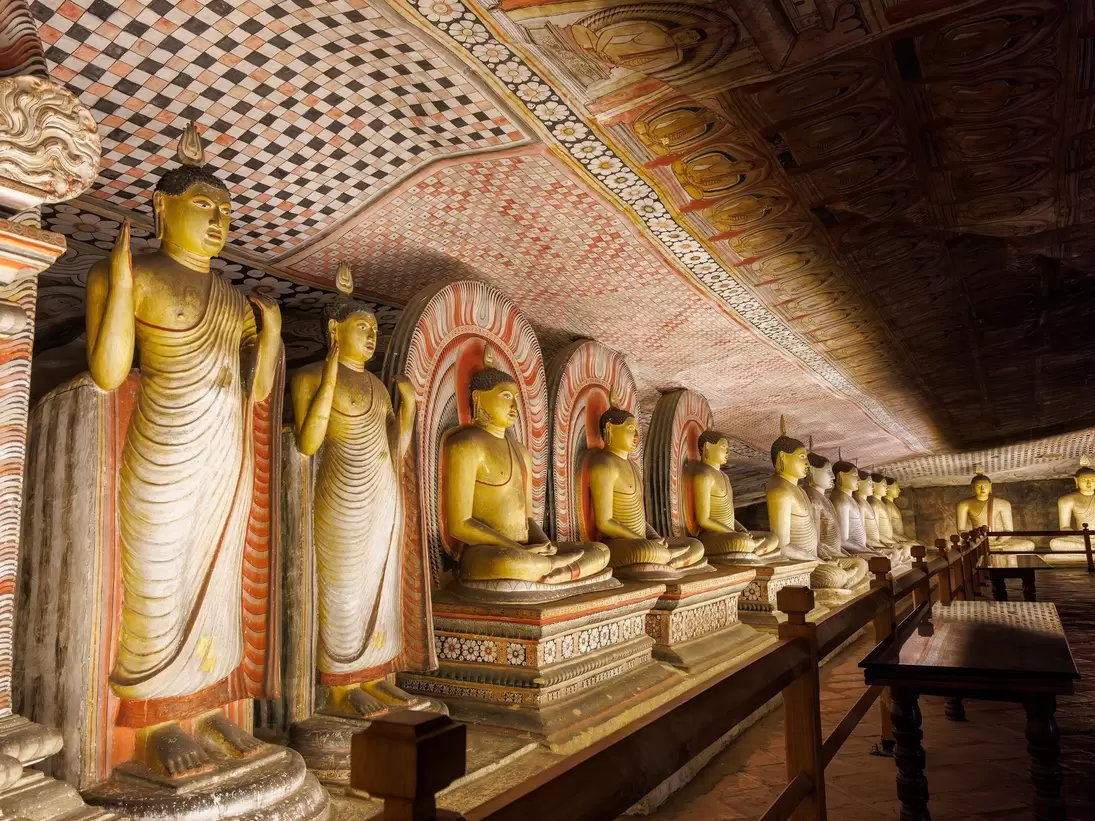
This beautiful temple complex sits about 160m above the road in the southern part of Dambulla. Five separate caves (adult Rs 3000, child under 12 free) contain about 150 absolutely stunning Buddha statues and paintings, some of Sri Lanka's most important and evocative religious art. Buddha images were first created here more than 2000 years ago, and over the centuries subsequent kings added to and embellished the cave art.
Leaving the plain rock exterior and entering the first of the five caves will stop you in your tracks. The riotously colorful Cave I (Devaraja Viharaya) (Temple of the King of the Gods), features a 15m-long reclining Buddha. The so-called sleeping position actually depicts Buddha attaining paranirvana (final nirvana) upon his death.
Cave II (Maharaja Viharaya) (Temple of the Great King) is the most spectacular of the caves, with every square inch covered in warm-hued murals, including stories from the life of Buddha. It measures 52m from east to west and 23m from the entrance to the back wall. Look for the painted wooden statue of King Valagamba on the left as you enter; a fine of example of a king inserting himself into the divine realm. The cave's main Buddha statue, which was once covered in gold leaf, is situated under a frame of makara (mythological crocodile-elephants), with the right hand raised in abhaya mudra (a pose conveying protection). Don't forget to look up at the exuberant ceiling murals. The vessel inside the cave to the right collects water that constantly drips from the ceiling of the temple, even during droughts, and which is used for sacred rituals.
The well-lit Cave III (Maha Alut Viharaya) (the New Great Temple), was said to have been converted from a storeroom in the 18th century by Kandyan king Kirti Sri Rajasinha. A statue of the king, bearded and wearing a crown, stands to the right of the doorway as you enter. It has a beautiful reclining Buddha and is separated from the Maharaja Viharaya by only a masonry wall.
The relatively small Cave IV (Pachima Viharaya) (Western Cave) is actually not the most westerly cave – that position belongs to Cave V. The small dagoba in the center was broken into by thieves who believed that it contained jewelry belonging to Queen Somawathiya.
The newer Cave V (Devana Alut Viharaya) was once used as a storehouse, but it's now called the Second New Temple. It features a reclining Buddha and Hindu deities, including Kataragama (Murugan) and Vishnu.
The caves open from 6.30am to 6pm; photography is allowed. The best way to visit is to take a tuk tuk to the Cave Temples Ticket Office, 1km west of the main Dambulla road, climb the 15 minutes of steep steps to the caves and descend east down the main stairway to the kitschy modern Golden Temple. You'll need to cover your arms and legs to enter the site. Sarongs can be rented at the entrance.
From the caves there are superb views over the surrounding countryside; Sigiriya is clearly visible some 20km distant.