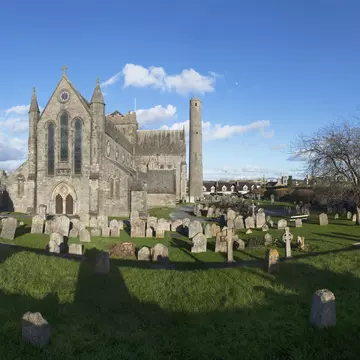
The Rock of Cashel is one of Ireland's most spectacular historic sites: a prominent green hill, banded with limestone outcrops, rising from a grassy plain and bristling with medieval towers. Sturdy walls surround an enclosure containing a 13th-century Gothic cathedral, a 28m-tall round tower and the finest 12th-century Romanesque chapel in Ireland, home to some of the land's oldest frescoes.
Cormac’s Chapel
The undoubted highlight of the Rock is the early 12th-century Cormac’s Chapel – an exquisite gem of Romanesque architecture with beautifully carved doorways and the only surviving Romanesque frescoes in Ireland. Gold-headed saints, lapis-lazuli blue ceilings and robes of blood-red are faint, but visibly there. The wall paintings in the chancel (dated to 1134) form the earliest known decoration of their kind; the ceiling is thought to depict the Adoration of the Magi; other paintings record scenes from the early life of Christ. Inside the main door on the left is the sarcophagus said to house King Cormac, dating from between 1125 and 1150.
Cathedral
Constructed between 1235 and 1270, the cathedral was built in the shape of a cross with a huge square tower on the southwestern corner soaring above. Scattered throughout are various monuments, a 16th-century altar tomb, coats of arms, and stone heads on capitals and corbels, but the main impression is of its vast size.
Round Tower
The Round Tower is the tallest of the site's buildings and dates from the early 12th century. It was built using a drystone technique, though some spots have now been filled in with mortar for safety reasons. Standing 28m tall, the doorway to this ancient edifice is 3.5m above the ground.
Hall of the Vicars Choral
The 15th-century choristers’ kitchen and dining hall was the last building to be completed on the Rock. It was restored in the 1980s complete with period furniture, tapestries and paintings beneath a fine carved oak roof and gallery.
St Patrick's Cross
Standing in the courtyard outside the Hall of the Vicars Choral, this cross is a replica of the eroded original, an impressive 12th-century crutched cross depicting a crucifixion scene on one face and animals on the other. The grounds of the complex also include an extensive graveyard with numerous Celtic high crosses marking some of the graves.
Enclosing Walls & Corner Tower
Constructed using lime mortar around the 15th century, and originally incorporating five gates, stone walls enclose the entire site. It’s thought the surviving corner tower was used as a watchtower. Amble around to enjoy the views of the surrounding countryside and the Devil's Bit to the north.
Hore Abbey
Looking west from the Rock of Cashel you can see Hore Abbey down in the fields. Founded in the 1270s by a Benedictine order, the hauntingly beautiful abbey now lies in ruins, its nooks and crannies and weather-ravaged gravestones making for a peaceful visit. Watch where you step because the field is used for grazing cattle.
There's no entry fee. You can reach the abbey by walking 10 minutes downhill to the west from the Rock of Cashel or parking next to the abbey on the small access road.