This museum helps throw light on Egypt's wealth of culture. Instead of focusing on one era, NMEC's galleries walk visitors through the vast breadth of Egyptian human history.
Partially open since 2017, NMEC's full opening in 2021 saw the Egyptian Museum's Royal Mummies transferred, via a dramatic parade, to their new home here where they form the prize exhibit.
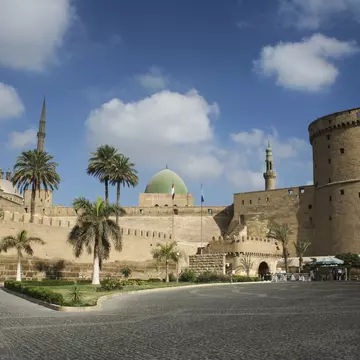
Behind the museum, Ayn As-Sirah Lake has views across to the Citadel. This area is currently being landscaped into a new park.
Central Exhibition Hall
Exhibits here span from the Palaeolithic period, through the Pharaonic, Greco-Roman, Coptic and Islamic eras up to the modern age. There is also a focus on traditional Egyptian cultures with ethnographical displays from Siwa and Sinai.
Don't miss the gold-covered anthropoid coffin of Ptolemaic priest Nedjemankh. The coffin was returned to Egypt in 2019 by New York's Metropolitan Museum after proof surfaced that the coffin had been illegally smuggled out of the country.
The Royal Mummies Hall
NMEC's most famous exhibits are the remains of some of Egypt’s most illustrious pharaohs and queens from the 17th to the 21st dynasties, 1650 to 945 BCE. There is no other single museum where you can see so many mummies, nor get to peer at them so closely. Parents should be aware that the mummies can be a frightening sight for young children.
The earliest of the hall's celebrated inmates is the brave Theban pharaoh Seqenenre Taa II who died violently, possibly during struggles to reunite the country at the end of the Second Intermediate Period, around 1560 BCE. His wounds are still visible beneath his curly hair, and his twisted arms reflect his violent death.
The perfectly wrapped mummies of Queen Merit Amun and Amenhotep I (1525–1504 BCE) show how all royal mummies would once have looked, bedecked with garlands.
Tuthmosis II (1492–1479 BCE) lies next to his sister-wife, the great female pharaoh Hatshepsut (1473–1458). The mummy of their son Tuthmosis III (1479–1425 BCE), is looking not too bad considering he’d been severely damaged by grave robbers centuries ago.
Unlike other mummies, the mummy of Amenhotep II (1427–1400) was discovered in his original Valley of the Kings tomb in 1898. He was then stolen in 1901 and tracked down and returned by Howard Carter before being shipped down the Nile to Cairo in the 1930s.
Tuthmosis IV (1400–1390 BCE) sports beautifully styled hair; he was also the first pharaoh to have his ears pierced.
Queen Tiye, wife of Amenhotep III, mother of Akhenaten and grandmother of Tutankhamun also has notable long flowing hair. Her mummy was only officially identified as Tiye in 2010 after DNA analysis.
With his smooth black skin and square chin, Seti I (1294–1279 BCE) is one of the most flawlessly preserved mummies in the hall.
Rivalling Seti I in the preservation stakes is Ramses II (1279–1213 BCE); his haughty profile revealing the family’s characteristic curved nose, his gray hair tinged with henna and his fingernails long. By contrast, his 13th son and successor, Merenptah (1213–1203 BCE), has a distinctly white appearance caused by the mummification process.
Ramses III (1184–1153 BCE), Ramses IV (1153–1147 BCE), and Ramses V (1147–1143 BCE) with his face marked by small raised spots likely caused by smallpox, represent the 20th dynasty pharaohs in the hall.
The youngest mummies hail from the 21st dynasty, directly after the end of the New Kingdom and the beginning of the Third Intermediate Period.
Nedjmet (c 1070–946 BCE), wife of the 21st dynasty high priest of Amun, Herihor, wears a lavish curly wig and has black-and-white stones for eyes.
Queen Henettawy (c 1025 BCE) is wrapped in a linen shroud painted with an image of Osiris. The shroud is a product of modern restorers who repaired her cheeks, which had burst from overpacking by ancient embalmers.
Queen Maatkare, daughter of Pinedjem I, lies with her pet baboon while the mummy of Queen Nesikhonsu, wife of Pinedjem II, still conveys the queen’s vivid features.