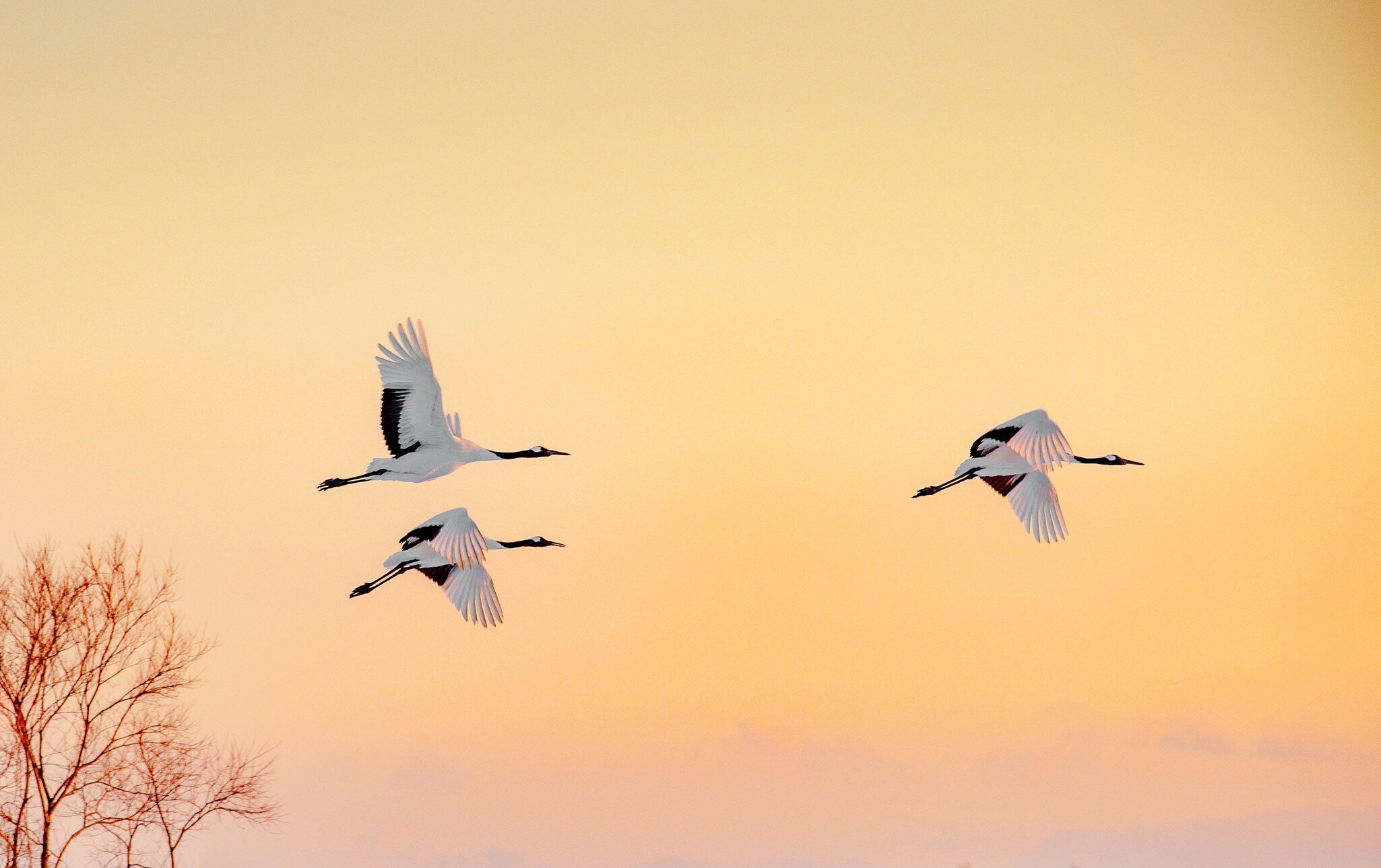
Stretching roughly 36km north to south and 25km east to west, Kushiro-Shitsugen National Park (釧路湿原国立公園) is Japan’s largest wetland and a haven for all kinds of wildlife. The park’s star attraction is the tanchō (red-crowned crane), which was once on the verge of extinction, but now has a healthy stronghold here.
Through the Marshes
The enormous wetlands of Kushiro-Shitsugen were once an ocean inlet which began to silt up around 6000 years ago, forming first a delta and then the marshes which we see today. In summer the park is awash with green and birds nesting in the dense reeds, while in winter everything transforms into a world of white. The wetlands are fed by the Kushiro River, which winds all the way down from its source in Akan-Mashū National Park to the north – canoeing and kayaking tours in the wetlands tend to follow sections of the river’s gentle meandering course and are a great way to see the park’s natural beauty up close, at any time of the year.
The Rise of the Cranes
Known as the tanchō in Japanese, and Sarurun Kamuy (the god of the marshes) to the Ainu, the red-crowned crane is a graceful creature which stands to around 1.5m tall, and has a striking black and white plumage and a distinctive flash of red on its crown.
Japan’s only resident crane species has long been an iconic bird in Japanese art and literature going back centuries, and is associated with longevity and happiness. Despite this, the tanchō was nearly hunted to extinction by the early 20th century, with only around 30 birds remaining in the Kushiro wetlands, its last stronghold. Thankfully concerted efforts were made to save the cranes, and they now have a much healthier population of around 2000 individuals, their range extending beyond the national park too.
Tanchō can be spotted in the wetlands throughout the year, but birdwatchers flock in droves to see them during the winter, when large numbers of cranes gather to perform elaborate mating dances in the snow – a mesmerizing spectacle and one of Hokkaidō’s real winter wonders.
Wildlife-Watching Spots
Possibly the best panoramic viewpoint in the national park is Hoso-oka Observatory (細岡展望台), a hilltop viewpoint in the southeast of the park with expansive views across the wetlands. There is a car park and visitor center close by, and it is only a 10-minute walk from the remote JR Kushiro-Shitsugen Station.
Tōro-ko (塘路湖) is the largest body of water in the park and is popular for canoeing and ice fishing when it freezes over in winter. On the lake’s western flank is a campsite, an excellent eco center, and a small but interesting local history museum. Stroll down the 600m-long nature trail to spot ducks, herons and other birdlife.
At the northwestern side of the park is the village of Tsurui (鶴居) which has a couple of popular tanchō viewing spots. A short drive south of the village is Otowa Bridge, where on cold winter mornings photographers gather to snap the cranes as they dance among the mists of the Setsuri River. A few minutes away is Tsurumidai, a roadside viewpoint where cranes gather in the snowy fields for feeding (daily at around 9am and 2pm).
Over to the west, you can see cranes up close at any time of the year at the Akan International Crane Centre, while at both Kushiro Marsh Observatory and Onnenai Visitor Centre there are gentle boardwalk trails which get you close to nature.
