Things to do in Venezuela
-
Leo Lameda Tours
For a less conventional view of Caracas, Leo Lameda Tours leads walking tours, hitting some of the city's less-visited pockets, such as the central university and cemetery, while offering plenty of illuminating historical insights along the way.
reviewed
-
Parque Nacional Mochima
About three dozen arid islands dot the clear, warm waters of Mochima, a 950 sq km (570 sq mi) national park, making up a favorite haven of beaches, bays and coral reefs. Most of the islands are pretty barren and rocky in parts, but some also have fine beaches and the surrounding reefs offer good snorkeling and diving opportunities. Pods of dolphins are a common sight in the area's waters.
Highlights include Isla Venado, Isla de Plata (popular with holidaying Venezuelans) and Playa Colorada on the mainland. The park also includes a strip of mountainous hinterland lined with appealing bays and beaches. Boats can ferry you to the islands from Puerto La Cruz, Sante Fe or…
reviewed
-
A
Parque del Este
Any given Sunday, there's plenty of activity within the extensive Parque del Este, from children playing hide-and-seek among the rock gardens, to soccer games, religious groups, martial arts classes and a profusion of lycra-clad bodies jogging while chatting into cell phones. Situated on a portion of a former coffee plantation, the 82-hectare park is the largest in Caracas, and a stroll through its expanses is a botanical odyssey, with many plants and trees labeled. You can visit the snake house, aviary and cactus garden, and on weekends enjoy astral displays in the Planetario Humboldt.
reviewed
-
B
Museo Bolivariano
Just a few paces north of the Casa Natal de Bolívar, this museum has successfully preserved its colonial style and displays a variety of independence memorabilia, from muskets to medals and shaving sets to swords. It also has some fascinating documents and letters written by the man himself, and numerous portraits. More on the morbid side are the coffin in which the remains of Bolívar were brought from Santa Marta in Colombia and the arca cineraria (funeral ark) that conveyed his ashes to the Panteón Nacional.
reviewed
-
C
Alto
Caraqueños bowed down to Chef Carlos Garcia’s bold cuisine and decor from the moment the doors opened in 2007: Alto became an instant culinary icon. Local ingredients built around a vanguard Euro-Catalonian framework make dishes like cordero al café (rack of lamb in coffee sauce) worth shelling out the big bolívares. Reservations essential.
reviewed
-
D
Catar
One of several restaurants in the culinary mall known as the Cuadra Gastronómica, Catar has aggressively eclectic food, with a funky, mismatched decor to match. The emphasis is on fresh, natural ingredients, which show up in artistically presented sandwiches, carpaccios and lovely artisanal pizzas. Don’t miss it.
reviewed
-
E
Osprey Expeditions
Small, personable, Venezuelan-owned agency attuned to a budget traveler’s perspective (but with offerings ranging the gamut). It can organize tours throughout Venezuela but it’s particularly strong on Los Roques, Canaima and the Orinoco Delta.
reviewed
-
F
Comercial Carrillo
For legitimately produced CDs (rather than the pirated versions that abound on the streets), try the small but well-crammed Comercial Carrillo, with a voluminous collection of Venezuelan folk and other styles from around the Caribbean.
reviewed
-
G
Iglesia de la Candelaria
Seven blocks east of Plaza Bolívar amidst an area steeped in Spanish flavor, the church Iglesia de la Candelaria has richly gilded monumental retables covering the chancel's walls. The central retable dates from about 1760, while the lateral ones are modern replicas.
But the holiest place in the church for Venezuelans is doubtless the tomb of José Gregorio Hernández, in the first chapel off the right-hand aisle. Though not canonized, José Gregorio is considered more important than many official saints whose images adorn the altars of this and other churches. Yes, ask Venezuelans to name their most important saint and most will answer 'José Gregorio Hernández.' Indeed,…
reviewed
-
H
Concejo Municipal
Occupying half of Plaza Bolívar's southern side, the city hall, the Concejo Municipal was erected by the Caracas bishops from 1641 to 1696 to house the Colegio Seminario de Santa Rosa de Lima. In 1725, the Real y Pontificia Universidad de Caracas, the province's first university, was established here. Bolívar renamed it the Universidad Central de Venezuela, the moniker it keeps to this day, though it has moved to a vast campus outside the historic center.
Today the building is the seat of the Municipal Council, but part of it is open to the public.
Museo Santana, on the ground floor, has a unique 'doll's-house version' of the city's development, filled with elaborate…
reviewed
Advertisement
-
Santuario Nacional de Nuestra Señora de Coromoto
The Santuario Nacional is Venezuela's most important pilgrimage site, marking the spot where patron saint the Virgen de Coromoto allegedly appeared in 1652. The story goes that a divine apparition appeared to Indian Chief Coromoto here, urging him and his tribe to go to the white men (Spaniards) and embrace their religion. The chief did so, but it took a second appearance - and his impending death - to finally convince him to accept Christianity.
A holy image that was left with the chief was later enshrined in the church at nearby Guanare, which was a place of pilgrimage for centuries. In 1980, the construction of a new church began at the actual site of the apparition,…
reviewed
-
Colonia Tovar
A little piece of old Germany lost in the Venezuelan cloud forest, this scenic town of red-tile-roof cabins lies scattered on a mountainside in the Cordillera de la Costa. It was founded in 1843 by a group of 376 German settlers from the Schwarzwald (Black Forest), recruited by swashbuckling Italian soldier/explorer/pirate Agustín Codazzi.
Isolated from the outer world by the lack of roads and rules prohibiting marriage outside the colony, the village followed the mother culture, language and architecture for a century. It wasn't until the 1940s that Spanish was introduced as the official language and the ban on marrying outside the community was abandoned. Today Colonia…
reviewed
-
I
Plaza Bolívar
This leafy square is the nucleus of the old town. It's always alive with huddled groups of caraqueños engaged in conversation and children feeding freshly popped corn to the black squirrels in the trees, while vendors hawk lemonade and cepilladas (shaved ices) on the sidelines, the whole scene shaded by African tulip trees and jacarandas. Golden cherubs gather round the fountains at each corner of the square.
In the center is the obligatory monument to Bolívar - the equestrian statue was cast in Munich, shipped in pieces, and eventually unveiled in 1874 after the ship carrying it foundered on the Archipiélago de los Roques. The plaza is a favorite stage for political…
reviewed
-
Fundación Bigott
If you’d like to dig a little deeper into traditional Venezuelan culture – perhaps learn to play joropo music with the bandola llanera (a string instrument) in the style of Anselmo López, or how to create your very own Festival de los Diablos Danzantes masks – you’ll want to pay a visit to Fundación Bigott. In a restored colonial home sitting prominently on richly preserved Plaza Sucre in the independent colonial town of Petare, Fundación Bigott offers extensive workshops in traditional Venezuelan culture, including traditional celebrations, music, gastronomy, popular arts and artesian crafts. Workshops generally last three months and cost a measly BsF15, but…
reviewed
-
Catatumbo Lightning
Imagine a region where lightning flashes virtually nonstop, but without a single clap of thunder. That's the stunning natural phenomenon that occurs in this bizarre national park on the southwest side of Lake Maracaibo. Known as the Relámpago de Catatumbo (Catatumbo Lightning) or Faro de Maracaibo (Maracaibo Beacon), the flashes can be seen at night all over the region, weather permitting. This phenomenon is found nowhere else on earth.
The natural lightshow consists of frequent flashes of lightning with no accompanying thunder, which gives an eerie sensation. On clear dry nights you are in for an unbelievable and shocking experience. No-one has proven why it happens,…
reviewed
-
J
Galería de Arte Nacional
The new, nearly completed National Art Gallery was inaugurated by Hugo Chávez in 2009 and now stands as Venezuela’s physically largest museum. Construction on its nearly 31,000 sq meters originally began in 1989 but was abandoned in the mid-’90s. Architect Carlos Gómez persevered and construction resumed in 2006. Its exhibition galleries are complete and house a selection from the 7000-piece collection that embraces five centuries of Venezuelan artistic expression. Anything from pre-Hispanic art to mind-boggling modern kinetic pieces may be showcased here in temporary exhibitions. Venezuela’s four most important artists – Arturo Michelena, Armando Reverón, Carlos Cruz…
reviewed
-
Salto Ángel
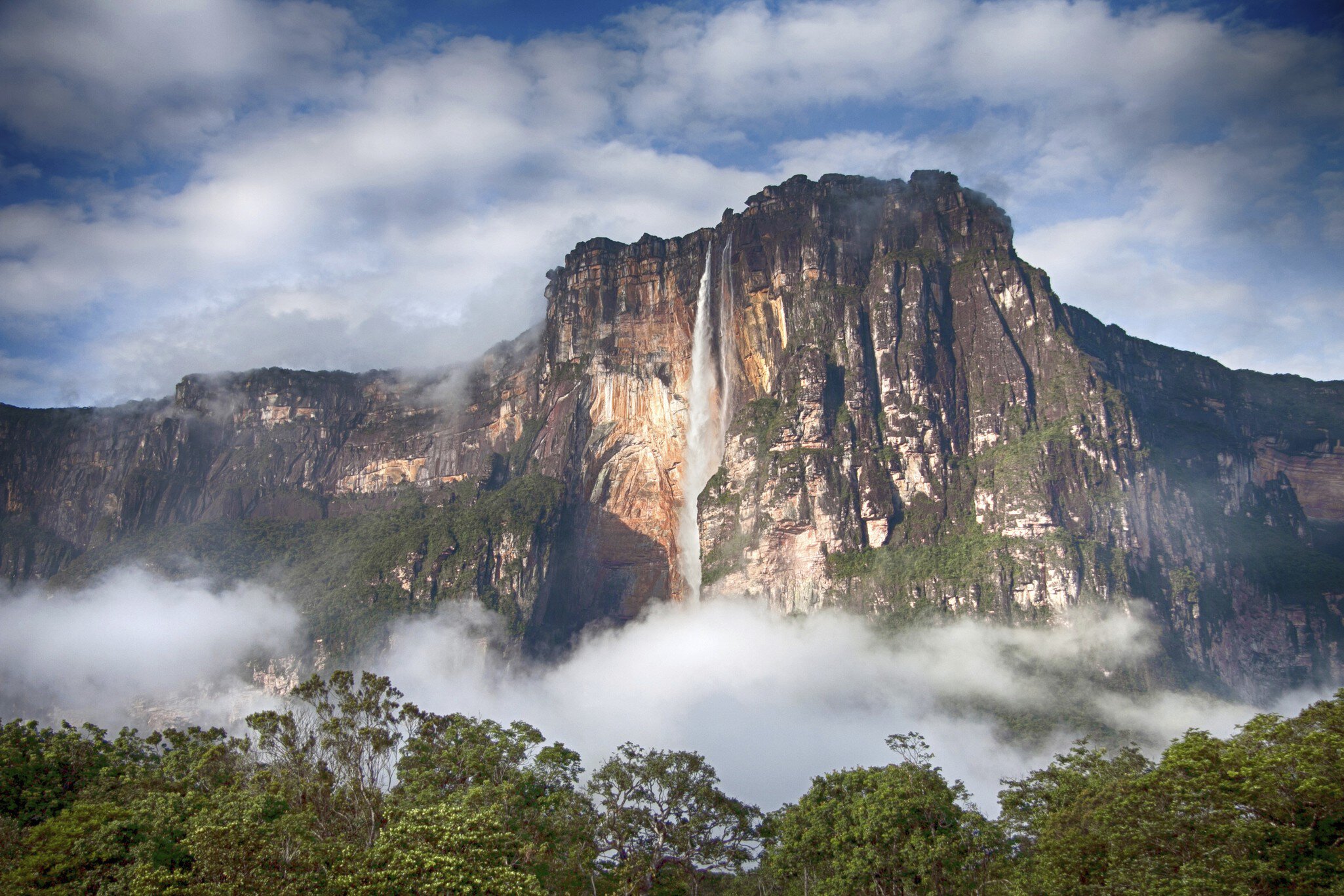
Angel Falls is the world's highest waterfall and Venezuela's number-one tourist attraction. Its total height is 979m (3211ft), of which the uninterrupted drop is 807m (2646ft), about 16 times the height of Niagara Falls. The cascade spills off the heart-shaped Auyantepui, one of the largest of the tepuis (sandstone-capped mesa), into Devil's Canyon.
Angel Falls is not named after a divine creature, but after an American bush pilot, Jimmie Angel, who landed his four-seater airplane atop Auyantepui in 1937 while in search of gold.
The waterfall is situated in a distant, lush wilderness with no road access. Most visitors who visit by boat opt to stay overnight in hammocks…
reviewed
-
Roraima
A stately tepui (flat-topped sandstone mountain) towering into churning clouds, Roraima (2810m/9270ft) lures hikers and nature-lovers looking for Venezuela at its natural and rugged best. Unexplored until 1884, the stark landscape contains strange rock formations and graceful arches, ribbon waterfalls, glittering quartz deposits and carnivorous plants. Frequent mist only accentuates the otherworldly feel.
The round trip, including all highlights and side trips, normally takes about five days return. There are several camp sites along the way - a good all-weather tent is a must. Hire guides and porters in San Francisco de Yuruaní or Paraitepuí. If you don't have your own…
reviewed
-
Teleférico de Mérida
An essential experience of any visit to Mérida is the teleférico, the world's highest and longest cable-car system. It takes you 12.5km (7.5mi) from the bottom station of Barinitas (1577m/5174ft) to the top of Pico Espejo (4765m/15,633ft) in four stages. The ascent to Pico Espejo takes close to two hours if you go straight through, and provides some stunning views of the Andes along the way.
It's best to go up as early as possible, as clouds usually obscure views later in the day. You can then take some short walks around Pico Espejo and/or Loma Redonda before heading back. The cable car also provides easy access for high-mountain hiking, but take into account that…
reviewed
-
Delta del Orinoco
A deep green labyrinth of islands, channels and mangrove swamps engulfing an area almost the size of Belgium, the Delta del Orinoco is one of the world's great river deltas and a mesmerizing region to explore. Roaring howler monkeys, ravenous piranhas and screaming clouds of parrots are some of the wildlife that make this a naturalists' mecca.
The Río Orinoco reaches a width of 20km (12mi) in its lower course before splitting into about 40 major channels (and perhaps 250 smaller ones), which flow out along 360km (216mi) of Atlantic coast. As well as a rich natural environment, the delta is home to the indigenous Warao Indians, known as the 'canoe people'.
Tucupita is the…
reviewed
Advertisement
-
Río Caura
The picturesque Río Caura, a tributary of the Río Orinoco, offers a variety of natural and cultural experiences few other rivers can match. The thick jungle setting resembles what you might find around Canaima, but unlike Angel Falls it is a year-round boat destination that's not seriously affected by the dry season.
The river is graced with islands, beaches and huge granite boulders, and cut by rapids and waterfalls. The most spectacular is Salto Pará. At the end of the lower Caura, two rapids form a huge lagoon and the long sandy beach of El Playón. For a good part of its course, the Caura flows through wildlife-rich rainforest, with riverbanks inhabited by indigenous…
reviewed
-
K
Catedral
Set on the eastern side of Plaza Bolívar, the catedral started its life in the mid-16th century as a mere mud-walled chapel. A church later replaced it, only to be flattened by the 1641 earthquake. Built from 1665 to 1713, the new cathedral was packed with dazzling gilded altars and elaborate side chapels. The wide, five-nave interior, supported on 32 columns, was largely remodeled in the late 19th century. The Bolívar family chapel is in the middle of the right-hand aisle and can be easily recognized by a modern sculpture of El Libertador (The Liberator) mourning his parents and Spanish bride. Bolívar was baptized here, but the baptismal font now stands in the Casa…
reviewed
-
Parque Nacional Henri Pittier
Venezuela's oldest and most diverse national park offers something for everyone - a gorgeous coastline for beach lovers, a huge variety of species for bird-watchers, a few trails for hikers, colonial towns for architecture buffs and rolling African drumbeats for rumba (party) ravers.
Created in 1937 and named for Swiss botanist Henri Pittier, the park is famous for its birds, with almost 600 species identified. The animal world here is also rich and includes tapirs, deer, pumas, agoutis, peccaries, ocelots, opossums, armadillos, monkeys, snakes, frogs and bats.
Many splendid and secluded beaches line the park's coastline - some accessible only by boat. The park is also…
reviewed
-
L
Iglesia de San Francisco
Just south of the Capitolio Nacional, the Church of San Francisco was built in the 1570s, but was remodeled on several occasions during the 17th and 18th centuries. Guzmán Blanco, unable to resist his passion for modernizing, placed a neoclassical facade on the church to match the just-completed capitol building. Fortunately, the interior of the church didn’t undergo such an extensive alteration, so its colonial character and much of its old decoration have been preserved. Have a look at the richly gilded baroque altarpieces distributed along both sidewalls, and stop at the statue of San Onofre, in the right-hand aisle. He is the most venerated saint in the church due to…
reviewed
-
Salto Aponguao
Although difficult to reach, this is one of the most impressive and photogenic waterfalls in La Gran Sabana. The 105m (344ft) Salto is quite spectacular, and a well-marked path leads to the base of the falls where you can bathe and swim in one of the natural pools. Nearby is an idyllic camping spot with excellent views of the falls.
One way to reach the falls is to leave the highway, then travel about 40km (25mi) on an unpaved road before coming to the Indian hamlet of Iboribó. The next step is to pay one of the locals to take you by curiara (dugout canoe) across the Río Aponguao, from where it's a half-hour trek to the falls. Another possibility is to arrange for a boat…
reviewed