go to content go to search box go to global site navigation

Uzbekistan

Things to do in Uzbekistan

‹ Prev

of 9

  1. A

    Advantour

    The reliable outfit located in the Rovshan Hotel can customize tours for both groups and individuals. The personable and knowledgeable husband-and-wife owners speak perfect English. They were relocating at research time.

    reviewed

  2. B

    Al Delfeen

    There are simply not enough superlatives in the English language to describe the cuisine at this Syrian restaurant. Load up on appetizers like baba ganush, hummus, falafel, samsa and tabbouleh, all redolent with ancient spices and bathing in exotic oils. If you still have room, dive right into the equally scrumptious mains - try the mosakan (chicken cooked with sumac and olive oil).

    Once you're finished, lie back on your outdoor tapchan (bedlike sitting platform) and send wisps of heavenly shisha (hookah) smoke skyward whilst marvelling at your luck for finding such a place.

    reviewed

  3. C

    Caravan

    Tashkent's quintessential theme restaurant is tarted up like a made-for-Hollywood Uzbek home. Its Westernised Uzbek cuisine is tasty, but comes saddled with bill-inflating service and 'entertainment' charges. The attached store is filled with crafts from all over the country and is open late, making Caravan a great place for both a nibble and a last-minute gift-buying spree.

    reviewed

  4. D

    SMI

    More bar than nightclub, this is where people gravitate after an evening of club hopping. The flow of so many inebriated people to one place can have a creative effect on the environment. As one British expat put it, 'SMI morphs into whatever you want it to be at six in the morning'. SMI is the Russian acronym for 'mass media', and the walls pay due homage to the honourable craft of the scribbler.

    reviewed

  5. E

    Tim Abdulla Khan

    For carpets, you couldn't ask for a better shopping atmosphere than at the silk weaving and carpet centre in the late 16th-century Tim Abdulla Khan, near Taqi-Telpaq Furushon Bazaar (a tim was a general market). They are not pushy and will openly inform you on what's handmade and what's machine-made. You can watch silk-carpet weavers in action here.

    reviewed

  6. Self-catering

    For self-caterers there are farmers markets, including Kolkhozny Bazaar and the Sunday and Thursday Kukluk Bazaar, buried deep in the Jewish Quarter.

    reviewed

  7. Oloy Bazaar

    This heavily policed market lacks the character of Chorsu, but will serve you well if your hotel is in the Amir Timur maydoni area.

    reviewed

  8. Denis Vikulov

    Recommended guide. Caters to budget travellers.

    reviewed

  9. Registan

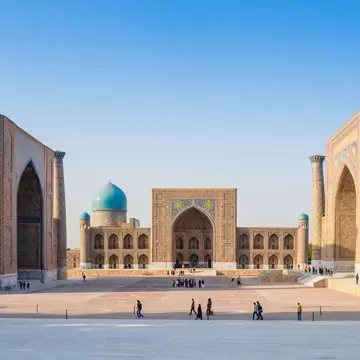
    This ensemble of majestic, tilting medressas - a near-overload of majolica, azure mosaics and vast, well-proportioned spaces - is the centrepiece of the city, and one of the most awesome single sights in Central Asia. The Registan, which translates to 'Sandy Place' in Tajik, was medieval Samarkand's commercial centre and the plaza was probably a wall-to-wall bazaar.

    The three grand edifices here are among the world's oldest preserved medressas, anything older having been destroyed by Jenghiz Khan. They have taken their knocks over the years courtesy of the frequent earthquakes that buffet the region; that they are still standing is a testament to the incredible…

    reviewed

  10. Guri Amir Mausoleum

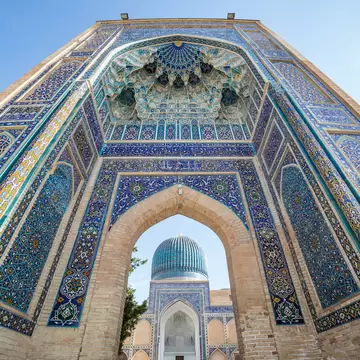
    Timur, two sons and two grandsons, including Ulugbek, lie beneath the surprisingly modest Guri Amir Mausoleum and its trademark fluted azure dome. Timur had built a simple crypt for himself at Shakhrisabz, and had this one built in 1404 for his grandson and proposed heir, Mohammed Sultan, who had died the previous year.

    But the story goes that when Timur died unexpectedly of pneumonia in Kazakhstan (in the course of planning an expedition against the Chinese) in the winter of 1405, the passes back to Shakhrisabz were snowed in and he was interred here instead. As with other Muslim mausoleums, the stones are just markers; the actual crypts are in a chamber beneath. In the…

    reviewed

  11. Advertisement

  12. F

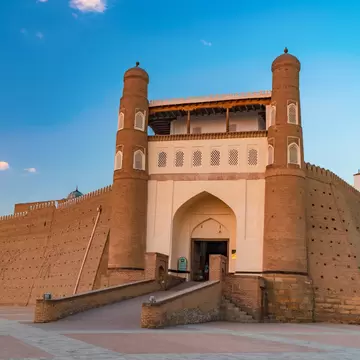
    The Ark

    The Ark, a royal town-within-a-town, is Bukhara's oldest structure, occupied from the 5th century right up until 1920, when it was bombed by the Red army. It's about 80% ruins inside now, except for some remaining royal quarters, now housing several museums.

    At the top of the entrance ramp is the 17th-century Juma (Friday) Mosque. Turn right into a corridor with courtyards off both sides. First on the left are the former living quarters of the emir's kushbegi (prime minister), now housing an exhibit on archaeological finds around Bukhara.

    Second on the left is the oldest surviving part of the Ark, the vast Reception & Coronation Court, whose roof fell in during the 1920…

    reviewed

  13. G

    Kuhna Ark

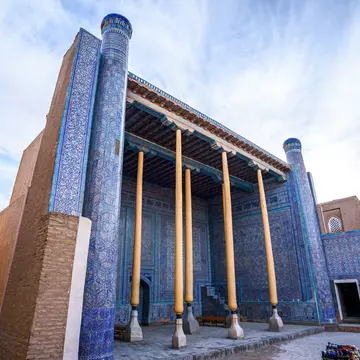
    To your left after you enter the West Gate stands the Kuhna Ark - the Khiva rulers' own fortress and residence, first built in the 12th century by one Oq Shihbobo, then expanded by the khans in the 17th century. The khans' harem, mint, stables, arsenal, barracks, mosque and jail were all here.

    The squat protuberance by the entrance, on the east side of the building, is the Zindon (Khans' Jail), with a display of chains, manacles and weapons, and pictures of people being chucked off minarets, stuffed into sacks full of wild cats etc.

    Inside the Ark, the first passage to the right takes you into the 19th-century Summer Mosque, open-air and beautiful with superb…

    reviewed

  14. Shah-i-Zinda

    Its shiny restoration in 2005 has been called an abomination by some, but the Shah-i-Zinda remains Samarkand's most moving sight. The name, which means 'Tomb of the Living King', refers to its original, innermost and holiest shrine - a complex of cool, quiet rooms around what is probably the grave of Qusam ibn-Abbas, a cousin of the Prophet Mohammed who is said to have brought Islam to this area in the 7th century.

    A shrine to Qusam existed here on the edge of Afrosiab long before the Mongols ransacked it in the 13th century. Shah-i-Zinda began to assume its current form in the 14th century as Timur and later Ulugbek buried their family and favourites near the Living…

    reviewed

  15. H

    Central Asian Plov Centre

    Few things excite the Uzbek palate like plov, that wonderful conglomeration of rice, vegetables and meat bits swimming in lamb fat and oil. This Central Asian staple has been elevated to the status of religion in Uzbekistan, the country with which it is most closely associated. Each province has its own style, which locals loudly and proudly proclaim is the best in Uzbekistan - and by default the world. That plov is an aphrodisiac goes without saying.

    Uzbeks joke that the word for 'foreplay' in Uzbek is 'plov'. Men put the best cuts of meat in the plov on Thursday; not coincidentally, Thursday's when most Uzbek babies are conceived. Drinking the oil at the bottom of the

    reviewed

  16. I

    Ichon-Qala

    The main entrance to the Ichon-Qala is the twin-turreted brick West Gate (Ota-Darvoza, literally 'Father Gate'), a 1970s reconstruction - the original was wrecked in 1920. The two-day ticket gives you access to all the sights and museums in the Ichon-Qala besides the Islom-Hoja Minaret, the Pahlavon Mahmud Mausoleum and the Akshaikh Baba Complex in Kuhna Ark. One highlight for which you do not need a ticket is the walk along the northwestern section of the wall, best at sunrise or sunset. The stairs are at the North Gate. The 2.5km-long mud walls date from the 18th century, rebuilt after being destroyed by the Persians.

    Despite what the guards at the West Gate say, you…

    reviewed

  17. J

    Islom-Hoja Medressa

    From the East Gate, where the slave market was held, go back to the Abdulla Khan Medressa and take the lane to the south beside it to the Islom-Hoja Medressa and minaret - Khiva's newest Islamic monuments, both built in 1910. The minaret, with bands of turquoise and red tiling, looks rather like an uncommonly lovely lighthouse. At 57m tall, it's Uzbekistan's highest.

    A host of vendors, street cleaners or random scallywags will try to collect money from you for the privilege of climbing the 118 steps to the top; you'll probably end up paying one of them sum500 to sum1000.

    The medressa holds Khiva's best museum, exhibiting Khorezm handicrafts through the ages - fine…

    reviewed

  18. Bibi-Khanym Mosque

    The enormous congregational Bibi-Khanym Mosque, northeast of the Registan, was finished shortly before Timur's death and must have been the jewel of his empire. Once one of the Islamic world's biggest mosques (the main gate alone was 35m high), it pushed construction techniques to the limit. Slowly crumbling over the years, it finally collapsed in an earthquake in 1897. Part of the mosque is Bibi-Khanym's own compact 14th-century mausoleum.

    Legend says that Bibi-Khanym, Timur's Chinese wife, ordered the mosque built as a surprise while he was away. The architect fell madly in love with her and refused to finish the job unless he could give her a kiss. The smooch left a…

    reviewed

  19. K

    Lyabi-Hauz

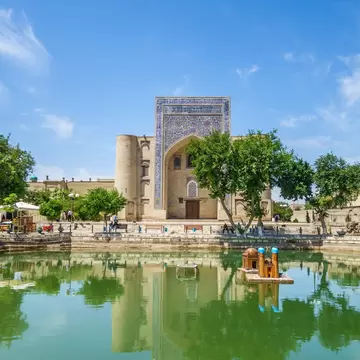
    Lyabi-Hauz, a plaza built around a pool in 1620 (the name is Tajik for 'around the pool'), is the most peaceful and interesting spot in town - shaded by mulberry trees as old as the pool. The old tea-sipping, chessboard-clutching Uzbek men who once inhabited this corner of town have been moved on by local entrepreneurs bent on cashing in on the tourist trade. Still, the plaza maintains its old-world style and has managed to fend off the glitz to which Samarkand's Registan has succumbed.

    On the east side is a statue of Hoja Nasruddin, a semimythical 'wise fool' who appears in Sufi teaching-tales around the world.

    Further east, the Nadir Divanbegi Medressa was built as a…

    reviewed

  20. L

    Kalon Minaret

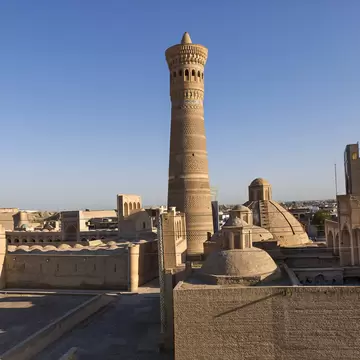
    When it was built by the Karakhanid ruler Arslan Khan in 1127, the Kalon Minaret was probably the tallest building in Central Asia - kalon means 'great' in Tajik. It's an incredible piece of work, 47m tall with 10m-deep foundations (including reeds stacked underneath in an early form of earthquake-proofing), which in 850 years has never needed any but cosmetic repairs. Jenghiz Khan was so dumbfounded by it that he ordered it spared.

    Its 14 ornamental bands, all different, include the first use of the glazed blue tiles that were to saturate Central Asia under Timur. Up and down the south and east sides are faintly lighter patches, marking the restoration of damage caused…

    reviewed

  21. Tilla-Kari (Gold-Covered) Medressa

    In between Ulugbek Medressa and the Sher Dor (Lion) Medressa is the Tilla-Kari (Gold-Covered) Medressa, completed in 1660, with a pleasant, gardenlike courtyard. The highlight here is the mosque, intricately decorated with gold to symbolize Samarkand's wealth at the time it was built. The mosque's delicate ceiling, oozing gold leaf, is flat but its tapered design makes it look domed from the inside.

    Many of the medressas' former dormitory rooms are now art and souvenir shops. In the high season a variety of traditional shows are put on for tourists in the Sher Dor courtyard, including mock Uzbek weddings and kurash, a form of Uzbek wrestling. There are also tacky evening…

    reviewed

  22. Advertisement

  23. Khiva

    Khiva (Uzbek: Hiva) is an odd place. Its historic heart, unlike those of other Central Asian cities, is preserved in its entirety - but so well preserved that the life has almost been squeezed out of it. As a result of a Soviet conservation program in the 1970s and 80s, it's now a squeaky-clean official 'city-museum'.

    Even among its densely packed mosques, tombs, palaces, alleys and at least 16 medressas, you need imagination to get a sense of its mystique, bustle and squalor.

    A few of the historic buildings in Ichon-Qala are functioning mosques or shrines, but most are museums. You can see it all in a day trip from Urgench, but you'll take it in better by staying longer.…

    reviewed

  24. M

    History Museum of the People of Uzbekistan

    The History Museum of the People of Uzbekistan is a must-stop for anyone looking for a primer on the history of Turkestan from ancient times to the present.

    The 1st floor has ancient Zoroastrian and Buddhist artefacts, including a small Buddha from a Kushan temple excavated at Fayoz-Tepe near Termiz. On the 2nd floor English placards walk you through the Russian conquests of the khanates and emirates, and there are some foreboding newspaper clippings of revolts in Andijon and elsewhere being brutally suppressed by the Russians around the turn of the 20th century. The 3rd floor, naturally, is dedicated to Karimov. A placard contains what is surely one of Karimov's more…

    reviewed

  25. Afrosiab Museum

    At a 2.2-sq-km site called Afrosiab, northeast of the bazaar, are excavations of Marakanda (early Samarkand) more or less abandoned to the elements. The Afrosiab Museum leads the visitor through the 11 layers of civilisation that is Afrosiab. From the museum, walk 1km north to the current excavation site where you may find weather-beaten archaeologists picking coins out of the dust.

    The best way to reach Afrosiab is on foot. Cross the intersection north of Bibi-Khanym and follow pedestrian Tashkent kochasi for about 1km to the Afrosiab Museum; Ulugbek's observatory is 1.5km beyond that. If it's too hot to walk, marshrutka 17 from the Registan takes an 8km detour via the…

    reviewed

  26. N

    Maghoki-Attar

    Between the two covered bazaars Taqi-Sarrafon and Taqi-Telpak Furushon, in what was the old herb and spice bazaar, is Central Asia's oldest surviving mosque, the Maghoki-Attar, a lovely mishmash of 9th-century façade and 16th-century reconstruction. This is probably also the town's holiest spot: under it in the 1930s archaeologists found bits of a 5th-century Zoroastrian temple ruined by the Arabs, and an earlier Buddhist temple.

    Until the 16th century, Bukhara's Jews are said to have used the mosque in the evenings as a synagogue.

    Only the top of the mosque was visible when the digging began; the present plaza surrounding it is the 12th-century level of the town. A…

    reviewed

  27. Ulugbek Medressa

    Ulugbek Medressa on the west side is the original medressa, finished in 1420 under Ulugbek (who is said to have taught mathematics there; other subjects included theology, astronomy and philosophy). Beneath the little corner domes were lecture halls, and at the rear a large mosque. About 100 students lived in the two storeys of dormitory cells here.

    Many of the medressas' former dormitory rooms are now art and souvenir shops. In the high season a variety of traditional shows are put on for tourists in the Sher Dor courtyard, including mock Uzbek weddings and kurash, a form of Uzbek wrestling. There are also tacky evening sound-and-light shows put on for tour groups in the…

    reviewed