Getting around
Norway’s has an extremely efficient public transport system and its trains, buses and ferries are often timed to link with each other. The handy NSB Togruter, available free at most train stations, details rail timetables and includes information on connecting buses. Boat and bus departures vary with the season and the day (services on Saturday are particularly sparse, although less so in the summer high season), so pick up the latest ruteplan (timetables) from regional tourist offices.
Rail lines reach as far north as Bodø (you can also reach Narvik by rail from Sweden); further north you’re limited to buses and ferries. Inter-Rail and Eurail pass holders are entitled to discounts on some northern routes. Some express boats and buses offer a 50% discount for the second person when two people travel together. A fine alternative to land travel is the Hurtigruten coastal ferry, which calls in at every sizable port between Bergen and Kirkenes.
One thing that you should always watch out for, whether you’re travelling by bus, train or air, are cheaper minipris tickets; they’re usually available only if you book early and/or over the internet.
Contents
Boat
Norway’s excellent system of ferries connects otherwise inaccessible, isolated communities with an extensive network of car ferries crisscrossing the fjords; express boats link the country’s offshore islands to the mainland. Most ferries accommodate motor vehicles, but express coastal services normally take only foot passengers and cyclists, as do the lake steamers.
Highway ferries are subsidised and therefore aren’t overly expensive (at least in a Norwegian context), but long queues and delays are possible at popular crossings in summer. They do, however, run deep into the night, especially in summer, and some run around the clock, although departures in the middle of the night are less frequent. Details on schedules and prices for vehicle ferries and lake steamers are provided in the timetables published by the Norwegian Tourist Board, or Rutebok for Norge. Tourist offices can also provide timetables for local ferries.
Canal trips
Southern Norway’s Telemark region has an extensive network of canals, rivers and lakes. There are regular ferry services or you can travel using your own boat.
Hurtigruten coastal ferry
For more than a century, Norway’s legendary Hurtigruten coastal ferry (810 30 000; www.hurtigruten.com) has served as a lifeline linking coastal towns and villages and it’s now one of the most popular ways to explore Norway. Year in, year out, one of 11 Hurtigruten ferries heads north from Bergen almost every night of the year, pulling into 35 ports on its six-day journey to Kirkenes, where it then turns around and heads back south. The return journey takes 11 days and covers a distance of 2500 nautical miles. In agreeable weather (which is by no means guaranteed) the fjord and mountain scenery along the way is nothing short of spectacular. Most of the ships are modern, others are showing their age; the oldest ship dates from 1982, but all were substantially remodelled in the 1990s.
If you’re travelling as a deck-class passenger, there are baggage rooms, a shower room, a 24-hour cafeteria and a coin laundry. Meals are served in the dining room and you can buy snacks and light meals in the cafeteria. At night, some people roll out a sleeping bag on the floor in one of the lounges, but all-night activity will mean short nights of little sleep, especially in the 24-hour summer daylight; at least one Lonely Planet author enjoyed a blissful sleep curled up in a cupboard.
Summer fares, which run from mid-April to mid-September, are considerably more expensive than winter prices. Sample summer/winter deck-class fares from Bergen are Nkr1705/1194 to Trondheim, Nkr2708/1895 to Bodø, Nkr3499/2449 to Tromsø and Nkr5426/3798 to Kirkenes. Cars can also be carried for an extra fee. Children aged four to 16, students, and seniors over the age of 67, all receive a 50% discount, as do accompanying spouses and children aged 16 to 25. Ask also about cheaper, 21-day coastal passes if you’re aged between 16 and 26 years.
If you prefer an en suite cabin you’ll pay an additional Nkr210 to Nkr3380. Cabins are extremely popular; book well in advance.
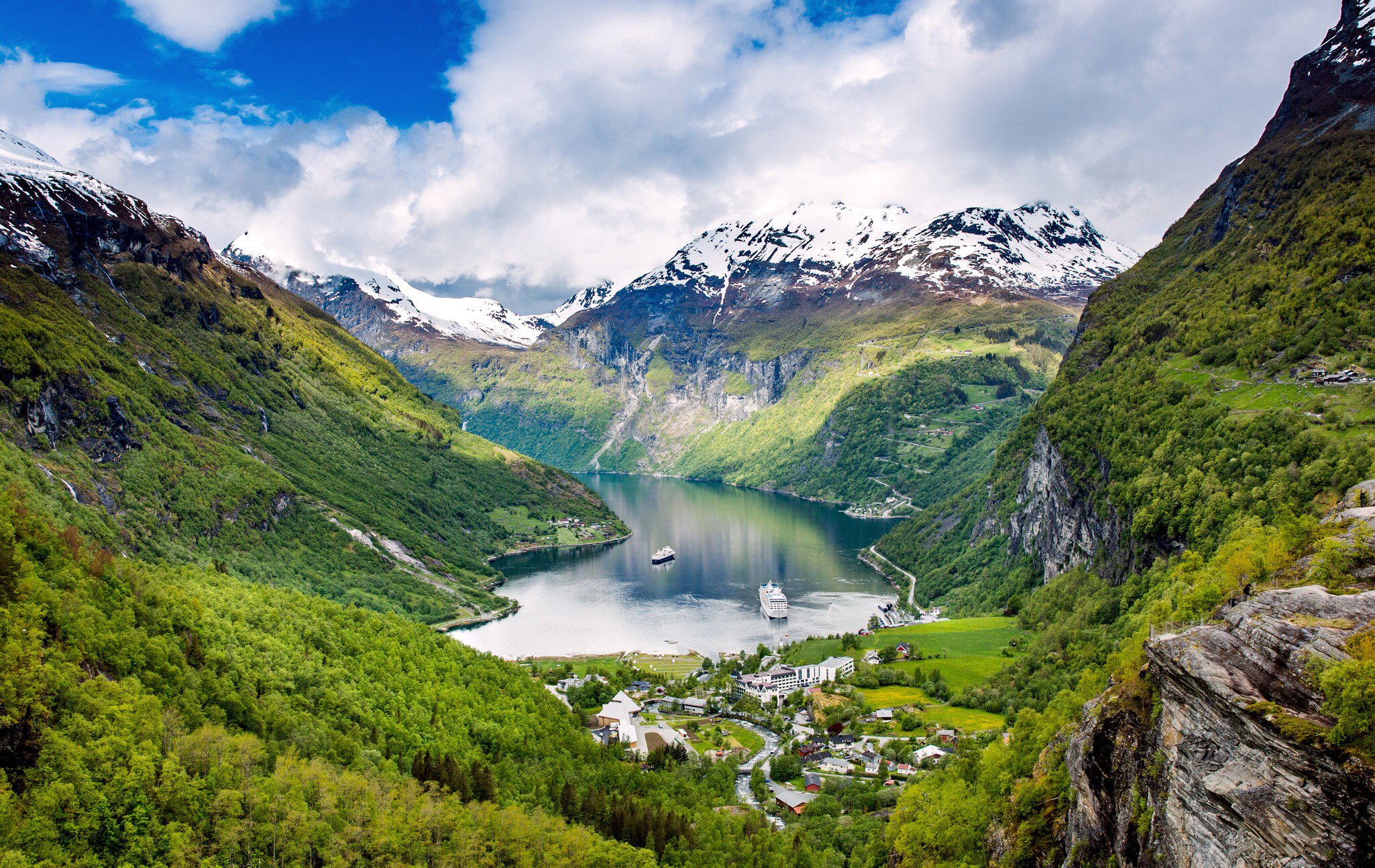
You may want to break up the trip with shore excursions, especially if you’re travelling the entire route. The possibilities, which are organised by the shipping company, include the following (northbound/southbound excursions are denoted by N/S): an overland tour between Geiranger and Ålesund or Molde (N; three or seven hours); a short tour of Trondheim (S; two hours); a day trip to Svartisen (N; six hours); spins around Lofoten (S; three hours) and Vesterålen (S; four hours); a haul from Honningsvåg up to Nordkapp (N; four hours); an overland tour between Honningsvåg and Hammerfest, via Nordkapp (S; seven hours); and a tour from Kirkenes, at the end of the route, to the Russian border (two hours). These offer fairly good value (contact the operators for prices) but, in some cases, you’ll miss segments of the coastal scenery.
The Hurtigruten website carries a full list of international sales agents. You can also purchase tickets through Fjord Tours (81 56 82 22; www.fjordtours.no).
Hitching
Hitching isn’t entirely safe and we don’t recommend it. Travellers who decide to hitch should understand they’re taking a potentially serious risk. People who choose to hitch will be safer if they travel in pairs and let someone know where they’re planning to go.
If you’re determined to hitch, you’ll find Norwegians generally friendly, and they understand that not all foreigners enjoy an expense-account budget or earn Norwegian salaries. Your chances of success are better on main highways, but you still may wait for hours in bad weather. One good approach is to ask for rides from truck drivers at ferry terminals and petrol stations; that way, you’ll normally have a place to keep warm and dry while you wait.
Car & motorcycle
Fuel
Leaded and unleaded petrol and diesel are available at most petrol stations. Although prices fluctuate in keeping with international oil prices, prevailing prices at the time of research ranged from Nkr10.90 per litre up to Nkr11.90. Diesel usually costs around Nkr1 per litre less. Credit cards are accepted at most places. In towns, petrol stations may be open until 10pm or midnight, but there are some 24-hour services. In rural areas, many stations close in the early evening and don’t open at all on weekends. Some have 24-hour automatic pumps operated with credit cards.
Hire
Norwegian car hire is costly and geared mainly to the business traveller. Walk-in rates for a compact car with 200km free start are typically over Nkr1000 per day (including VAT, but insurance starts at Nkr60 per day extra).
You’ll get a better daily rate the longer you rent. In summer, always ask about special offers, as you may be able to get the smallest car (eg VW Polo) for a three- to five-day period for Nkr500 per day with 50km free, or Nkr600 per day with 200km free; each extra kilometre costs Nkr2.50, which quickly adds up.
Some major rental agencies also offer weekend rates, which allow you to pick up a car after noon on Friday and keep it until 10am on Monday for around Nkr1200 – be sure it includes unlimited kilometres.
All major firms, such as Hertz, Avis, Budget and Europcar, have desks at many airports around the country and some city centres. Any speed-camera tickets are auto-matically paid through your credit card; always scrutinise your credit-card statements for months afterwards.
In general, local companies will offer better deals than larger international firms, although their offers aren’t always as good.
The following is a partial list:
Avis (81 56 30 44; www.avis.no in Norwegian)
Bislet Bilutleie (22 60 00 00; www.bislet.no)
Budget (81 56 06 00; www.budget.no in Norwegian)
Europcar (22 83 12 42; www.europcar.no in Norwegian)
Hertz (67 16 80 00; www.hertz.no)
Rent-a-Wreck (81 52 20 50; www.rent-a-wreck.no)
If you’ll be using the car for a while, you should seriously consider hiring your car in Sweden and either return it there afterwards, or negotiate a slightly more expensive one-way deal. One of the best online rental agencies is Auto Europe (www.autoeurope.com), which acts as a clearing house for cheap rates from major companies and offers a host of pick-up and drop-off options in Norway and across Europe.
Vehicle ferries
While travelling along the scenic but mountainous and fjord-studded west coast may be spectacular, it also requires numerous ferry crossings that can prove time-consuming and costly. For a complete list of ferry schedules and fares, get hold of the Nkr225 Rutebok for Norge, a phone book–sized transport guide sold in bookshops and larger Narvesen kiosks. Otherwise, order directly from Norsk Reiseinformasjon (22 47 73 40; www.reiseinfo.no; Karl Johans gate 12A, 0154 Oslo), or download it at www.rutebok.no.
Bus & tram
Bus
Buses on Norway’s extensive long-distance bus network are comfortable and make a habit of running on time.
Nor-Way Bussekspress (82 02 13 00; www.nor-way.no) operates the largest network of express buses in Norway, with routes connecting most towns and cities, from Mandal in the far south to Alta in the far north. There are also a number of independent long-distance companies that provide similar prices and levels of service.
Considerably cheaper are buses operated by Lavprisekspressen (67 98 04 80; www.lavprisekspressen.no in Norwegian), which sells tickets over the internet. At the time of writing, it only operates along routes from Oslo to Bergen, Trondheim and Kristiansand, but let’s hope that the number of routes expands and that the competition drives down the prices of other companies. In the meantime, Oslo to Bergen costs as little as Nkr149 with Lavprisekspressen; the cheapest fare with Nor-Way Bussekspress is Nkr700.
In northern Norway, there are several Togbuss (train-bus) routes, while elsewhere there’s also a host of local buses, most of which are confined to a single fylke (county). Most local and even some long-distance bus schedules are drastically reduced everywhere in Norway on Saturday, Sunday and in the low (usually mid-August to mid-June).
To get a complete listing of bus timetables (and some prices) throughout the country, pick up a copy of the free Rutehefte from any reasonably sized bus station and some tourist offices. All bus stations and tourist offices have smaller timetables for the relevant routes passing through town.
Costs & reservations
Advance reservations are almost never required in Norway and Nor-Way Bussekspress even has a ‘Seat Guarantee – No Reservation’ belief in its ability to get you where you want to go at the time of your choosing. That said, you’re more likely to find cheaper fares the further in advance you book.
Buying tickets over the internet is usually the best way to get the cheapest fare. Tickets are also sold on most buses or in advance at the bus station, and fares are based on the distance travelled, averaging around Nkr165 for the first 100km. Some bus companies quote bus fares excluding any ferry costs so always check.
Many bus companies offer student, child, senior and family discounts of 25% to 50%, so it pays to inquire when purchasing. Groups (including two people travelling together) may also be eligible for discounts. In northern Norway, holders of Inter-Rail and Eurail passes are also often eligible for discounts on some routes.
In summer, special minipris tickets are frequently offered for some of the more popular long-distance services if you book early.
Bus
Nearly every town in Norway supports a network of local buses, which circulate around the town centre and also connect it with outlying areas. In many smaller towns, the local bus terminal is adjacent to the train station, ferry quay and/or long-distance bus terminal. Fares range from Nkr16 to Nkr25 per ride. Day- or multitrip tickets are also available.
Train
Norwegian State Railways (Norges Statsbaner; NSB; 81 50 08 88; www.nsb.no) operates an excellent, though limited, system of lines connecting Oslo with Stavanger, Bergen, Åndalsnes, Trondheim, Fauske and Bodø; lines also connect Sweden with Oslo, Trondheim and Narvik. Most train stations offer luggage lockers for Nkr20 to Nkr50 and many also have baggage storage rooms.
Most long-distance day trains have 1st- and 2nd-class seats and a buffet car or refreshment trolley service. Public phones can be found in all express trains and most Inter-City trains. Doors are wide and there’s space for bulky luggage, such as backpacks or skis.
Reservations cost an additional Nkr35 and are mandatory on a number of long-distance routes, including between Oslo and Bergen.
Classes & costs
On long-distance trains, 2nd-class carriages provide comfortable reclining seats with footrests. First-class carriages, which cost 50% more, offer marginally more space and often a food trolley, but they’re generally not worth the extra expense.
Travelling by train in Norway is (like everything else) expensive. Indeed, the fact that it often costs less to fly than it does to catch a train puts a serious dint in Norway’s otherwise impressive environmental credentials. However, if you learn how to work the minipris system, or the train passes, train travel suddenly becomes affordable. And think of the scenery...
There’s a 50% discount on rail travel for people aged 67 and older and for children under 16. Children under four travel free. Students get a 60/40% discount on departures marked green/white in timetables.
Second-class sleepers offer a good, cheap sleep: a bed in a three-berth cabin costs Nkr135; two-berth cabins cost Nkr240/295 per person in old/new carriages.
Tours
Norway has some outstanding local tours that enable you to make the most of limited time and which save the hassle of having to arrange your own transport. In every tourist office you’ll find an exhaustive collection of leaflets, folders and brochures outlining their offerings in the immediate area.
Norway in a Nutshell
An extremely popular option is the almost legendary, year-round ‘Norway in a Nutshell’ tour, organised through travel agencies, NSB rail services and tourist offices around southern and western Norway. To find out more, contact Fjord Tours (81 56 82 22; www.fjordtours.no). Itineraries vary, but most involve a one- or two-day excursion taking in the rail line between Bergen or Oslo and Myrdal, the Flåmsbana line to Flåm, a cruise along Nærøyfjord to Gudvangen, a bus to Voss, and then rail trips to Bergen or to Oslo on the overnight train. The full tour from Oslo to Bergen costs Nkr1165/1896 one-way/return. The cheaper (and shorter) options from Bergen/Voss cost Nkr820/530.
Other tours
Fjord Tours also organises a number of other, similar self-guided tours around southern and western Norway. These include: Lysefjord & Norway in a nutshell (from Oslo to Stavanger with a ‘Norway in a Nutshell’ itinerary en route); Geiranger & Norway in a Nutshell ; Hardanger in a Nutshell (round trip to/from Bergen via Voss, Ulvik, Eidfjord and Norheimsund); and a host of other one- to five-day tours, some of which include the Hurtigruten Coastal Ferry. Each of these tours can, like ‘Norway in a Nutshell’, be taken in whole or in part. Full details are available on the Fjord Tours website or from most larger tourist offices.
Other companies that offer fjord tours include Norway Fjord Cruise (57 65 69 99; www.fjordcruise.no) whose offerings include Lofoten and Sognefjord, and Fjord1 (55 90 70 70; www.fjord1.no/fylkesbaatane), which runs a range of tours and ferries.
Den norske turistforening
Den Norske Turistforening (DNT; Norwegian Mountain Touring Club; 22 82 28 22; www.turistforeningen.no; Storgata 3) organises hundreds of year-round adventure trips in the Norwegian mountains, including cycling, fishing, hiking, skiing, glacier hiking, rock and ice-climbing, family activities, hut-to-hut trekking, Svalbard tours, and so on. Information on the tours is available on the DNT website, or you can pick up the brochure Norwegian Summer from any DNT office.
Air
Airlines in Norway
Norway has nearly 50 airports with scheduled commercial flights, from Kristiansand in the south to Longyearbyen and Ny Ålesund (Svalbard) in the north. For a full list visit www.avinor.no. Due to the time and distances involved in overland travel, even budget travellers may want to consider a segment or two by air.
The five airlines operating on domestic routes:
Coast Air (52 84 85 00; www.coastair.no)
Danish Air Transport (57 74 67 00; www.dat.dk)
Norwegian (81 52 18 15; www.norwegian.no)
SAS Braathens (91 50 54 00; www.sasbraathens.no)
Widerøe (81 00 12 00; www.wideroe.no)
The major Norwegian domestic routes are quite competitive, meaning that it is possible (if you’re flexible about departure dates and book early) to travel with SAS Braathens from Oslo to Bergen (from Nkr461), Ålesund (from Nkr380), Stavanger (from Nkr380), Tromsø (from Nkr547) and Trondheim (from Nkr461) for little more than the equivalent train fare. That said, fares vary widely – for example, on the Bergen–Oslo route, you could pay anywhere from Nkr461 to Nkr1724.
Although their coverage is not quite as extensive, both Widerøe (a subsidiary of SAS) and Norwegian usually offer cheaper fares (eg Oslo–Bergen with Norwegian starts at Nkr320, while the cheapest fare we found with Widerøe was Nkr361). Coast Air, based in Haugesund, flies small planes and has a much smaller network, which includes Haugesund–Bergen (from Nkr399), Haugesund–Sandefjord (from Nkr490) and Oslo–Røros (Nkr499).
Danish Air Transport has flights to Florø from Bergen and Oslo; one-way fares start at Nkr353.
Bicycle
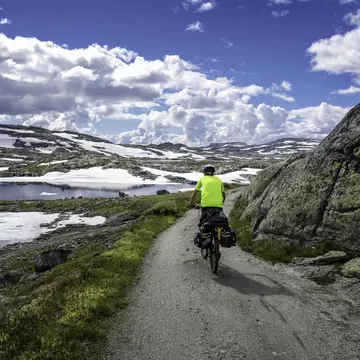
Given Norway’s great distances, hilly terrain and narrow roads, only serious cyclists engage in extensive cycle touring, but those who do rave about the experience. Assuming you’ve steeled yourself for the challenge of ascending mountain after mountain, the long-distance cyclist’s biggest headache will be tunnels, and there are thousands of them. Most of these, especially in the Western Fjords, are closed to nonmotorised traffic; in many (although not all) cases there are outdoor bike paths running parallel to the tunnels. If no such path exists, alternative routes may involve a few days’ pedalling around a long fjord or over a high mountain pass.
Rural buses, express ferries and nonexpress trains carry bikes for various additional fees (around Nkr100), but express trains don’t allow them at all and international trains treat them as excess baggage (Nkr250). Nor-Way Bussekspress charges half the adult fare to transport a bicycle!
The Norwegian government takes cycling seriously enough to have developed an official Cycling Strategy (www.sykkelby.no), among the primary goals of which are to increase cycling in larger Norwegian cities.
Hire
Although there are few dedicated bicycle hire places outside larger towns, most tourist offices and many hostels and camping grounds rent out bicycles. Bicycle shops are another good place to ask. Rental usually starts at around Nkr50 for an hour and is rarely more than Nkr250 per day, although prices drop if you rent for a few days.
Norway
Things to do
- All things to do (1,150)
- Activities (187)
- Entertainment (140)
- Restaurants (308)
- Shopping (56)
- Sights (444)
- Tours (15)