Things to do in Namibia
-
Etosha National Park
The 20,000 sq km (7722 sq mi) Etosha National Park is one of the world's greatest wildlife-viewing spots. For a few days each year, this immense, flat, saline desert is converted by the rains into a shallow lagoon teeming with flamingos and white pelicans. However, it's the surrounding bush and grasslands that provide habitat for Etosha's diverse wildlife.
It may look barren, but the landscape surrounding the pan is home to 114 mammal species as well as 340 bird species, 16 reptiles and amphibians, one fish species and countless insects.
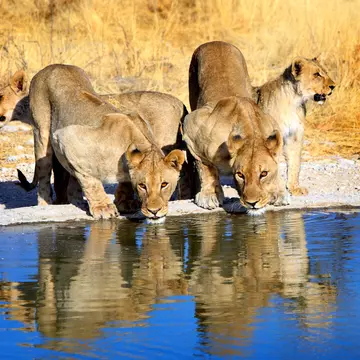
The best way to see Etosha's animals is to hire a vehicle, park near a waterhole and wait for the lions, elephants and springboks to…
reviewed
-
Joe's Beer House
Similar to Carnivore's in Nairobi, Joe's Beer House is a popular tourist spot where you can indulge in a game-meat-oriented evening meal (such as oryx, kudu, springbok, crocodile, zebra, eland) - with prolonged drinking until early in the morning. Sure, it's touristy, but there's a lot of fun to be had here, especially on a warm evening when you can kick back a few cold ones underneath a faux African hut. Reservations are recommended.
reviewed
-
Fish River Canyon
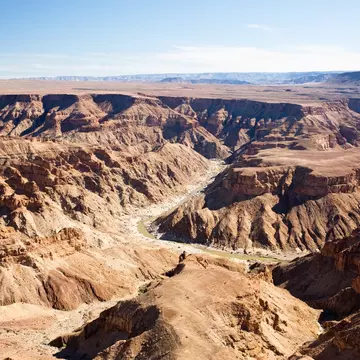
There's nowhere else in Africa like Fish River Canyon, which has been gouging this gorge for thousands of years with incredible results. It's huge - 160km (99mi) long and 27km (17mi) wide - and most of the canyon falls within Fish River Canyon National Park, where you can camp, walk, hike or relax in the bubbling hot springs.
At the northern end of the national park, there's the Hobas Information Centre, picnic sites, camp grounds, walking trails, and access to some of the best viewpoints in the canyon.
From Hobas, you can walk the five-day Fish River Hiking Trail to Ai-Ais, at the other end of the canyon. The 85km (53mi) walk follows the sandy bed of the river (it should…
reviewed
-
Fish River Canyon
The NWR Administers The Main Access Points To Fish River Canyon, which is entered at Hobas, near the Northern end of the park, or at Ai-Ais, near the Southern end. All accommodation must be booked in advance through the Windhoek office. Daily park permits, which cost around US$3 per person and around US$3 per vehicle, are valid for both Hobas and Ai-Ais.
Note that following the death of an ill-prepared hiker in 2001, Namibia Wildlife Resorts (NWR) decided to prohibit day hikes into Fish River Canyon, despite the fact that over the years, thousands of people have done it without incident. During the cooler weather, however, you may be able to get special permission at…
reviewed
-
A
Homestead
Arguably Windhoek's best restaurant, Homestead features a range of starters, salads, pasta, vegetarian dishes, fresh fish, beef and chicken dishes, as well as oryx, crocodile, fondues and a hunters' grill featuring zebra. The herbs and vegetables come from the restaurant's own garden and it's all served up in a pleasant outdoor setting. There's also an extensive selection of wines, liqueurs and cigars.
reviewed
-
Katutura
Unlike its South African counterparts, the township of Katutura is relatively safe by day if you stick to the northern areas and/or find a local who can act as a guide. An especially interesting spot is the informal Soweto Market, where traders sell just about anything imaginable. A shared taxi from the Wernhill Park Centre to Katutura costs around US$1 per person.
reviewed
-
B
La Marmite
Here you can sample wonderful North and West African cuisine, including Algerian, Senegalese, Ivorian, Cameroonian and Nigerian dishes. This excellent restaurant deserves its popularity - bookings are advisable.
reviewed
-
Napolitana
This quaint and romantic Italian bistro specialises in gourmet pizzas and pasta, as well as heartier meat and seafood dishes. If you're feeling lazy, ring them up and they'll deliver right to your door.
reviewed
-
Swakopmund Brauhaus
This excellent restaurant and boutique brewery offers one of Swakopmund's most sought-after commodities (traditional German-style beer) as well as excellently prepared beef and seafood.
reviewed
-
Lighthouse Pub & Cafe
With a view of the beach and crashing surf, the Lighthouse Pub & Cafe is an atmospheric choice that serves up good-value seafood including kabeljou, calamari, kingklip and lobster.
reviewed
Advertisement
-
O Portuga
The best place in town for genuine Portuguese and Angolan dishes, including numerous seafood options. There is also a good selection of wines.
reviewed
-
Daan Viljoen Game Park
The beautiful Daan Viljoen Game Park sits in the Khomas Hochland about 18km west of Windhoek. Because there are no seriously dangerous animals, you can walk to your heart's content through lovely wildlife-rich desert hills, and spot gemsboks, kudus, mountain zebras, springboks, hartebeests, warthogs and elands.
Daan Viljoen is also known for its birdlife, and over 200 species have been recorded, including the rare green-backed heron and pin-tailed whydah - if you're serious about birding, the park office sells a handy identification booklet. Daan Viljoen's hills are covered with open thorn-scrub vegetation that allows excellent wildlife viewing, and three walking tracks…
reviewed
-
Hot Springs
Ai-Ais is Nama for 'Scalding Hot' and these springs are beneath the towering peaks at the southern end of Fish River Canyon National Park. Although the 60°C springs have probably been known to the San for thousands of years, the legend goes that they were 'discovered' by a nomadic Nama shepherd rounding up stray sheep. They're rich in chloride, fluoride and sulphur, and are reputedly therapeutic for sufferers of rheumatism or nervous disorders.
The hot water is piped to a series of baths and jacuzzis as well as an outdoor swimming pool. A pleasant diversion is the short scramble to the peak which rises above the opposite bank (note that the trail isn't marked). It…
reviewed
-
Fish River Hiking Trail
The five-day hike from Hobas to Ai-Ais is Namibia's most popular long-distance walk - and with good reason. The magical 85km route, which follows the sandy riverbed past a series of ephemeral pools (in March and April the river actually does flow), begins at Hikers' Viewpoint, and ends at the hot spring resort of Ai-Ais.
Due to flash flooding and heat in the summer months, the route is open only from 1 May to 30 September. Groups of three to 40 people may begin the hike every day of the season, though you will have to book in advance as the trail is extremely popular.
Reservations can be made at the Namibia Wildlife Resorts (NWR) office in Windhoek Officials sometimes…
reviewed
-
Desert Explorers Adventure Centre
After aspiring for years to become a dry version of Victoria Falls, Swakopmund is one of the top destinations in Southern Africa for extreme sports enthusiasts. Although filling your days with adrenaline-soaked activities is certainly not cheap, there are few places in the world where you can climb up, race down and soar over towering sand dunes.
Your one-stop booking agent for just about every breathtaking activity you'd like to pursue is the Desert Explorers Adventure Centre . Here you can organise sandboarding, ecologically sensitive quadbiking, tandem skydiving, dolphin cruising, deep-sea fishing, hot-air ballooning, dune parasailing, descending on the flying-fox…
reviewed
-
Löwenfish Hiking Trail
From April to October there's also this wonderful five-day, 85km hike. This hike takes in the Löwen Canyon and several days along Fish River Canyon, interrupted by several ascents to the plateau and descents down scenic cliffs. Camp sites (with no facilities) are situated at water sources along the way and the last night you can stay at the Koelkrans Camp with cooking facilities and hot showers. On the last day, hikers climb out of the canyon for the last time and follow a scenic route back to the lodge. Stages of the trip may be done as one- to four-day hikes. Note that prebooking is essential.
To reach the guest farm, head west from Keetmanshoop and turn south on the…
reviewed
-
C
Tintenpalast
The road east from Alte Feste leads to the Tintenpalast, now the parliament building, which was designed by Gottlieb Redecker and built in 1913 as the administrative headquarters for German South-West Africa. The name means 'Ink Palace', in honour of all the ink spent on the typically excessive government paperwork it generated. It has also served as the nerve centre for all subsequent governments, including the present one.
The building is remarkable mainly for its construction from indigenous materials. The surrounding gardens were laid out in the 1930s, and include an olive grove and a bowling green. In front, have a look at Namibia's first post-independence monument,…
reviewed
-
Goerke Haus
Lieutenant Hans Goerke came to Swakopmund with the Schutztruppe in 1904, though he was later posted to Lüderitz, where he served as a diamond company manager. His home, designed by architect Otto Ertl and constructed in 1910 on Diamond Hill, was one of the town's most extravagant.
Goerke left for Germany in 1912 and eight years later his home was purchased by the newly formed Consolidated Diamond Mines (CDM) to house the company's chief engineer. When the CDM headquarters transferred to Oranjemund in 1944, the house was sold to the government and became occupied by the resident Lüderitz magistrate. In 1981, however, the magistrate was shifted to Keetmanshoop, and the…
reviewed
-
Woermannhaus
From the shore, the delightful German-style Woermannhaus stands out above surrounding buildings - you'd be forgiven for assuming it's the town hall. In fact, it was designed by Friedrich Höft, and built in 1905 as the main offices of the Damara & Namaqua Trading Company. In 1909 however, it was taken over by the Woermann & Brock Trading Company, which supplied the current name. In the 1920s, it was used as a school dormitory, and later served as a merchant sailors' hostel.
It eventually fell into disrepair, but was declared a national monument and restored in 1976. For years, the prominent Damara tower (formerly a water tower) of the Woermannhaus provided a landmark for…
reviewed
-
Swakopmund Museum
When ill winds blow, head for the Swakopmund Museum , at the foot of the lighthouse, where you can hole up and learn about the town history. The museum occupies the site of the old harbour warehouse, which was destroyed in 1914 by a 'lucky' shot from a British warship.
Displays include exhibits on Namibia's history and ethnology, including information on local flora and fauna. Especially good is the display on the !nara melon, a fruit which was vital to the early Khoikhoi people of the Namib region. It also harbours a reconstructed colonial home interior, Emil Kiewittand's apothecary shop and an informative display on the Rössing Mine. Military buffs will appreciate the…
reviewed
Advertisement
-
Jetty
In 1905, the need for a good cargo- and passenger-landing site led Swakopmund's founders to construct the original wooden pier. Over the years, however, it was battered by the high seas and damaged by woodworm, and in 1911, construction began on a 500m iron jetty .
When the South African forces occupied Swakopmund, the port became redundant (they already controlled Walvis Bay), so the old wooden pier was removed in 1916 and the unfinished iron pier was left to the elements. In 1985 it was closed for safety purposes, but a year later, a public appeal raised 250,000 rand to restore the structure. It's now open to the general public, but unfortunately once again suffering…
reviewed
-
D
Zoo Park
The centrepiece of Zoo Park, a former zoo turned park, is a column designed by Namibian sculptor Dörthe Berner, which commemorates a Stone Age elephant hunt that occurred here some 5000 years ago. In 1962 the remains of two elephants and several quartz tools used to cut up the carcasses were unearthed. The fossils and tools were displayed in situ under glass, but in 1990 they were transferred to the State Museum.
The rather anachronistic Kriegerdenkmal (War Memorial), topped by a golden imperial eagle, was dedicated in 1987 to the memory of the Schutztruppe soldiers who died fighting the troops of Nama leader Hendrik Witbooi in the Nama wars of 1893-94.
reviewed
-
Southern Africa Explorer
21 days (Cape Town)
A classic overland journey through South Africa, Namibia, Botswana and Zimbabwe.
Not LP reviewed
from USD$2,690 -
African Wilderness in Comfort
21 days (Cape Town)
A diverse accommodated overland traverse through South Africa, Namibia, Botswana and Zimbabwe (Victoria Falls).
Not LP reviewed
from USD$4,190 -
Dunes, Deltas & Falls
21 days (Cape Town to Livingstone)
by G Adventures
If you want to soak up the colours, culture and scenery of this incredible region, this is the ultimate expedition to southwestern Africa. Experience game…Not LP reviewed
from USD$2,399