Things to do in Lebanon
-
Baalbek Ruins
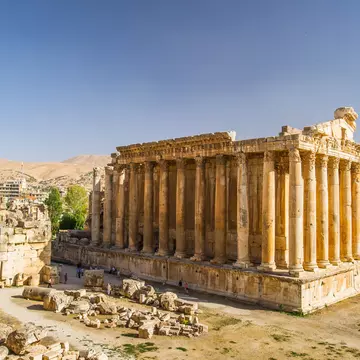
The site houses the hexagonal court, a monumental propylaea, the hexagonal court, the Great Court (Sacrificial Courtyard, the Temple of Jupiter, the Temple of Bacchus and a free museum. A good free map of the site, entitled Heliopolis Baalbek 1898-1998: Rediscovering the Ruins is produced by the German Archaeological Institute and is available all over town.
ATerrific multilingual guides can be found (or will find you) around the ticket office. The entrance to the main site is currently at the southeastern end of the temple complex. Note that at the time of writing, a new entrance to the museum complex was planned and under execution: the new entrance, when finally…
reviewed
-
Al-Bass site
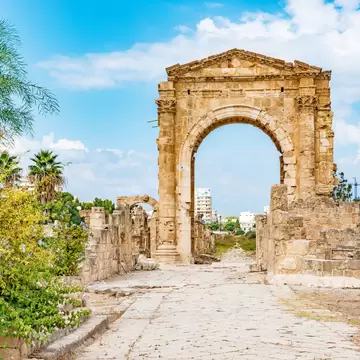
Al-Bass site On the landward side of Tyre, about 20 minutes on foot from the other sites, is the enormous Al-Bass Archaeological site. A colonnaded east-west road, possibly a continuation of the road at Al-Mina site, takes you through a vast funerary complex containing dozens of highly decorated marble and stone sarcophagi.
The more elaborate have reliefs depicting scenes from Greek mythology and Homeric epics. Most are from the 2nd and 3rd century AD, but some date back as far as the 2nd century BC, and there are Byzantine coffins from as late as the 6th century.A huge, triple-bay monumental archway stands further along the colonnaded street. Originally the gateway to…
reviewed
-
Jeita Grotto
This grotto, with its extraordinary stalactites and stalagmites, is definitely worth a visit; the ticket includes a boat ride through part of the grotto, an informative film about the history of the caves, and access to a cafe and restaurant. The vast honeycomb of galleries and ravines was first surveyed in the 19th century and opened to the public in 1958.
reviewed
-
A
Abdel Wahab el-Inglizi
Set in a nice old Ottoman house, this place is a favourite with locals for its table-bending buffets. It is a great choice if you're hungry for high quality mezze and are a particular fan of hummus, of which there's numerous varieties - it won't leave you much room for dessert.
reviewed
-
B
Al-Balad
This place offers the tastiest, best-value Lebanese mezze in Downtown, and is especially popular with lunching business people. The spicy red hummus, in particular, is well worth a dip.
reviewed
-
Sheikh Abdullah Hill Quarry
Stopping off to see the world's largest cut stone at the quarry on Sheikh Abdullah Hill, you'll undoubtedly hear the tale of Baalbek native Abdul Nabi Al-Afi, who saved it from life at the bottom of a rubbish dump. Measuring 21.5m by 4m by 4.5m, lying on its side, locals call this stone Hajar al-Hubla (Stone of the Pregnant Woman), and local folklore has it that women can touch the stone to increase their fertility.
Al-Afi, a retired army sergeant, single-handedly saved the site from obscurity, and his friendly young son, who runs the tiny gift shop at its edge, will be happy to provide information on his father's remarkable one-man litter-picking story.In case you're on…
reviewed
-
C
Souqs
The old covered souqs are the city's highlight, lying between the Sea Castle and the Castle of St Louis. This is where, in labyrinthine alleyways, shopkeepers ply their trades in workshops the same way they have done for centuries. Officially there are some 60 listed historic sites here, many of them in ruins, though renovation work is ongoing.
Scattered throughout the souqs are several coffeehouses and plenty of tiny canteens dishing out cheap, simple and tasty Arabic dishes; there are also a huge number of pastry shops where you can buy hot bread and biscuits. The delicious sanioura (a light crumbly biscuit) is a speciality of Sidon and the souqs are also famous for…
reviewed
-
Palm Islands Reserve
Six nautical miles north west of Tripoli lies the Palm Islands Reserve, which consists of three islands and covers a rough area of 5 sq km of land and sea. Declared a protected site by Unesco in 1992 and dedicated as a nature reserve in 1993, the islands are a haven for endangered loggerhead turtles, rabbits, rare monk seals and over 300 species of migratory birds that stop here to rest and nest. Of these, seven are considered threatened worldwide, while 11 are rare in Europe.
The largest of the islands, Nakheel (Palm Island), supports most of the turtles and contains some 2,500 palm trees, with paths laid out for visitors. There are beaches from which you can swim…
reviewed
-
Corniche
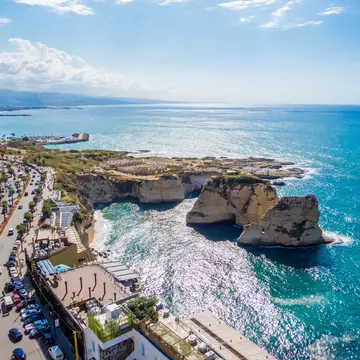
The Corniche is a favourite promenade spot. Families, couples and groups of dressed-up young people saunter along its length, stopping to greet friends or to have a coffee-and-nargileh break at one of the cafés along the route. While many locals say the Corniche starts at Ras Beirut on Ave de Paris in the east and ends at the St George Yacht Motor Club in Ain al-Mreisse to the west, others say it encompasses the entire waterfront area around to Pigeon Rocks to the south.
You'll see a great cross-section of Beiruti life on your walk, from backgammon-playing old men to teenagers dressed to impress, particularly on a Saturday night, when people bring their own plastic…
reviewed
-
D
Temple of Jupiter
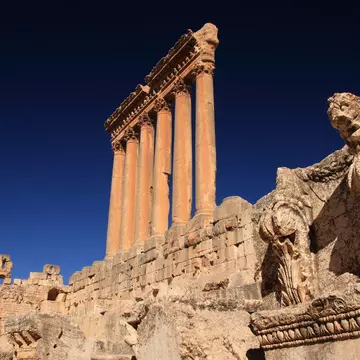
The Temple of Jupiter was built on an immense substructure over 90m long, and was approached by another monumental staircase that rose high above the surrounding buildings. It consisted of a cella in which the statue of the god was housed and a surrounding portico of 10 columns along the façade and 19 columns along the side, making for 54 columns in all. These columns are the largest in the world - 22.9m high with a girth of 2.2m.
Today only six of these remain standing with the architrave still in position. It was thought in the old days that Baalbek had been constructed by giants and a quick look over the side of the temple to the foundation stones beneath reveals some…
reviewed
Advertisement
-
E
Maghen Abraham synagogue
Tucked away to the north of the Grand Serail, between Rue France and Wadi Abou Jmil, are the remains of the once grand Maghen Abraham synagogue, which in the early 20th century served a thriving Jewish Beirut community. Though desperately in need of rebuilding, you can still make out the stars of David and Hebrew inscriptions adorning the synagogue's surviving walls.
This is not the only evidence of Lebanon's once open and active Jewish community. In Deir al-Qamar, the now disused synagogue remains intact; in Beirut and elsewhere there are several overgrown Jewish cemeteries. But today, most of Lebanon's Jews prefer to keep their religious identity closely guarded and no…
reviewed
-
F
Temple of Bacchus
Temple of Bacchus . This temple was in fact dedicated to Venus/Astarte, not Bacchus, and is the most beautifully decorated temple in the Roman world. Completed around AD 150, it is also in a great state of preservation. While it wasn't built on the scale of the Temple of Jupiter, it more than makes up for this with style and decoration.
Ironically it was called 'the small temple' in antiquity, although it is larger than the Parthenon in Athens. The entrance is up a flight of 30 stairs with three landings. It has a portico running around it with eight columns along the façade and 15 along the sides. They support a rich entablature; the frieze is decorated with lions and…
reviewed
-
G
Citadel of Raymond de Saint-Gilles
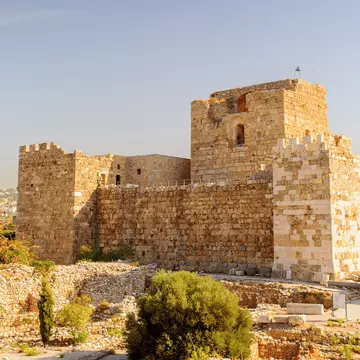
The city is dominated by the vast Citadel of Raymond de Saint-Gilles , known as Qala'at Sanjil in Arabic. In AD 1102 Raymond de Saint-Gilles occupied the hill which overlooks the valley, the town and the coast. He decided to transform this position, which he called Mont Pelerin (Mt Pilgrim), into a fortress. The original castle was burnt down in 1289, and again on several subsequent occasions.
It was rebuilt (1307-08) by Emir Essendemir Kurgi, and was added to right up until the 19th century. As a result, only the foundation stones remain of the original construction.The first entrance is a huge Ottoman gateway, over which is an engraving from Süleyman the Magnificent,…
reviewed
-
H
National Museum of Beirut
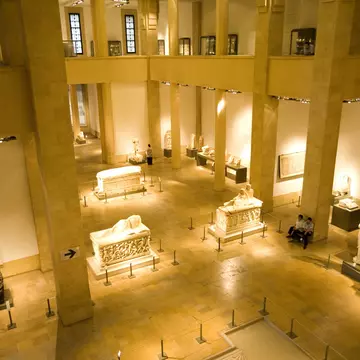
Once situated on a strategically important intersection of the former Green Line, the must-see National Museum of Beirut has an impressive collection of archaeological artefacts, statuettes and sarcophagi. Every hour, between 09:00 and 16:00, the museum screens 'Revival,' a fascinating short documentary on how staff saved the collection from the destruction of the civil war and subsequently restored the museum to its former glory.
The easiest way to get to the museum is to either take a 15-minute walk from Sodeco Square along Rue de Damas (part of the former Green Line), or hail a service taxi and ask for Musee or the Hippodrome.
Inside, the exhibits are organised from…
reviewed
-
I
Khan al-Franj
Khan al-Franj is the largest, most beautiful and best preserved of the many khans built by 17th century Fakhreddine, and was donated to the French by Fakhreddine to encourage trade relations. The khans all followed the same basic design, with a large rectangular central courtyard, fountain, covered arcades (used for stables and storage) and a galleried second storey providing accommodation for merchants and travellers.
In the 19th century, the Khan al-Franj was Sidon's principal khanand the city's centre of economic activity, also housing the French consul. Today, it has been painstakingly restored courtesy of the Hariri Foundation.
The activities of the foundation, many…
reviewed
-
Beiteddine Palace
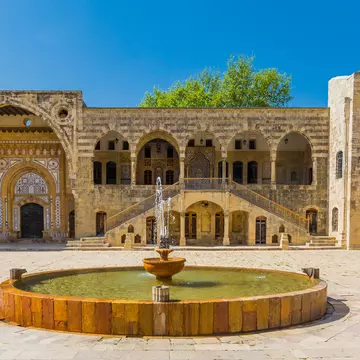
Beiteddine (House of Faith) is the name of both the village and the magnificent palace complex that lies within. The palace, perched on a steep elevation, rises from the surrounding landscape like a fairytale vision, a Scheherazadean delight rendered with Italianate flair (in fact, the architects were Italian).
Work began on the palace in 1788 but wasn't completed for another 30 years, during which time Emir Bashir, the Ottoman-appointed governor, oversaw the building of a monument that would reflect the power and glory of his reign.
Visitors to Beiteddine have to be grateful for the Ottoman's streak of egomania. The result is one of the finest remaining examples of…
reviewed
-
J
Sea Castle
Built by the Crusaders in 1228, the Sea Castle, connected to the mainland by a fortified Arab stone causeway, sits around 80m offshore on a small island that was formerly the site of a temple to Melkart, the Phoenician version of Hercules. One of many coastal castles built by the Crusaders, it was largely destroyed by the Mamluks to prevent the Crusaders from returning to the region, but its renovation was ordered by Fakhreddine in the 17th century.
The building consists of two towers joined together by a wall. The rectangular west tower, to the left of the entrance, is the best preserved, measuring 21m by 17m, and has a large vaulted room scattered with old carved…
reviewed
-
Cilicia Museum
The gorgeous collection of Armenian religious and cultural artefacts at the Cilicia Museum is one of Beirut's best-kept secrets. And secrets play a major role in the history of this museum, as most of the collection was smuggled out of what was known as Turkish Armenia in 1915, by monks from the Monastery of Sis in Cilicia.
Given just several days to flee the genocide by the Turks, the monks removed as much of their treasure as they could and began their dangerous overland journey, eventually arriving in Aleppo (Syria). In 1930 they finally settled in Antelias, just north of Beirut.To get to the museum, take the LCC bus 6, or any minibus going north to Jounieh and Byblos…
reviewed
-
Al-Mina excavations
In an impressive setting leading down to the ancient Egyptian (south) harbour, the Al-Mina excavations incorporate remains of Roman and Byzantine Tyre. Upon entering, a double line of columns to the right is thought to be part of the agora (market place). Further down is a long colonnaded road leading directly to what was the southern harbour. The marble sections of the pavement date back to the Roman era, while the black-and-white mosaic street is Byzantine.
To the right of the road, below a modern cemetery, are the remains of an unusual, rectangular arena, with five rows of terraced seating cut in to limestone. In the centre was a pool that may have been used for some…
reviewed
-
K
Great (Omari) Mosque
Facing the northern tip of the harbour is the Great (Omari) Mosque, said to be one of the best examples of 13th-century Islamic religious architecture. Originally a fortified Knights Hospitaller structure and converted to a mosque after the Crusaders were driven out of the Holy Land, it was heavily damaged during the civil war and underwent a lengthy restoration. The main prayer hall once housed the Church of St John of the Hospitallers and its original walls can still be seen.
There are two entrances to the mosque: one down a maze of covered streets in the souqs to the north of the mosque; the other on the eastern side of the building (once the site of a palace built by…
reviewed
Advertisement
-
L
American University of Beirut
The American University of Beirut is one of the Middle East's most prestigious educational institutes, and its campus and the surrounding Ras Beirut and Hamra areas are a hive of activity during semesters. The university is privately owned, nonsectarian and teaches all classes in English - hence the local students wandering around the Hamra district conversing in English as often as Arabic. Both the museum and the campus grounds are open to the public and are definitely worth a look.
Spread over 28 hectares, the beautiful, tree-shaded campus runs from Rue Bliss down to the sea and even has its own beach club for the summer months. But the stately charms of the campus did…
reviewed
-
M
Musée Du Savon
Although Tripoli may take credit for being the centre of the traditional soap-making industry, Sidon has Lebanon's first museum, courtesy of the Audi Foundation, dedicated to the craft. (The Audis is a wealthy family that is committed to the regeneration of the old city. The foundation frequently organises cultural events.)
Located in the Old City in the Khan al-Saboun, a 13th-century stone building adapted for use as a soap factory in the 19th century, it once produced soap to meet the needs of the hammams (bathhouses).The well laid-out galleries and trilingual (Arabic, English, French) explanations take you through the entire soap-making process - referred to in the…
reviewed
-
N
Castle of St Louis
The ruins of this once-impressive castle stand on a mound to the south of town. The present structure dates back to the Crusaders, who built on the site of an earlier Fatimid fortress - as reflected in the local name, Qala'at al-Muizz (Fortress of Al-Muizz) after the Fatimid caliph Al-Muizz li-Din Allah, who fortified the site. The English-French name comes from Louis IX, who rebuilt and then occupied the fortress when he retook Sidon from the Ayyubids in 1253.
After the Arabs retook the city it was restored, but it later suffered at the hands of the Mamluks. This, coupled with centuries of pilfering, has left the structure in poor condition.The hill on which the castle…
reviewed
-
O
Sursock Museum
Lit up at night, so that the full glory of its colourful stained glass is on show, the Sursock Museum is truly an extraordinary sight.
Owned by the Sursock family, one of the country's most illustrious dynasties, the extraordinary and magnificent Lebanese-Italian architectural style of the building itself often overshadows the temporary exhibitions. The location of the museum, in a wonderful street of luxurious modern apartment blocks and beautiful Ottoman- and French Mandate-era mansions, makes a walk around the neighbourhood mandatory. The interior of the museum is equally grand with vast marble floors and wood panelling. Some of the rooms are decorated in the oriental…
reviewed
-
P
Burj Es-Sabaa (Lion Tower)
The only monument of real interest in Al-Mina is the Lion Tower, a miniature fortress at the eastern end of the harbour. Named after the bas-relief lions that used to line the facade, the building dates from the end of the 15th century and was probably built by Mamluk sultan Qaitbey to protect the coastline against attack from the Ottomans.
It's an exceptional example of Mamluk military architecture, with a striking black-and-white striped portico. The whole of the ground floor is one vast chamber with traces of paintings and armorial carvings. The upper floor has eight rooms opening onto a central hall and the roof terrace has great views. Lion Tower is separated from…
reviewed