Sights in Laos
-
Buddhas
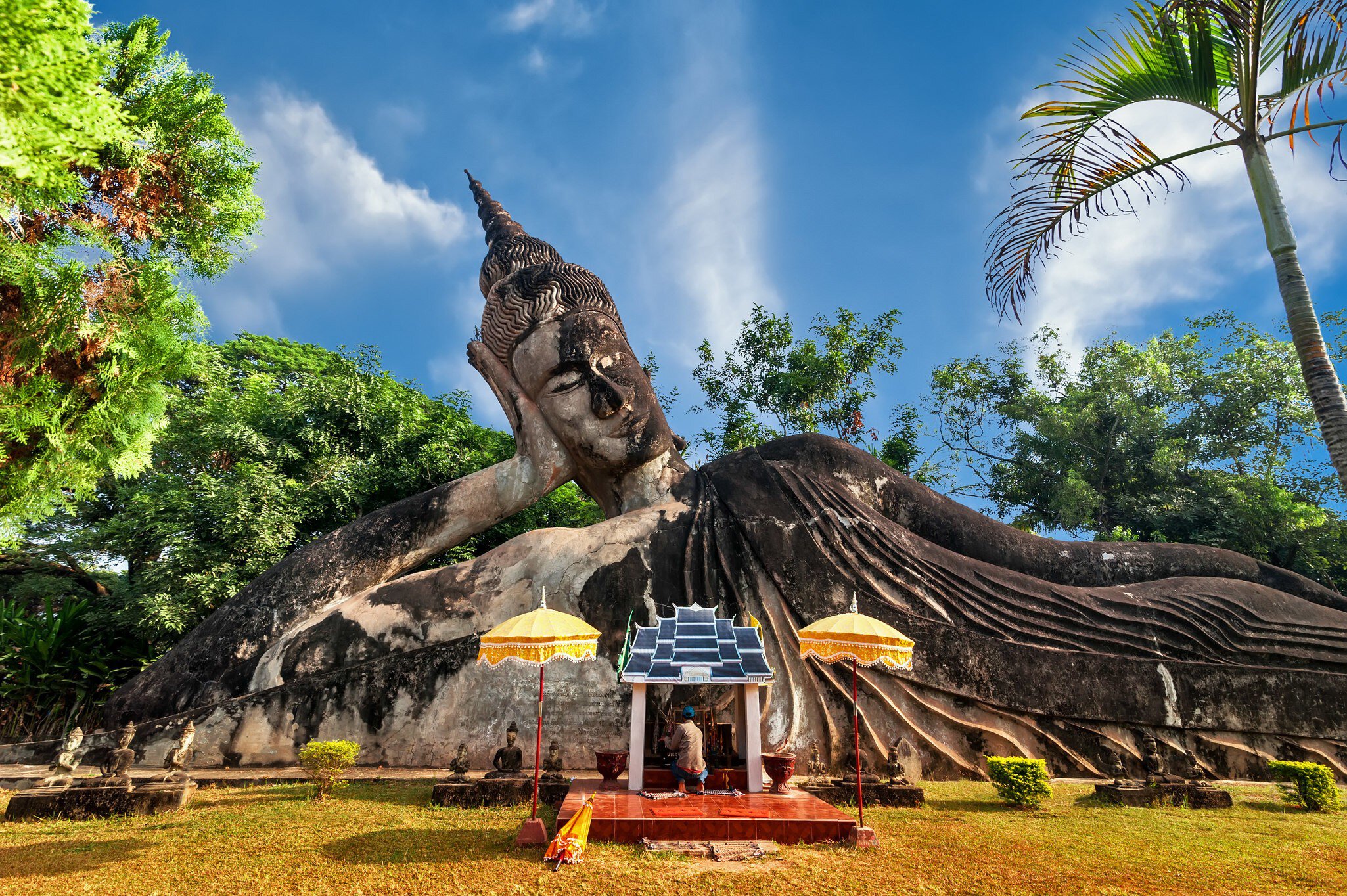
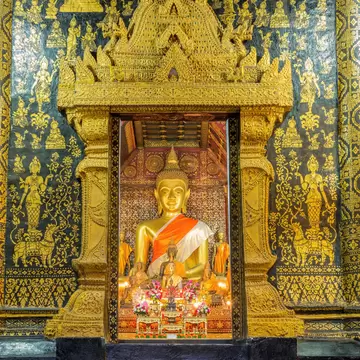
Along the western side of the cloister is a pile of Buddhas that were damaged during the 1828 Siamese-Lao war. And in the sǐm (ordination hall) a slightly damaged Khmer-style Naga Buddha - which depicts the Buddha seated on a coiled cobra deity (naga), sheltered by the naga's multiheaded hood - is also on display just in front of the main seated Buddha; it is believed to date from the 13th century and was brought from a nearby Khmer site.
The sǐm is surrounded by a colonnaded terrace in the Bangkok style and topped by a five-tiered roof. The interior walls bear hundreds of Buddha niches similar to those in the cloister, as well as beautiful - but decaying - Jataka…
reviewed
-
A
Patuxai
Reminiscent of the Arc de Triomphe in Paris, the Patuxai is Vientiane’s most prominent monument. The name is approximately equivalent to Arch ( pátųu, also translated as ‘door’ or ‘gate’) of Triumph ( xái, from the Sanskrit jaya or ‘victory’), but unlike its Parisian namesake the Patuxai boasts four, rather than two, archways. It was built in the 1960s with US-purchased cement that was supposed to have been used for the construction of a new airport. Hence it’s sometimes called ‘the vertical runway’.
reviewed
-
B
That Dam
Sitting at the centre of a quiet roundabout near the centre of Vientiane, legend has it that the stupa now known as That Dam was once coated in a layer of gold. The gold is said to have been carted off by the Siamese during their pillaging of 1828, after which the stupa took the ‘black’ sobriquet in memory of the dastardly act. However, another myth is slightly at odds with this. It says That Dam is the abode of a dormant seven-headed dragon that came to life during the 1828 Siamese–Lao war and protected local citizens, though apparently not the stupa’s gold…
reviewed
-
C
Wat Xieng Thong
Near the northern tip of the peninsula formed by the Mekong River and the Nam Khan is Luang Prabang’s most magnificent temple, Wat Xieng Thong. King Setthathirat ordered the construction of Wat Xieng Thong’s sǐm (ordination hall) in 1560, and the compound remained under royal patronage until 1975. Wat Xieng Thong was placed within easy reach of the Mekong. The hǎw tąi (Tripitaka library) was added in 1828, and the haw kąwng (drum tower) in 1961.
reviewed
-
D
Lao National Museum
With a limited collection of historical and revolutionary exhibits, the Lao National Museum will never be confused with the Louvre. But it does serve to sum up the country’s ongoing struggle to come to grips with its own identity, so it’s worth a look.
reviewed
-
E
Wat Ho Pha Bang
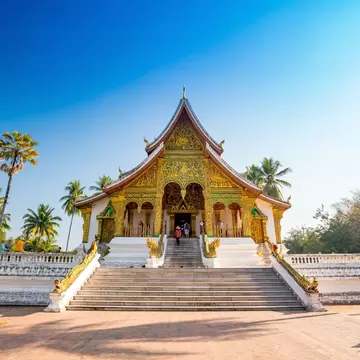
The Pha Bang is a 83cm tall Buddha cast of a gold, silver and bronze alloy, and is said to weigh 53.4kg. Legend has it the image was cast around the 1st century AD in Sri Lanka and later presented to Khmer King Phaya Sirichantha, who in turn gave it to King Fa Ngum in 1359 as a Buddhist legitimiser of Lao sovereignty. A project planned before the monarchy was abolished in 1975, construction on this highly ornate pavilion began in 1993.
Upon completion the highly revered Pha Bang will be moved from palace museum where it currently rsides, to an altar in the centre of the pavilion.
Since stylistically it's obviously of Khmer origin, its casting most likely took place nearer…
reviewed
-
Plain of Jars
The Plain of Jars is a large area extending around Phonsavan from the southwest to the northeast where huge jars of unknown origin are scattered about in over a dozen groupings. There are three main sites available to visit, with site 1 the closest and containing the most jars.
The purpose of these possibly 2000-year-old jars remains a mystery and without any organic material - such as bones or food remains - there is no reliable way to date them. Archaeological theories and local myth suggest the enigmatic jars were used for burial purposes.
The jars weigh as much as six tonnes (6.6 tons) and have been fashioned from solid stone, which doesn't seem to have come from the…
reviewed
-
Wat Phu Champasak
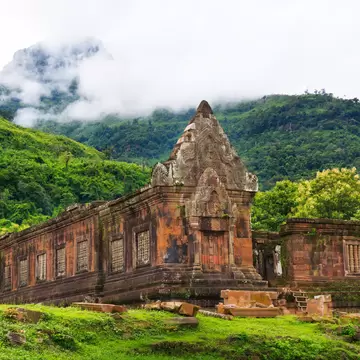
Spread over the lower slopes of Phu Pasak (also known more colloquially as Phu Khuai), Wat Phu is small compared with the monumental Angkor-era sites in Cambodia or Thailand. But the tumbledown pavilions, ornate shiva-lingam sanctuary, enigmatic crocodile stone and tall trees that shroud much of the site in soothing shade give Wat Phu a mystical atmosphere.
This town cranks it up every year when pilgrims from near and far amass for Bun Wat Phu Champasak. During this three-day Buddhist festival (usually held in February) worshippers wind their way up and around Wat Phu Champasak, praying and leaving offerings; bands play traditional and modern music; young and old dance…
reviewed
-
Wat Wisunarat
Originally built in 1513 during the reign of Chao Wisunarat (King Visoun), Wat Wisunarat is the oldest operating temple in Luang Prabang. It was rebuilt between 1896 and 1898 following an 1887 fire set by Black Flag Haw raiders. The original was wooden, and in the brick and stucco restoration the builders tried to make the balustraded windows of the sǐm appear to be fashioned of lathed wood (an old South Indian and Khmer contrivance that is uncommon in Lao architecture). The front roof that slopes sideways over the terrace is another unique feature. Inside the high-ceilinged sǐm is a collection of gilded wooden ‘Calling for Rain’ Buddhas and 15th- to 16th-century Luang…
reviewed
-
Khon Phapheng
South of Don Khong the Mekong River features a 13km stretch of powerful rapids with several sets of cascades. The largest, and by far the most awesome anywhere along the Mekong, is Khon Phapheng, near the eastern shore of the Mekong not far from Ban Thakho. Khon Phapheng isn’t as beautiful as the towering waterfalls of the Bolaven Plateau or the fairytale pools of Tat Kuang Si near Luang Prabang. But Khon Phapheng is pure, unrestrained aggression as millions of litres of water crash over the rocks and into Cambodia every second. Especially when the Mekong is at full flood this is a spectacular sight, and it’s probably the most visited site in Laos for Thai tourists, who…
reviewed
Advertisement
-
F
Wat Xieng Muan
The sǐm (ordination hall) at Wat Xieng Muan dates back to 1879, though the monastery site is much older. The sculpture inside is impressive and the ceiling is painted with gold nagas (mythical water serpents), an uncommon motif in this position - possibly a Thai Lü influence. Also notable is the elaborate háang thíen (candle rail) with nagas at either end.
Wat Xieng Maen, in the village of Xieng Maen, was founded in 1592 by Chao Naw Kaewkumman, son of Setthathirat, but it fell into ruin and had to be rebuilt in 1927. The newer sǐm contains a few artefacts dating from the original temple, including the original doors. This spot is especially sacred to Xieng Maen…
reviewed
-
Wat Tham Xieng Maen
Founded in 1889 and since abandoned, Wat Tham Xieng Maen is in a 100m-deep limestone cave called Tham Sakkarin Savannakuha, a little northwest of Wat Long Khun. Many Buddha images from temples that have been torched or otherwise fallen into decay are kept here; during Bun Pi Mai Lao many local worshippers come to Wat Tham to pay homage and cleanse the images. The large stone-block entrance built around the mouth of the cave displays good relief work on stair pedestals, and is flanked by two large ruined spirit houses and a couple of plumeria (frangipani) trees. An iron gate across the cave mouth is usually locked; inquire at Wat Long Khun and someone will come and unlock…
reviewed
-
G
Wat Pa Huak
The decaying sǐm at Wat Pa Huak - on the lower northern slope of Phu Si, near the Royal Palace Museum - has a splendid carved wood and mosaic façade showing Buddha riding Airavata, the three-headed elephant of Hindu mythology (in which he is usually depicted as Lord Indra's mount). The gilded and carved front doors are often locked, but during the day there's usually an attendant nearby who will open the doors for a tip of a couple of hundred kip.
Inside, the original 19th-century murals have excellent colour, considering the lack of any restoration. The murals show historic scenes along the Mekong River, including visits by Chinese diplomats and warriors arriving by…
reviewed
-
H
Wat Mai Suwannaphumaham
Inaugurated in 1821 (some sources claim 1797), Wat Mai succeeded Wat Aham as the residence of the Sangkharat until that position moved to Pha That Luang in Vientiane. The five-tiered roof of the wooden sǐm follows the standard Luang Prabang style, but the roofed front veranda, with its gables angled towards the sides of the chapel rather than towards the front, is an anomaly. This unusual plan may have been influenced by local vernacular architecture, as exemplified in the old wooden house just across the street from Wat Mai. The front veranda is also remarkable for its decorated columns and the sumptuous gold relief walls that recount the tale of Vessantara (Pha Wet in…
reviewed
-
I
Wat Long Khun
Wat Long Khun, almost directly across the Mekong River from Wat Xieng Thong, is the best place to disembark by boat for Xieng Maen explorations if you’re chartering a boat. This wat features a nicely decorated portico, vintage 1937, plus older sections from the 18th century and a few fading Jataka murals. When the coronation of a Luang Prabang king was pending, it was customary for him to spend three days in retreat at Wat Long Khun before ascending the throne. A restoration project, completed in 1995 by the Department of Museums and Archaeology, with the assistance of the Ecole Française d’Extrême Orient, has brought new life and beauty to the monastery buildings.
reviewed
-
Pha That Sikhottabong
About 6km south of town is the much-venerated Pha That Sikhottabong stupa which stands in the grounds of a 19th-century monastery of the same name. According to local lore the stupa was erected on the site of a 6th- to 10th-century thâat (Buddhist stupa or reliquary) built by King Nanthasen during a time when Tha Khaek was part of a principality called Si Khotabun. Considered one of the most important thâat in Laos, Sikhottabong was first renovated by King Setthathirat in the 16th century, when it assumed its current general form. It was again restored in the 1950s and later augmented in the 1970s. It’s the site of a major festival each February.
reviewed
-
That Ing Hang
Thought to have been built in the mid-16th century, this well-proportioned, 9m-high thâat is the second holiest religious edifice in southern Laos after Wat Phu Champasak. Built on or near the spot where Chao Fa Ngum’s forces were based during the takeover of Muang Sawa in the mid-14th century, That Ing Hang may occupy an earlier site sacred to the Si Khotabun kingdom. The Buddha is believed to have stopped here when he was sick during his wanderings back in ancient times. He rested by leaning (ing) on a hang tree (thus Ing Hang). A relic of the Buddha’s spine is reputed to be kept inside the thâat.
reviewed
-
J
That Chomsi
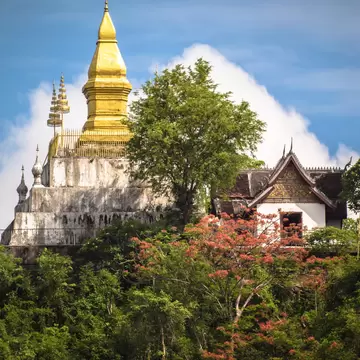
The 24m-high That Chomsi, erected in 1804 and restored in 1914, stands at the summit, clearly visible from most ground-level points in the city. This stupa is the starting point for a colourful Lao New Year procession in mid-April. If you continue over the summit and start down the path on the other side, you'll come to a small cave shrine (sometimes called Wat Tham Phu Si, although without monks it's not officially a wat).
Plopped down in the middle of the cave is a large, fat Buddha image - called Pha Kasai in Lao - and a sheltered area for worshippers. On a nearby crest is a Russian anti-aircraft cannon that children use as a makeshift merry-go-round.
reviewed
-
K
Pha That Luang
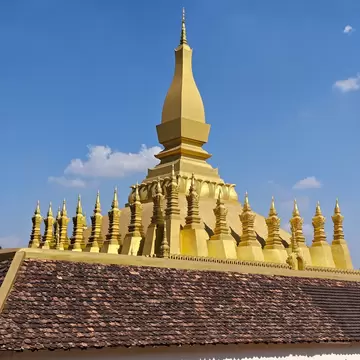
The most important national monument in Laos, Pha That Luang is a symbol of both the Buddhist religion and Lao sovereignty. Its full official name, Pha Chedi Lokajulamani, means World-Precious Sacred Stupa, and an image of the main stupa appears on the national seal and in countless other places. Legend has it that Ashokan missionaries from India erected a thâat or reliquary stupa here to enclose a piece of the Buddha’s breastbone as early as the 3rd century BC. Excavations have found no trace of this, but did find suggestion of a Khmer monastery that might have been built near here between the 11th and 13th centuries AD.
reviewed
-
Tham Xang
Famous for its stalagmite ‘elephant head’, which is found along a small passage behind the large golden Buddha; take a torch (flashlight). This cave has an unusually lively recent history. Before 1956 it was home to a limestone formation believed to resemble an evil monster’s head. Various taboos were observed to avoid upsetting the monster’s spirit, but when a wave of sickness hit the village in that year the locals decided the evil head had to go and promptly blew it to smithereens with dynamite. Soon after this the elephant’s head miraculously appeared and village health improved. It’s been revered ever since.
reviewed
Advertisement
-
L
Wat Sok Pa Luang
In a shaded, almost semi-rural setting that is entirely in keeping with its name ( wat paa means ‘forest temple’), Wat Sok Pa Luang is famous for its herbal saunas and expert massage. The masseurs are usually lay people who reside at the temple. After a relaxing sauna, you can take herbal tea on the veranda, then opt for a massage. You’re not supposed to wash away your accumulated perspiration for two or three hours afterward to allow the herbs to soak into your pores. A few women have commented that some masseurs may cover more territory than is comfortable. The sauna (US$1) and massage (US$2) operate from 1pm to 7pm daily.
reviewed
-
Public Park
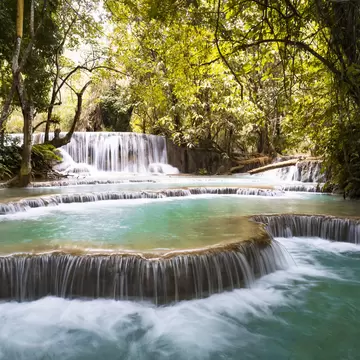
This beautiful spot 32km south of town has a wide, many-tiered waterfall tumbling over limestone formations into a series of cool, turquoise pools. With thick banks of green and florid vegetation on either side, the setting is impossibly picturesque and photogenic. The lower level of the falls has been turned into a well-maintained public park with shelters and picnic tables; some of the trees near the waterfall have been labelled. Just past the entrance are two enclosures, one housing sun bears and the other a tiger. All have been confiscated from poachers and are kept here in preference to releasing them to the same certain fate.
reviewed
-
M
Wat Manolom
Although its outer appearance isn’t very impressive, Wat Manolom stands just outside the barely visible city walls and occupies possibly the oldest temple site in Luang Prabang. City annals say it was founded in 1375 on the site of a smaller temple established by King Fa Ngum. The decaying sǐm held the Pha Bang from 1502 to 1513 and still contains a sitting bronze Buddha cast in 1372. This image is about 6m high and weighs an estimated two tonnes – some parts of the bronze are 15mm thick. An important city talisman, the image would probably be moved to another temple if anyone could figure out how!
reviewed
-
N
Savannakhet Provincial Museum
In a French-era mansion on expansive grounds is the mildly interesting Savannakhet Provincial Museum. In the front yard are a few rusting artillery pieces aimed at Thailand and the barely recognisable remains of an American-built T-28, the main combat aircraft of the Royal Lao Army. Inside is more rusting ordnance, but otherwise this is a shrine to Kaysone Phomvihane, who was born nearby. There are hundreds of photos, most with basic English captions, and if you’re interested in Kaysone or in the beatification of socialist heroes, then it’s fascinating. The curator is rarely there at 8am so come later.
reviewed
-
Pak Ou Caves
About 25km by boat from Luang Prabang along the Mekong River, at the mouth of the Nam Ou, are the famous Pak Ou caves. Two caves in the lower part of a limestone cliff facing the river are crammed with Buddha images of all styles and sizes (but mostly classic Luang Prabang standing Buddhas). The lower cave, known as Tham Ting, is entered from the river by a series of steps and can easily be seen in daylight. Stairs to the left of Tham Ting lead around to the upper cave, Tham Phum, which is deeper and requires artificial light for viewing – be sure to bring a torch (flashlight) if you want to see both caves.
reviewed