Note: Javascript is disabled in your browser.
To see the gallery in all its glory, you'll need to enable Javascript.
Introducing Davit Gareja
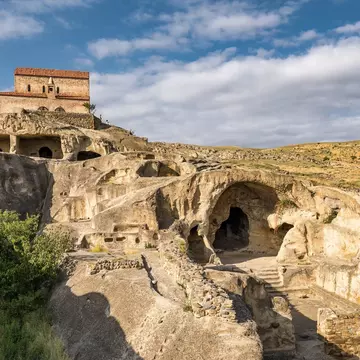
On the border with Azerbaijan, Davit (or David) Gareja is perhaps the most remarkable of all Georgia’s ancient sites, and the most interesting easy day trip from Tbilisi. Comprising about 15 old monasteries spread over a large, remote area, its uniqueness is heightened by a lunar, semidesert landscape which turns green and blooms with flowers in early summer. Monstrously neglected during the Soviet era, Davit Gareja has since seen some restoration and is now again inhabited by monks. Two of the key monasteries, and the most visited, are Lavra (the only inhabited one today), and, on the hill above it, Udabno, which has beautiful frescoes (not to be confused with the village Udabno several kilometres north).
Advertisement
Lavra, the first monastery here, was founded by Davit Gareja, one of the 13 ascetic ‘Syrian fathers’ who returned from the Middle East to spread Christianity in Georgia in the 6th century. The religious complex grew until there were monasteries spread over a wide area. Here manuscripts were translated and copied, and a celebrated Georgian school of fresco painting developed. The monasteries were destroyed by the Mongols in 1265, revived in the early 14th century by Giorgi V the Brilliant, sacked by Timur and then suffered their worst moment of all on Easter night 1615 when Persian Shah Abbas’ soldiers killed 6000 monks and destroyed most of their artistic treasures. In 1675 King Archil initiated some restoration and gave stipends to the monks. The monasteries never regained their former importance but remained working until the end of the 19th century.
During the Soviet era the area was used for military exercises, and some of the first demonstrations of the perestroika period in Tbilisi were protests against this vandalism. Ironically, the Georgian army then used the area for training in the mid-1990s. These manoeuvres were stopped when protesters camped in the firing range.
Entrance to both Lavra and Udabno is free, but you may want to leave a donation at Lavra. It takes two to three hours to explore both places at a leisurely pace.
The Lavra monastery is on three levels, with buildings dating from many different periods. The watchtower and the outer walls are from the 18th century. You enter by a gateway on the middle level which is decorated with reliefs illustrating stories of the monks’ harmony with the natural world. From the gateway you go down past the 17th-century Church of St Nicholas to the lower level, where the caves of Davit and his companions are. Davit and his Kakhetian disciples Lukiane and Dodo are buried in the 6th-century cave Peristsvaleba (Church of the Transfiguration) on this lower level. Monks are now living in the monastery again, but you can’t enter their quarters (caves in the rock above those of Davit and his companions), and you should refrain from making too much noise. They will also be offended by inappropriate clothing.
To get to Udabno, take the uphill path beside the church shop outside Lavra. Watch out for poisonous vipers on this route, including in the caves and especially from April to June. When you come level with a watchtower overlooking Lavra, take the path leading straight up the hill. In 10 to 15 minutes you will reach a metal railing. Follow this to the left and up to the top of the ridge, then along the far side of the ridge (where the railing deteriorates to a series of posts). The plains and low hills below you now are in Azerbaijan, and the caves alongside and above the path are the Udabno monastery. Some were churches or chapels or rooms, and their inner walls still bear frescoes painted by the renowned fresco school that flourished here between the 10th and 13th centuries. The monastery’s refectory, where the monks had to kneel to eat at low stone tables, is decorated with beautiful light-coloured frescoes, the principal one being an 11th-century depiction of the Last Supper. Paintings on the north wall of what was the main church show Davit Gareja and Lukiane surrounded by deer, a reference to the story that deer gave them milk when they were wandering without sustenance in this remote wilderness. Below them are figures of Kakhetian princes.
Finally the path climbs up to a stone chapel on the hilltop, then down past a cave known as Davit’s Tears (because of the spring inside) and the top of Lavra monastery, to the watchtower you passed earlier.
Last updated: Mar 2, 2009
Hotels & Hostels
Check out all our reviewed and recommended accommodation and book online.
Advertisement