Sights in El Salvador
-
A
Museo de la Palabra y La Images
In its brand-new location, the Museum of Word and Image is a museum of Salvadoran writing and writers, with a heavy emphasis on the revolutionary movement of the '70s and '80s. No surprise really - the museum's director is Carlos Henríquez Consalvi, aka 'Santiago,' the Venezuelan-born journalist who was the founder and main voice of Radio Venceremos during the war. (You're liable to see him around the museum most days.)
The museum has three small exhibit areas, through which it rotates compelling exhibits on themes such as writers (like Roque Dalton and Salarrué), the massacre of 1932, and women in Salvadoran history. Throughout the museum are terrific black-and-white…
reviewed
-
B
Military History Museum
Head to the troubling but surprisingly interesting Military History Museum. In a series of interconnected, barrack-like rooms, President Maximiliano Martínez is praised for the 'resolve and patriotism' with which he suppressed Communist insurgents in 1932 - some 30,000 indigenous men, women and children were killed in the process - and Colonel Domingo Monterrosa, alleged mastermind of the massacre at El Mozote, is described as having 'written pages of glory for the history of the armed forces.'
On the walls and in floor-mounted displays is an incredible array of rifles, machine guns, grenade launchers, mortars, flame throwers, radio and night-vision equipment - almost…
reviewed
-
C
Volcán Guazapa
Volcán Guazapa, towering to the southwest of Suchitoto, was an FMLN stronghold during the war. Today you can see bomb shells, craters and tatús, plus views of San Salvador and San Vicente volcanoes. You can visit by horse or on foot; the tours are operated by an independent cooperative, and the quality (vegetation cleared, tatús maintained, horses not depressed) depends greatly on who's in charge at the time. Check with the tourism office for details.
reviewed
-
D
Templo del Señor Juayúa
Juayúa's white-washed church - the Templo del Señor Juayúa - is famous for its crucifix: the 'Cristo Negro,' carved by Quirio Cataño in the late 16th century and displayed prominently at the back of the nave. It is the object of a great deal of worship and pilgrimage - you can climb a set of stairs behind the altar for a closer look. On your way out, don't miss the beautiful stained-glass windows along the walls, representing the 14 stages of the cross.
reviewed
-
E
Iglesia Santa Lucia
Constructed in 1853, this church is one of Suchitoto's colonial gems. Its facade features exquisite arches with molded keystones and six huge columns. Two statuesque towers loom down from above (both chime - one with a bell and the other with metal bars) and an antique clock sits in between. The wood-paneled interior is well preserved and worth a prayer.
reviewed
-
Casa Museo de Alejandro Cotto
Considering this is one of the most expensive museums in the country, you'd think it might be a little more spectacular. It's a private collection of antiques, musical instruments, paintings and books crammed in a rambling colonial-era home. If you like poking around, Alejandro Cotto, a filmmaker born in Suchitoto, may even be there to show you around.
reviewed
-
F
Iglesia El Rosario
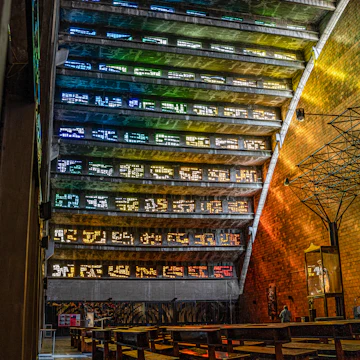
What appears from the outside like a dilapidated airport hangar is, in fact, one of the most intriguing churches in the country. After entering through an easy-to-miss corridor, you'll see that Iglesia El Rosario opens into a shallow nave backed by a high brick wall and soaring arched roof above. The roof isn't a true arch, though, but a series of overhanging steps inset with a rainbow of stained-glass panels.
On the walls are figures made of scrap metal, with larger, more detailed stone and metal statues displayed in the wings on either side of the main entrance. Besides the simple beauty of the place, the contrasts are striking - the modern industrial-style artwork, the…
reviewed
-
Chaparrastique
Also known as Volcán de San Miguel, Chaparrastique is the 2130m volcano towering southwest of San Miguel. It's a real behemoth, and climbing it requires some advance planning (and should be done only in the dry season). First, you'll need a police escort, usually arranged through the Chinameca police station, whose jurisdiction the volcano falls into. Two weeks' notice is preferred, but with some friendly pleading you may be able to get an escort, within a couple of days.
You'll have to fax a written request with the date and names of the people in your group. There is no fee, but definitely bring food for all - say, tamales for breakfast and pupusas for lunch - and…
reviewed
-
G
Tin Marín Museo de los Niños
Where to start? This gem of a museum has so many interesting hands-on features, your little one may need a return trip. Roughly divided into four sections - health, environment, technology and culture - exhibits include a miniature supermarket (to learn about food groups), a huge artificial volcano (complete with smoke and red lights for lava) and a papermaking area (to learn about recycling).
There's a cockpit and fuselage of a real Boeing 727 airplane, and a real VW Beetle that kids can handpaint to their heart's delight - part of an exhibit on color and senses, it looks like an Andy Warhol piece. Another kid-favorite is the Casa de Gravedad (Gravity House) - a small…
reviewed
-
H
Plaza Barrios
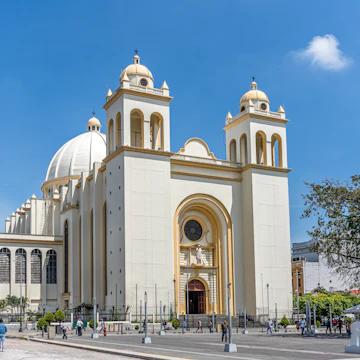
The main plaza is called Plaza Barrios and dedicated to a former president and crusader for the separation of church and state. There is a statue of Barrios astride a horse in the middle of the plaza, turned to face the cathedral and streaked (of course) with pigeon shit. The Palacio Nacional is on the west side of the plaza and all the trees have been removed directly in front of it - the view is clear, but the stone-paved plaza can get hot in the afternoon as a result.
Plaza Barrios is where most political protests begin or end (on our last visit, a group of family members and advocates for imprisoned gang members took control of the cathedral to protest new highly…
reviewed
Advertisement
-
I
Museum of Popular Art
Yet another terrific museum is the Museum of Popular Art, which showcases El Salvador's underappreciated contribution to Central American folk art. The main attraction is the Sala Dominga Herrera, which describes the evolution of 'sorpresas,' the tiny clay figures made and sold in nearby Ilobasco.
Dominga Herrera (1911-1982), the daughter of ceramic doll makers, gained modest fame for her miniature and meticulously painted creations, which she began making on a whim but have since become a cottage industry for the whole town, even the country. Classic sorpresas are single pieces, usually portraying a profession, domestic scene or, more recently, sexual entanglements.…
reviewed
-
Cascada Los Tercios
Cascada Los Tercios is a small waterfall that tumbles over a cliff of tightly packed hexagonal stone spires, a geological oddity related to volcanic activity. The falls are a bit underwhelming when the water is low (often), but the rock formation is interesting enough, as is getting there.
To visit, go south on the road in front of Iglesia Santa Lucia; it curves left, down and up again, before intersecting with a main road at a soccer field. Turn left and continue for about 1.5km. Right after a smoking garbage dump, look for a gate on your left. Enter here or continue to the next house, where one of the kids can guide you - either way, you pass through the family's…
reviewed
-
J
Capilla Medalla Milagrosa
Built in 1904 by an order of French nuns and modeled after their church in Paris, the small Gothic-style Capilla Medalla Milagrosa is one of San Miguel's best attractions. It's a sublime place, set in the middle of large tree-filled grounds, with a high arched ceiling (painted baby blue) and famously gorgeous stained windows.
The altar is populated with flowers and statues of saints, most prominently the Virgin Mary, who has a neon crown and displays the words - also in neon - María, concebida sin pecado, rogad por nos que recurrimos a vos (Mary, conceived without sin, pray for us who have recourse to thee). The saying comes from the namesake 'Miraculous Medal,' which…
reviewed
-
Ruinas de Tazumal
The Mayan ruins of Tazumal, in Chalchuapa, are considered the most important and best preserved in El Salvador. The name Tazumal means 'pyramid where the victims were burned' in the Quiché language. The excavated ruins on display here are only one part of a zone covering 10 sq km (4 sq mi) - most of the ancient wonders still lie buried under the town.
Archaeologists estimate that the first settlements in the area date from around 5000 BC. The excavated structures date from a period spanning over 1000 years. The artifacts found at Tazumal provide evidence of ancient trade between Tazumal and places as far away as Panama and Mexico.
One of the most important artifacts…
reviewed
-
Museo de la Revolución Salvadoreña
Just west of the parque central, the Museo de la Revolución Salvadoreña is an excellent museum that charts the causes and course of the armed struggle with photos, posters, weapons and histories of those who served and died in action. Weapons range from high-tech hardware to homemade bombs and mines. Behind the main building are the remains of the downed helicopter that carried Lieutenant Colonel Domingo Monterrosa, head of the notorious Atlacatl Battalion, to his death.
The studios of the FMLN's clandestine station Radio Venceremos (We Shall Prevail Radio) are also here; an elaborate hoax involving a radio transmitter rigged with explosives was what brought…
reviewed
-
Salto El Cubo
Salto El Cubo is a somewhat larger waterfall (about 15m) than Cascada Los Tercios and has water year-round. A pair of pools has been formed at the base of the falls - climb from the lower one to the upper, hemmed in by rocks with the water crashing down from above.
To get there, take Calle Francisco Morazán west out of town; it turns to dirt before reaching the trailhead. A narrow path descends steeply to the falls. To return, continue on the same trail, which climbs through the trees and has some excellent lake views before reaching town, near the Hotel Villa Balanza. The first leg takes about a half-hour, the second about double that. You can also go the reverse…
reviewed
-
Parque Nacional Los Volcanes
One of El Salvador's gems, this park encompasses three major volcanoes and thousands of acres in the heart of the country. Cerro Verde is 1.5 million years old, Izalco began burping lava in 1770 and Santa Ana, aka Mother Hill, awoke from its slumber in 2005 in a dramatic cloud of ash. Closed for months, the park will reopen when scientists give the go-ahead.
A paved road leads all the way to the visitor center. You can climb Izalco or Santa Ana in a day - not the same day - or take a short stroll on a nature loop in the forested area. For a little more adventure, there are areas for camping, and guided hikes up the volcanoes from there. Before 2003, the park was simply…
reviewed
-
K
Centro Monseñor Romero
This small center pays homage to the martyred archbishop, assassinated by government agents in 1980. It is also the place where six Jesuits, who, along with their maid and her daughter, were slain in their sleep by military forces in 1989. The displays include photos of the murder scene - be forewarned, they're pretty grizzly. University students give tours.
To get here, take bus 44. Don't get off at the main entrance; instead, wait until the smaller back entrance on Calle de Mediterreáno (ask the driver if you're unsure). From there, Centro Romero is a few minutes' walk into the campus; ask a student for directions or look at one of the posted campus maps. You can also…
reviewed
-
L
Parque Libertad
Two blocks east of Plaza Barrios is Parque Libertad, with a winged statue of Liberty in the middle. This is the more pleasant of the two plazas, with islands of grass and trees, and many benches to sit on. The traffic is still loud - and this is the end of the line for a number of local bus services - but the park is as good a place as any to relax and take in the scene.
Both plazas are relatively safe, but always be aware of your surroundings and don't linger after dark. And it's probably best not to bring your camera - though you'll regret not being able to capture some of the scenes down there! Foreigners are already a rare sight downtown - you may be the only one when…
reviewed
-
Parque Nacional Montecristo-El Trifinio
The borders of El Salvador, Honduras and Guatemala converge at a point which has an elevation of 2400m (7900ft), receives 200cm (80in) annual precipitation and has 100% humidity - ideal conditions for a cloud forest. Parque Nacional Montecristo-El Trifinio sits right in its middle. Get permission from the National Parks and Wildlife Service and take a look.
In the Montecristo cloud forest, oak and laurel trees grow to 30m (98ft) and their leaves form a canopy impenetrable to sunlight.
Ferns, orchids, mushrooms and mosses coat the forest floor, and the local wildlife includes rare and protected spider monkeys, two-fingered anteaters, pumas, agoutis, toucans and striped…
reviewed
Advertisement
-
M
Museo Nacional de Antropología David J Guzmán
Absolutely one of the best museums in the country, the Museo Nacional de Antropología David J Guzmán is worth a solid morning's visit. It may not look like much on the outside, but once you walk through the front door, you'll find it hard to leave.
Inside are two expansive floors of thoughtfully and beautifully presented exhibits on the Maya, the development of the people and land of El Salvador, the arts, religion and economy of the country…even prehistoric rock carvings and an artifact garden. The only downside of the museum is that signage is in Spanish only. It's worth bringing your dictionary.
reviewed
-
N
Jardín Botánico La Laguna
Also called Plan de La Laguna, Jardín Botánico La Laguna is a lovely, cool botanical garden, at the bottom of a volcanic crater. Gravel and cement paths wind through the garden, where trees and plants are labeled and offer plenty of shade along the way.
Most people arrive by car, but it's easy enough to take bus 44 from the city center or Blvd de los Héroes, and ask the driver to let you off at the right spot - it's easy to miss, so ask a couple times so he doesn't forget. From there it's a 1km downhill walk to the garden. Signage is sparse, so ask along the way if you're unsure.
reviewed
-
O
San Salvador Fútbol Club
It should come as no surprise that fútbol (soccer) is the biggest sport in San Salvador. The capitol's team San Salvador Fútbol Club was formed in 2002 and joined the la Primera División del Fútbol Salvadorenó, the major league of Salvadoran soccer, straight away. Despite its youth, the team won the national championship in 2003, giving capitalinos something to cheer about.
When at home, San Salvador Fútbol Club plays in the 80,000-seat Estadio Mágico González, also known as Estadio Flor Blanco, located west of Parque Cuscatlán.
reviewed
-
P
Museum of Modern Art
San Salvador's Museum of Modern Art is small but well designed. The permanent exhibit, called 'Puntos Cardinales,' uses the artwork of several generations of Salvadoran modern painters to explore facets of the national consciousness. Two temporary exhibit halls feature mostly Latin American artists.
The museum is a healthy uphill walk from the anthropology museum, and sits just behind the large Monumento a la Revolución. The museum restaurant, Punto Café, is a local favorite, but isn't particularly cheap. For something less expensive, try the street stands near the parking area.
reviewed
-
Q
Antiguo Teatro Nacional
Just around the corner from the main plaza sits the Antiguo Teatro Nacional . Opened in 1909, this neoclassical building was converted into a movie theater during the silent-film era, and later functioned as the Telecom building and a public hospital. At the time of research it was undergoing a slow renovation - there were no stage lights and only plastic chairs - but music concerts and spoken-word performances are held often, and typically free of charge.
reviewed