Things to do in Croatia
-
Dubrovnik City Walls
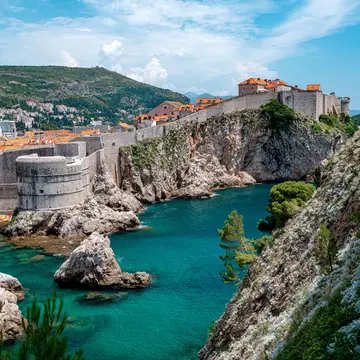
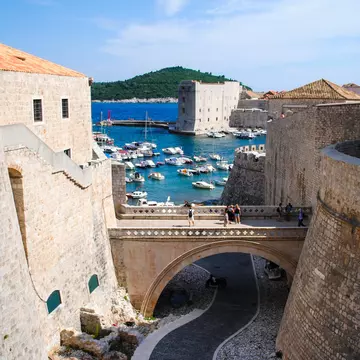
No visit to Dubrovnik would be complete without a leisurely walk around the city walls. Built between the 13th and 16th centuries and still intact today, these powerful walls are the finest in the world and Dubrovnik's main claim to fame.
The first set of walls to enclose the city were built in the 13th century. In the middle of the 14th century the 1.5m-thick walls were fortified with 15 square forts. The threat of attacks from the Turks in the 15th century prompted the city to strengthen the existing forts and add new ones so that the entire Old Town is now contained within a curtain of stone over 2km long and up to 25m high. The walls are thicker on the land side - up…
reviewed
-
Plitvice Lakes National Park
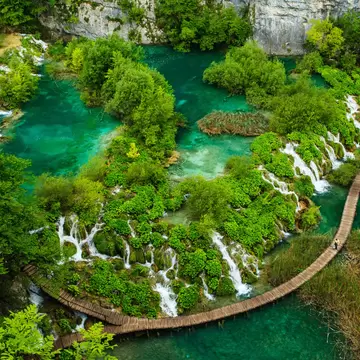
The extraordinarily beautiful pocket of wooded hills in this World Heritage site enclose 16 turquoise lakes that are connected by waterfalls and cascades. The mineral-rich waters carve through the rock, depositing tufa in continually changing formations. Wooden footbridges follow the rumbling water for an exhilaratingly damp 18km (11mi).
Animal life flourishes in the unspoiled conditions. The stars of the park are bears and wolves, but there are also deer, boar, rabbits, foxes and badgers. There are over 120 different species of bird such as hawks, owls, cuckoos, thrushes, starlings, kingfishers, wild ducks and herons. You might also occasionally see black storks and…
reviewed
-
A
Adriatic Explore
Day trips to Mostar and Montenegro (both 380KN) are very popular. Excursions to Mljet, Korčula and the Elafiti Islands (250KN) are offered, too.
reviewed
-
B
Kamenice
Looks vaguely like a socialist-style canteen, with prices to match. Order the squid, anchovies or kamenice (oysters).
reviewed
-
C
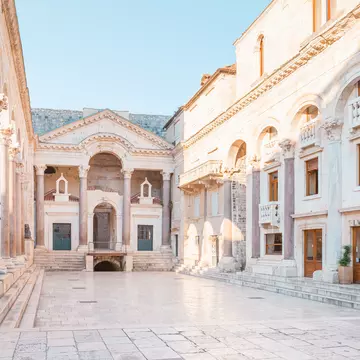
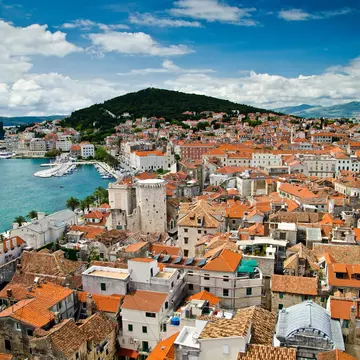
Diocletian's Palace
Facing onto the harbour, Diocletian's Palace is one of the most imposing Roman ruins in existence. Although the original structure was modified in the Middle Ages, the alterations have only served to increase the allure of this fascinating site. Far from being a museum, the 220 buildings within the palace boundaries are home to about 3000 people. The cellars are a market for crafted jewellery, reproductions of Roman busts, silver cigarette cases, candlestick holders, wooden sailing ships, leather goods and other odds and ends.
The palace was built from lustrous white stone from the island of Brač and construction lasted 10 years. Diocletian spared no expense, importing…
reviewed
-
D
Cathedral of St Domnius
This cathedral was originally built as Diocletian's mausoleum. The original octagonal form of the mausoleum, encircled by 24 columns, has been almost completely preserved. The domed interior is round with two rows of Corinthian columns and a frieze showing Emperor Diocletian and his wife, Prisca. The Romanesque belfry was constructed between the 12th and 16th centuries and reconstructed in 1908 after it collapsed. Notice the two lion figures at the foot of the belfry and the Egyptian black-granite sphinx dating from the 15th century BC on the right wall.
The oldest monuments in the cathedral are the remarkable scenes on the wooden entrance doors from the life of Christ.…
reviewed
-
E
Lucín Kantun
A modest-looking place with shabby-chic decor and a few pavement tables, but appearances are deceptive – this restaurant serves some of the most creative food in Dubrovnik. Virtually everything on the short meze-style menu is excellent, including amazing squid (stuffed with smoked ham and served with lemon and butter sauce), a lentil and shrimp creation, cheeses (including paški sir) and Dalmatian hams. Everything is freshly cooked from an open kitchen so you may have to wait a while at busy times.
reviewed
-
F
Gregorius of Nin Statue
An imposing statue of the 10th-century Croatian bishop who fought for the right to use old Croatian in liturgical services. Sculpted by Ivan Meštrović, this powerful work is one of the defining images of Split. Notice that his left big toe has been polished to a shine. It's said that touching it brings good luck. To the west of the statue is the well-preserved corner tower of the palace.
reviewed
-
G
Chihuahua Cantina Mexicana
No matter how good the local cuisine is, sometimes the palate cries out for exotic spices. The tapas, fajitas and empanadas may be ersatz Mexican, but it is a refreshing change from pasta, risotto and fish. Plus there are vegetarian dishes to fortify the lively young crowd.
reviewed
-
H
Orhan
Fancy restaurant beautifully located by the Pile Gate. Fish and seafood are good here, but you’ll pay a premium for the location.
reviewed
Advertisement
-
I
Jupiter
This popular place serves up the best pizza in town and the pasta is good too.
reviewed
-
J
Cathedral of St Lovro
The glory of the town is the three-naved Venetian Cathedral of St Lovro, built from the 13th to 15th centuries and one of the finest architectural works in Croatia. Note first the Romanesque portal (1240) by Master Radovan. The sides of the portal depict lion figures (the symbol of Venice) with Adam and Eve above them, the earliest example of the nude in Dalmatian sculpture.
The outer pilasters show saints, the centre scenes represent the calendar months and the small posts feature hunting scenes. Overhead is the Nativity of Christ. At the end of the portico is another fine piece of sculpture - the baptistry sculpted in 1464 by Andrija Aleši. Enter the building through an…
reviewed
-
K
Rector’s Palace
The Gothic-Renaissance Rector’s Palace was built in the late 15th century and is adorned with outstanding sculptural ornamentation. It retains a striking compositional unity despite being rebuilt many times. Notice the finely carved capitals and the ornate staircase in the atrium, which is often used for concerts during the Summer Festival. Also in the atrium is a statue of Miho Pracat, who bequeathed his wealth to the Republic and was the only commoner in the 1000 years of the Republic’s existence to be honoured with a statue (1638). We may assume that the bequest was considerable. The palace was built for the rector who governed Dubrovnik, and it contains the rector’s…
reviewed
-
L
Old Town
The Old Town of Trogir occupies a tiny island in the narrow channel between Čiovo island and the mainland, just off the coastal highway. Most sights can be seen on a 15-minute walk around this island. The nearest beach is 4km west at the Hotel Medena.
The heart of the Old Town is divided from the mainland by a small channel and a few minutes' walk from the bus station. After crossing the small bridge near the station, go through the North Gate. Turn left (east) at the end of the square and you'll come to Trogir's main street, Gradska. Trogir's finest sights are around Trg Ivana Pavla II, straight ahead. The seafront, Obala Bana Berislavića, is lined with bars,…
reviewed
-
M
Church of St Donat
The main places of interest are near the circular Church of St Donat , one of the most outstanding monuments in Dalmatia. Dating from the beginning of the 9th century, it was named after Bishop Donat who allegedly had it built following the style of early Byzantine architecture. The unusual circular ground plan is especially visible on the southern side because the southern annexe is missing.
The church was built over the Roman forum, which was constructed between the 1st century BC and the 3rd century AD. A few architectural fragments are preserved and two complete pillars are built into the church. The original floors were removed, and now slabs from the ancient forum…
reviewed
-
N
Roman Amphitheatre
Pula's most imposing sight is the 1st-century Roman amphitheatre overlooking the harbour northeast of the Old Town. Built entirely from local limestone, the amphitheatre was designed to host gladiatorial contests and could accommodate up to 20,000 spectators. The 30m-high outer wall is almost intact and contains two rows of 72 arches, but the stone spectator seats were removed for building materials in the Middle Ages.
On the top of the walls is a gutter that collected rain water and you can still see the slabs used to secure the fabric canopy, which protected spectators from the sun. Around the end of July a Croatian film festival is held in the amphitheatre, and there…
reviewed
-
O
Franciscan Monastery & Museum
Over the doorway of this monastery is a remarkable pietà sculpted by the local masters Petar and Leonard Andrijić in 1498. Unfortunately, the portal is all that remains of the richly decorated church, which was destroyed in the 1667 earthquake. Inside the monastery complex is a mid-14th-century cloister, one of the most beautiful late-Romanesque structures in Dalmatia. Notice how each capital over the incredibly slim dual columns is topped by a different figure, portraying human heads, animals and floral arrangements. Also enjoyable is the small square garden that’s shaded by orange and palm trees.
reviewed
-
P
Euphrasian Basilica
The main reason to visit Poreč is to see the 6th-century Euphrasian Basilica , a World Heritage site and one of the finest intact examples of Byzantine art. Built on the site of a 4th-century basilica and 5th-century church, the complex includes a church, atrium and baptistry. Mosaics from the earlier structures are still visible on the floor of the northern nave but it is the glittering wall mosaics in the apse that packs in the crowds.
These 6th-century masterpieces feature Biblical scenes, archangels and Istrian martyrs.
reviewed
-
Beaches & Islands
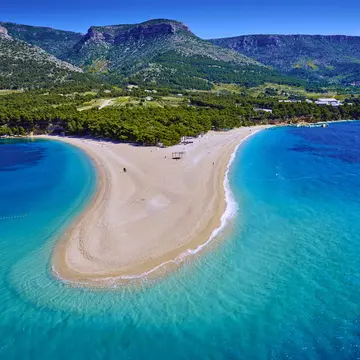
There are coves around the Hotels Amfora and Dalmacija for swimming, but most people head to the Pakleni Islands (Pakleni Otoci), which got their name from Paklina, the resin that once coated boats and ships.
Taxi boats (30mins) leave regularly during the high season from in front of the Arsenal to the islands of Jerolim and Stipanska, which are popular naturist islands (although nudity is not mandatory), and then continue on to Ždrilica and Palmižana, the latter being a sandy beach.
reviewed
-
Q
Peristyle
Peristyle is the ceremonial entrance court to the imperial quarters, measuring 35m by 13m and three steps below the level of the surrounding streets. The longer side is lined by six granite columns, linked by arches and decorated with a stone frieze. The southern side of the Peristyle is enclosed by the Protiron, which is the entrance into the imperial quarters. The square has an outdoor café and the ancient stones provide handy seats to relax and people-watch in this popular meeting place.
reviewed
Advertisement
-
R
Marjan Hill
From the Meštrović Gallery it's possible to hike straight up Marjan Hill (123m). Go up Tonća Petrasova Marovića on the western side of the gallery and continue straight up the stairway to Put Meja. Turn left and walk west to Put Meja 76. The trail begins on the western side of this building. Marjan Hill offers trails through the forest, lookouts and old chapels.
reviewed
-
Explore Croatia
8 days (Dubrovnik)
by Intrepid
Walk the famed city walls of Dubrovnik, Dine on traditional treats in Korcula, Try travarica - the local tipple, Sip a cocktail at a waterside bar in Hvar,…Not LP reviewed
from USD$1,395 -
S
Boban
It's not just the food at this Italian restaurant-bar-café that is sophisticated. It's also the cosy indoor lounge with comfy sofas that offer the perfect resting place for the foot-weary and the outdoor terrace that attracts Zagreb's most attractive people.
reviewed
-
Konoba Ankora
Right by the sea, this is the best of a strip of restaurants in Polače. The short menu, chalked up on a blackboard, usually includes grilled Mljet lamb, game, kid and whatever is fresh from the sea – try the brodetto (mixed seafood stew).
reviewed
-
T
Buffet Fife
Dragomir presides over a motley crew of sailors and misfits who drop in for the simple, savoury home cooking (especially the pašticada; beef stuffed with lard and roasted in wine and spices) and his own brand of hospitality.
reviewed