Things to do in Belarus
-
Dudutki Open Air Museum
Near the sleepy, dusty village of Dudutki, is an open-air museum, where 19th-century Belarusian country life comes to life. If you only make one day trip from Minsk let this be the one. Traditional crafts, such as carpentry, pottery, handicraft-making and baking are on display in old-style wood-and-hay houses.
You can wander around the grounds, taking in the fresh air, spying on a working farm as it was a century ago. Nearby is a working windmill which you can climb. You can also go horse riding or just rest on bales of hay.
Best of all though is the meal you can order, prepared on site using traditional recipes and techniques. Homemade cheeses, bread, draniki(potato…
reviewed
-
A
Stary Mensk
The hippest cafés are the itsy-bitsy Stary Mensk and its teeny-weeny cousin, London. They both serve coffees and fresh teas, and whip up a mean hot chocolate. In summer, Stary Mensk puts on batlejka (traditional Belarusian puppet shows) - very nationalistic, and all right across from the KGB headquarters.
reviewed
-
B
Strawnya Talaka
This small Belarusian eatery is suitable for a romantic, intimate dinner amid sophisticated Slavic décor, although it can get a little smoky, depending on the other diners. It's a stone's throw from Rakovsky Brovar, if you're up for something rowdier afterward. Reservations are required.
reviewed
-
C
Grunwald
A great place for a splurge. The décor is lightly medieval, the atmosphere relaxed, and the superb food a mix of European and Belarusian (delicious soups and draniki, filling enough for a meal). There's a dazzling array of inventive fish and meat dishes.
reviewed
-
Chomolungma
Wow. A huge menu with a wide range of prices and cuisines: Nepalese, Tibetan, sushi and Indian. There is only one tofu dish, but there is plenty more for vegetarians. It's well worth the 10-minute walk from metro Yakuba Kolasa.
reviewed
-
Praspekt Francyska Skaryny
Minsk's main thoroughfare impresses in its sheer girth. Hectic and huge, it tripled in width when it was rebuilt after WWII and extends over 11km from the train station to the outer city. The busiest section - with the best architectural examples of Soviet monumentalism - is sandwiched between pl Nezalezhnastsi and pl Peramohi, with the block between vul Lenina and vul Enhelsa doubling as a popular evening youth hangout.
The stubbornly austere and expansive ploshcha Nezalezhnastsi (Independence Square; ploshchad Nezavisimosti in Russian) is dominated by the Belarusian Government Building (behind the Lenin statue) on its northern side, and the equally proletarian…
reviewed
-
D
Brest Fortress
If you are going to see only one Soviet WWII memorial in your life, make it Brest Fortress. The scale of the fortress itself is so massive and the heroism of its defenders so vast, even the giant stone face and glistening obelisk are dwarfed in comparison.
Between 1838 and 1842 the entire town of Brest was moved east to make way for this massive fort. During the interwar period it was used mainly for housing soldiers and had lost most of its military importance. Nevertheless, two regiments bunking here at the time of the sudden German invasion in 1941 defended the aged fort for an astounding month. The whole structure withstood incredible attacks, including at least 500…
reviewed
-
St Efrasinnia Monastery
The St Efrasinnia Monastery was founded in 1125 by St Efrasinnia (1110-73), Belarus' first saint and the first woman to be canonised by the Orthodox Church. She was the founder of the city's first library and had a strong independent streak, shunning numerous offers of marriage to establish her own convent here and to commission the Holy Saviour Church.
Still standing, it's one of the finest examples of early 12th-century religious architecture in Belarus, and the small, dark interior is mesmerisingly beautiful, with haunting frescoes. The saint's embalmed remains are in a glass-covered coffin inside. The small Church of the Transfiguration (Spaso-Preobrazhenski Sabor),…
reviewed
-
St Sophia Cathedral & Museum
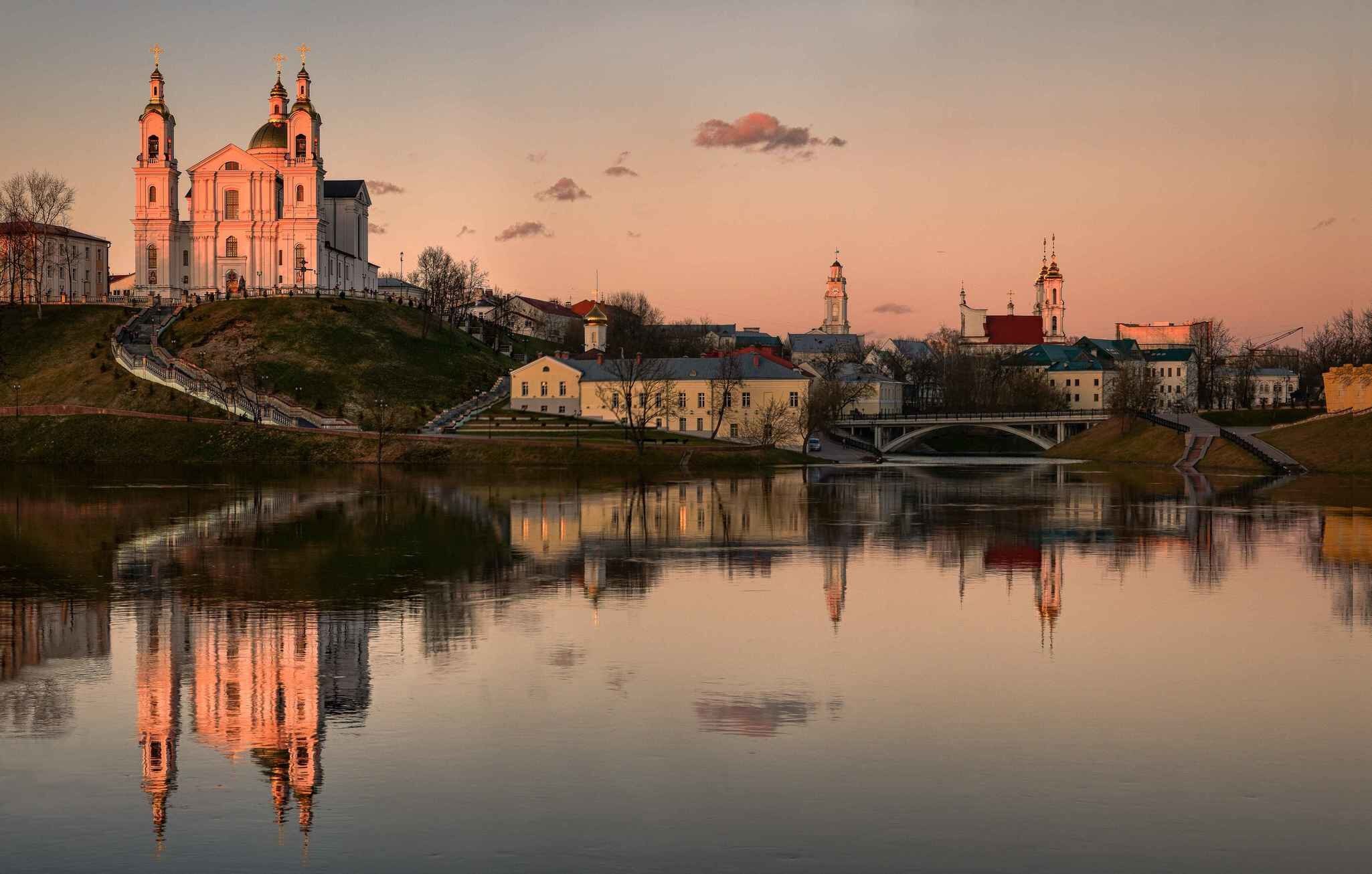
Atop a small hill past the western end of vul Lenina is the finely moulded façade of the St Sophia Cathedral, its twin baroque bell towers rising high over the Dvina River. It's the oldest surviving monument of architecture in Belarus and one of two original 11th-century Kyivan Rus cathedrals (the other is in Novgorod) modelled and named after the St Sophia Cathedral in Kyiv.
Its original appearance, however, has long gone. Damaged by fire in the 15th century, it was turned into an armoury which was subsequently destroyed by retreating Russians in 1710. About 40 years later the Poles reconstructed it - inside and out - as a baroque Catholic cathedral. The interior is a…
reviewed
-
Dudutki
Near Dudutki, 40km (25mi) south of Minsk, is an open-air museum where 19th-century Belarusian country life comes to life. Traditional crafts, such as carpentry, pottery, handicraft-making and baking are on display in wood-and-hay houses. Best of all is the traditional meal you can order, washed down with a shot of local samagon (moonshine).
If you only make one day trip from Minsk, let this be the one. You can wander around the grounds spying on a working farm as it was a century ago. Nearby is a working windmill which you can climb. You can also go horse riding or just rest on bales of hay. Public transport to Dudutki is iffy. About three daily buses go to Ptich from…
reviewed
Advertisement
-
Chagall Museum
One of the most important names in 20th-century art, visionary Marc Chagall (1887-1985), often grouped with surrealists, was born in Vitsebsk on 7 July 1887. Nestled in a pretty park, Chagall Museum has two floors filled with 300 original, colourful lithographs (all donations), as well as reproductions of some of his famous paintings, including the infamous murals he did for the Moscow Jewish Theatre, considered so mesmerising that they were banned from the stage for distracting the audience.
There would be more originals at the museum had Soviet authorities accepted Chagall's offer to donate some to the city of his birth; they didn't think much of his art and declined.…
reviewed
-
Marc Chagall House Museum
One of the most important names in 20th-century art, visionary Marc Chagall, was born in Vitsebsk on 7 July 1887. He spent from 1897 to 1910 in what is now the Marc Chagall House Museum, now charmingly kitted out with early-20th-century Jewish knick-knacks and photos. Chagall left Vitsebsk to go on to greater fame in St Petersburg and Moscow, finally settling in Paris from 1923, where he lived until his death, churning out fantastically poetic and often humorous murals and artwork.
Many of his pieces reflect the Jewish country life of his childhood, largely influenced by his beloved Vitsebsk.
To get there, turn left when exiting the bus or train station, walk one block,…
reviewed
-
Stari Zamak
Two castles face each other in the city centre, and although not overly impressive, are still worth a look. The Novi Zamak (New Castle) is to the southeast and the Stari Zamak (Old Castle) to the northwest and each houses a branch of the Historical and Architectural Museum. Between the castles is a wooden carving of Vytautas the Great, the Lithuanian leader responsible for Stari Zamak, which was built in the 14th century on a site the Kyivan Rus settlers had established a few centuries earlier.
The only original remains are the sections of wall to the left as you enter, from which there are nice views across the river. The rest was cheaply refurnished in a pseudomodern…
reviewed
-
E
Traetskae Prodmestse
A minuscule area on the eastern bank of the Svislach River, bordered by vul Maxima Bahdanovicha, has been rebuilt in 17th- and 18th-century style to recreate the look and feel of what much of Minsk once looked like. This Old Town is known as Traetskae Prodmestse (Trinity Suburb). It's the city's most photographed area, and there are a few cafés, bars, restaurants and craft-gift shops to tempt you for a lazy hour.
By the river banks is the Ostrov Slyoz (Island of Tears), in memory of Belarusians who lost their lives to war. There sits a fantastic monument in the shape of a chapel, ornamented with mourning female figures; nearby a guarding angel weeps for having failed to…
reviewed
-
Ploshcha Svabody
Ploshcha Svabody, to the southeast of the overpass, bordered by vul Lenina, became the new city centre in the 16th century. The surrounding area is known as Upper Town (Verkhny Garad). The baroque, twin-towered Orthodox Holy Spirit Cathedral, off the northern end of the small square, stands on a small hill and was once part of a Polish Bernardine convent (founded in 1628) along with the former Bernardine Church next door.
There are several side streets in the triangle formed by vuls Lenina, Torhovaja and Internatsjanalnaja, on which some houses remain from the pre-WWII period. They are in poor condition, but their old-world charm offers a welcome respite in a city whose…
reviewed
-
F
Catholic Farny Cathedral
The sight in Hrodna is the Catholic Farny Cathedral, one of Belarus' most impressive churches. Inside is a row of splendidly ornate altars leading to a huge main altarpiece constructed of multiple columns interspersed with sculpted saints. The sense of space and history inside is almost dizzying. It was built up from the late 17th century and throughout the 18th century, as foreign masters (especially Kristof Peykher from Königsberg) designed altars and drew frescoes.
Another church once stood on the opposite side of the square. It was damaged in WWII and later razed by the Soviet regime; fragmented foundation ruins now mark the spot.
reviewed
-
Art Museum
Immerse yourself in what distinguishes Vitsebsk from other Belarusian cities: art. Nowhere else in the country will you get such a concentrated dose of quality art! The grand halls of the Art Museum are decked out with mainly local art, both old and new. There are numerous 18th- to 20th-century works, including those by Repin and Vladimir Egorovic Makovsky. A highlight is the collection of very moving realist scenes of early 20th-century Vitsebsk street life by Yudel Pyen.
Of the 793 paintings he donated to the city before he died, only 200 have survived, most of them held here.
reviewed
-
G
Former Residence of Lee Harvey Oswald
Just across the bridge over the Svislach River, on the west bank, is the former residence of Lee Harvey Oswald; it's the bottom left apartment. The alleged assassin of former US president John F Kennedy lived here for a couple of years in his early 20s. He arrived in Minsk in January 1960 after leaving the US Marines and defecting to the USSR. Once here, he truly went native: he got a job in a radio factory, married a Minsk woman, had a child - and even changed his name to Alek.
But soon he returned to the United States and…you know the rest.
reviewed
-
H
Museum of the Great Patriotic War
Don't leave town without visiting the Museum of the Great Patriotic War, where Belarus' horrors and heroism during WWII are exhibited in photographs, huge dioramas and other media. Particularly harrowing are the photographs of partisans being executed in recognisable central Minsk locations. The big sign above the building (ПОДВИГУ НАРОДА ЖИТЬ В ВЕКАХ) means 'The Feats of Mankind Will Live On for Centuries'.
reviewed
-
I
Souvenir Market
Folk art is the main source of souvenirs, which include carved wooden trinkets, ceramics and woven textiles. Unique to Belarus are wooden boxes intricately ornamented with geometric patterns composed of multicoloured pieces of straw. These are easily found in city department stores and in some museum kiosks. Most days, this small outdoor souvenir market operates in the small space between the Trade Unions' House of Culture and the Museum of the Great Patriotic War.
Breeze past the cheesy paintings and you'll find crafts in the back.
reviewed
Advertisement
-
J
KGB Building
This yellow neoclassical building occupies an entire block and its ominous, temple-like Corinthian portal looks down over Independence Square (ploshcha Nezalezhnastsi). On the opposite side of the street is a long, narrow park with a bust of terror-monger Felix Dzerzhinsky, the founder of the KGB's predecessor, the Cheka.
The downing of his statue in Moscow was one of the defining moments of the breakup of the USSR in 1991; this is one of the world's last remaining statues to the person responsible for much bloodshed.
reviewed
-
Al' Halil'
Don't let the hole-in-the-wall aspect of this Palestinian joint freak you - here you'll chow down on hot fresh lavash (soft flatbread) and all kinds of Middle Eastern treats: dolma, baba ganoush and several meat dishes. Note that what's on the menu isn't everything, and that some of what is on the menu is prepared in a 'Russianised' way (think mayonnaise). But talk to the staff (they speak a little English) and let them know what you want. They're eager to please.
reviewed
-
Island of Tears
At the end of a little footbridge near the Old Town is the evocative Afghan war memorial, Island of Tears. Standing on a small island connected by a walking bridge, it's built in the form of a tiny church, with four entrances, and is surrounded by towering gaunt statues of sorrowful mothers and sisters of Belarusian soldiers who perished in the war between Russia and Afghanistan (1979-89). Look for the small statue of the crying angel, off to the side - it is the guardian angel of Belarus.
reviewed
-
Metro Entrance Memorial
The congested overpass that now carries vul Lenina over vul Njamiha near the Njamiha metro station was the site of Minsk's main marketplace in the 12th century. In May 1999 the metro entrance was the site of a brutal stampede in which 53 people died. The tragedy occurred when hundreds of young people ran into the pedestrian tunnel to escape a sudden thunderstorm at a beer festival. There is now a touching memorial at the metro entrance, with a bronze rose for each of the people who died.
reviewed
-
Graffiti
The place to go if you want to hear the latest Belarusian musicians or to see some live theatre is Graffiti. The underground club is small (get there early if you want in) and not conveniently located (best take a taxi), but the bands and the troupes are often on Lukashenko's shit-list, and this is the only venue in town where they get away with performing (at least most of the time). Bar snacks and beer are tasty and super cheap.
reviewed