Sights in Tasmania
-
Port Arthur
Port Arthur is the name of the small settlement in which the well-preserved Port Arthur Historic Site is situated. In 1830, Governor Arthur chose the Tasman Peninsula as the place where prisoners who had committed further crimes in the colony would be confined in an allegedly 'escape-proof' natural prison. The town is also the site of the tragic April 1996 massacre in which a lone gunman opened fire on visitors and staff, killing 35 people.
Between 1830 and 1877, about 12,500 convicts served sentences at Port Arthur and for many it was a living hell, though convicts who behaved well often lived in better conditions than those they'd experienced back home.
The penal…
reviewed
-
A
Cascade Brewery
The Cascade Brewery, in South Hobart, is a grand gothic edifice. It’s Australia’s oldest brewery, established in 1832 next to the clean-running Hobart Rivulet, and still pumps out superb beer and soft drinks today. Tours involve plenty of stair climbing with beer tastings at the end. Visitors must wear flat, enclosed shoes and long trousers (no shorts or skirts), and book in advance. You can take a tour on weekends, but none of the machinery will be operating (brewers have weekends, too).
reviewed
-
B
Tiagarra
The absorbing displays here tell the story of Aboriginal culture in Tasmania from the time humans first crossed over the land bridge that's now under Bass Strait. There's a soberingly frank assessment of the decimation of Aboriginal society and culture at the time of European invasion. Outside, you can follow a trail around the headland to see Aboriginal rock carvings (petroglyphs); some are more than 10,000 years old.
reviewed
-
Walls of Jerusalem National Park
This isolated Central Plateau national park, part of the Tasmanian Wilderness World Heritage Area, features glacial lakes and valleys, alpine flora and the rugged dolerite Mt Jerusalem (1459m). It’s a favourite of experienced bushwalkers with a lust for challenging, remote hiking. The most popular walk here is the full-day trek to the ‘Walls’; you can also camp in the park. National park fees apply.
reviewed
-
C
Island Cycle Tours
Island Cycle Tours, with its office inside the Pickled Frog backpackers, offers a van ride to the summit of Mt Wellington, followed by more than 20km of downhill riding (mostly on sealed roads, but with off-road options) back to sea level. There is also the option of combining a bike descent with kayaking trip - this 'pedal 'n' paddle' outing lasts about five hours and includes a meal.
reviewed
-
Cradle Mountain-Lake St Clair National Park
The preservation of this region as a national park is due in part to Austrian immigrant Gustav Weindorfer. In 1912 he built a chalet out of King Billy pine, called it Waldheim (German for ‘Forest Home’) and, from 1916, lived there permanently. Today the site of his chalet at the northern end of the park retains the name Waldheim.
reviewed
-
D
Richmond Maze
Loose the kids in the wooden-walled Richmond Maze.
reviewed
-
Spion Kop Lookout
For top-of-the-town views, follow Hunter St uphill, turn left onto Bowes St, then sharp left onto Latrobe St to a small car park. From here a short, steep track ascends Spion Kop Lookout.
reviewed
-
Mersey Bluff
Lighthouse-topped Mersey Bluff is the most striking feature of Devonport. The red-and-white-striped lighthouse was built in 1889 to aid navigation into the expanding port, which still handles agricultural produce from northern Tasmania.
reviewed
-
Westbury Maze
Lose the kids in the hedges of Westbury Maze, then recover in the tearoom.
reviewed
Advertisement
-
Bridestowe Estate Lavender Farm
Bridestowe Estate Lavender Farm is near Nabowla, 22km west of Scottsdale. It’s the biggest lavender farm in the southern hemisphere. Admission charges (per person/vehicle $4/12) apply during the flowering season from mid-December to late January (a purple patch?) only, which covers a guided tour; the rest of the year it’s free. Try lavender-flavoured muffins and ice cream at the cafe.
reviewed
-
Mt Field National Park
Mt Field National Park is a favourite of both locals and visitors for its spectacular mountain scenery, alpine moorlands and lakes, rainforest and waterfalls. The area around Russell Falls was made a reserve in 1885 and by 1916 had become one of Australia's first national parks. The abundance of wildlife that can be viewed at dusk makes this a great place to stay overnight with kids. When nature sees fit to deposit snow, skiing is also an option.
The park's visitors centre has reams of information on the area's walks, and on the free, child-occupying, ranger-led activities usually held from late December until early February. Also inside are a cafe and displays on the…
reviewed
-
Richmond & the Coal River Valley
With more than 50 19th-century buildings and just 27km from Hobart, Richmond is arguably Tasmania's premier historic town. Straddling the Coal River and on the old route between Hobart and Port Arthur, Richmond was once a strategic military post and convict station. The town is surrounded by Tasmania's fastest-growing wine region - known as the Coal River Valley - and there are wineries in all directions.
With the completion of the Sorell Causeway in 1872, traffic travelling to the Tasman Peninsula and the east coast bypassed Richmond. The town remained the focus of a farming community but ceased to grow - in fact, for more than a century it changed very little. It has…
reviewed
-
E
Arthur Circus
During colonial times this area was a colourful maritime village, home to master mariners, shipwrights, sailors, fishers, coopers and merchants. The houses reflect the occupants' varying lifestyles, ranging from tiny one- and two-room houses, such as those around Arthur Circus, to mansions. While most houses are still occupied by locals, many are now guesthouses where you can stay and experience the area's unique village atmosphere.
Battery Point's pubs, churches, conjoined houses and narrow winding streets have all been lovingly preserved and are a delight to wander around, especially when you get glimpses of the harbour between the buildings. Highlights of the area…
reviewed
-
F
Salamanca Place
This picturesque row of four-storey sandstone warehouses on Sullivans Cove is a wonderful example of colonial architecture and Australia's best-preserved historic urban precinct. Salamanca Place was the hub of old Hobart Town's trade and commerce, but by the mid-20th century many of these 1830s whaling-era buildings had become decrepit ruins. The 1970s saw the dawning of Tasmania's sense of 'heritage', from which flowed a push to revive the warehouses as home to restaurants, cafes, bars and shops.
Showcasing a vibrant cultural scene, the Salamanca Arts Centre occupies seven Salamanca warehouses and is home to many galleries, studios, performing arts venues and public…
reviewed
-
G
Hunter Street
Hunter St has a row of fine Georgian warehouses (including the old IXL jam factory) that have recently been restored and now house the super-swish Henry Jones Art Hotel, Hobart's new hotspot, plus affiliated restaurants and a couple of art galleries. While this development has remained true to the heritage of the area and retains much of its original façade, not all of the hotel's neighbours can make the same claim.
It's no secret that the design of the large, modern hotel and apartment complex at the corner of Davey and Hunter Sts has few admirers; many Hobartians consider it totally inappropriate for the historic area (and you'd be forgiven for feeling the same way…
reviewed
-
H
Queen Victoria Museum & Art Gallery
The Queen Victoria Museum & Art Gallery has two campuses. The purpose-built 1891 museum at Royal Park is currently closed, as it is undergoing major refurbishment, and will reopen in 2010 as a home for fine arts; the superb remodelled site at the Inveresk Railyards remains open and showcases an outstanding collection of traditional Aboriginal mareener shell necklaces, an impressive display of early colonial paintings, interactive museum spaces with old aeroplanes and railway workshops, and shifting contemporary exhibits. The popular Planetarium will be relocated to Inveresk site from the Royal Park campus. Both sites have cafes and access for wheelchairs.
reviewed
-
South Bruny National Park
You really need a few days to appreciate Bruny’s isolated coastal communities, swimming and surf beaches, and the forests and walking tracks within the South Bruny National Park – don’t try and cram it into a day trip. Each hour or so another convoy of vehicles alights from the ferry and drives in formation along the main road. Tourism is the mainstay of the island’s economy, yet there are no large resorts – just self-contained cottages and guest houses. A car or bicycle is essential for getting around. Supplies are available at the well-stocked Adventure Bay general store and the tiny shops at Alonnah and Lunawanna. Many island roads are unsealed – and not all car…
reviewed
-
Mt William National Park
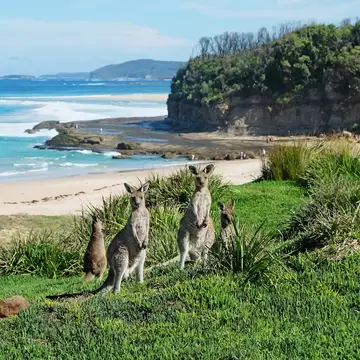
The little-known, isolated Mt William National Park brings together long sandy beaches, low ridges and coastal heathlands – visit during spring or early summer when the wildflowers are at their bloomin’ best. The highest point, Mt William (1½-hour return walk), stands only 216m tall, yet projects your gaze over land and sea. The area was declared a national park in 1973, primarily to protect Tasmania’s remaining Forester (eastern grey) kangaroos that were nearly wiped out by disease in the 1950s and ’60s (they’ve been breeding themselves silly ever since). Activities on offer in the area include bird-watching and wildlife-spotting, fishing, swimming, surfing and…
reviewed
-
I
Cadbury Chocolate Factory
A must-see for sweet-tooths and Willie Wonka wannabes is the Cadbury Chocolate Factory, 15km north of the city centre. You can enjoy samples, invest in low-priced choc products and watch a chocolate-making video.
Some companies offer day trips and river cruises incorporating the Cadbury tour, or book directly with Cadbury by phone or online and make your own way here on bus 37, 38 or 39 to Claremont from stop E on Elizabeth St.
reviewed
Advertisement
-
J
Moorilla Estate
Twelve kilometres north of Hobart's centre, Moorilla occupies a saucepan-shaped peninsula jutting into the Derwent River. Founded in the 1950s, Moorilla plays a prominent and gregarious role in Hobart society. Stop by for wine and 'Moo Brew' beer tastings, have lunch or dinner at the outstanding restaurant the Source, or catch a summer concert on the lawns.
To get here catch the Moorilla ferry from Hobart's Brooke St Pier (45 minutes, each way $15). Moorilla is also the driving force behind Hobart's annual MONA FOMA arts and music festival.
reviewed
-
K
Inveresk Railyards
One of the two campuses of the Queen Victoria Museum & Art Gallery. The superb remodelled site at the Inveresk Railyards remains open and showcases an outstanding collection of traditional Aboriginal mareener shell necklaces, an impressive display of early colonial paintings, interactive museum spaces with old aeroplanes and railway workshops, and shifting contemporary exhibits. The popular Planetarium will be relocated to this site from the Royal Park campus. The site has a cafe and access for wheelchairs.
reviewed
-
Maria Island
The car-free Maria Island was declared a national park in 1972. Its mixed history provides some interesting convict and industrial ruins among some exquisite natural features: forests, fern gullies, fossil-studded sandstone and limestone cliffs, and empty beaches. Maria is popular with bushwalkers, mountain bikers and bird-watchers, and snorkellers and divers are in for a treat. National park fees apply; island info is available at the visitors reception area in the old Commissariat Store near the ferry pier.
reviewed
-
L
Maritime Museum of Tasmania
Celebrating Hobart's unbreakable bond with the sea, the excellent Maritime Museum of Tasmania has a fascinating, salt-encrusted collection of photos, paintings, models and relics (try to resist ringing the huge brass bell from the Rhexenor).
reviewed
-
Franklin-Gordon Wild Rivers National Park
Saved from hydroelectric immersion in the 1980s, this World Heritage–listed national park embraces the catchment areas of the Franklin and Olga Rivers and part of the Gordon River – all exceptional rafting, bushwalking and climbing areas. The park’s snow-capped summit is Frenchmans Cap (1443m; a challenging three- to five-day walk). The park also boasts a number of unique plant species and the major Indigenous Australian archaeological site at KutikinaCave.
reviewed