WalesThings to do

Things to do in Wales

‹ Prev

of 27

  1. A

    Chapter Arts Centre

    Probably the city's most interesting arts venue, the Chapter has a varied programme of contemporary drama, as well as art exhibitions, workshops, alternative theatre and dance performances; it's also an appealing, arty place to hang out and there's a good café-bar with Cardiff's biggest range of beers.

    reviewed

  2. Beacon Park Boats

    The Monmouthshire and Brecon Canal runs along the foot of the Blorenge mountain, southwest of town. You can take to the water with Beacon Park Boats which rents out electric-powered boats (up to six persons). In a day, you can cruise south to Goytre Wharf, or north to Llangattock and back.

    reviewed

  3. Ty Gwyn Hotel

    This village pub, 5 miles southwest of Conwy in the village of Rowen, has a gorgeous riverside garden and simple pub food with homemade curries and bar meals. Try to time a visit with the practice session for the local male voice choir, held each Friday at 21:00.

    reviewed

  4. B

    Craft in the Bay

    This retail gallery showcases work by contemporary Welsh artists and craftspeople, with a wide range of ceramics, textiles, woodwork, jewellery, glassware, canvases and ironwork.

    reviewed

  5. C

    Laston House

    William Paxton built his saltwater baths above the harbour in what is now Laston House. The Greek writing on the pediment translates as the optimistic, 'The sea will wash away all the evils of man'.

    reviewed

  6. D

    Mike Mayberry Kayaking

    Offers instruction courses (one/two days £87/147) and guided kayaking tours for more experienced paddlers.

    reviewed

  7. E

    Blue Boar

    This bar-cum-restaurant specialises in hearty, home-cooked fare and has an inventive range of dishes, from light bites, such as hummus and pitta bread to traditional Welsh stew.

    reviewed

  8. F

    Misbah Tandoori

    One of the best curry houses not only in Wales, but in the whole of Britain, the Misbah is an authentic Bangladeshi family restaurant with a large and loyal following.

    reviewed

  9. G

    Llandudno Museum

    Llandudno Museum presents local history through an assortment of artefacts and explores themes such as the development of the town as a holiday resort.

    reviewed

  10. H

    Bar Creation & Club Eden

    One of the biggest gay venues in Wales, this bar and club combo stages a packed programme of club nights, drag acts, film screenings and cabaret shows.

    reviewed

  11. Advertisement

  12. I

    Andrew Morton Books

    Andrew Morton Books offers a staggering selection of fiction, nonfiction and local interest books. There's another branch at 10-11 Lion Yard.

    reviewed

  13. J

    D Fecci & Sons

    For the best fish and chips in town, head to D Fecci & Sons , in business since 1935.

    reviewed

  14. K

    Tenby Cycles

    You can rent bikes from Tenby Cycles.

    reviewed

  15. L

    Bizzie Lizzie's Bistro

    A warmly lit basement with country-kitchen pine furniture and green-and-white check tablecloths, decorated with bric-a-brac and old street signs, Bizzie's has a half-vegetarian, half-carnivore menu - whichever you are, go for the delicious nut roast with chilli and tomato sauce.

    reviewed

  16. M

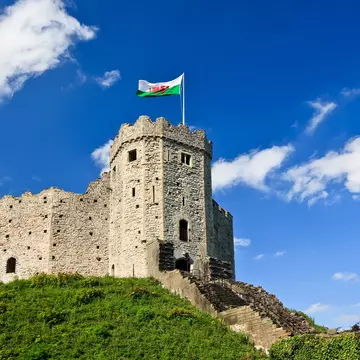
    Cardiff Castle

    The grafting of Victorian mock-Gothic extravagance onto Cardiff's most important historical relics makes Cardiff Castle the city's leading attraction. It's far from a traditional Welsh castle, more a collection of disparate castles scattered around a central green, encompassing practically the whole history of Cardiff. The most conventional castle-y bits are the 12th-century motte-and-bailey Norman keep at its centre and the 13th-century Black Tower, which forms the entrance gate.

    In the 19th century it was discovered that the Normans had built their fortifications on top of the original 1st-century Roman fort. The high walls that surround the castle now are largely a Vict…

    reviewed

  17. N

    National Museum Cardiff

    Set around the green lawns and colourful flowerbeds of Alexandra Gardens is the Civic Centre, an early-20th-century complex of neo-Baroque buildings in gleaming white Portland stone. They include the City Hall, police headquarters, law courts, crown offices, Cardiff University and this excellent museum, one of Britain's best, covering natural history, archaeology and art.

    The Evolution of Wales exhibit takes you through 4600 million years of geological history, with a rollicking multimedia display that places Wales into a global context. Films of volcanic eruptions and aerial footage of the Welsh landscape explain how its scenery was formed, while model dinosaurs and wooll…

    reviewed

  18. O

    St David's Cathedral

    Hidden in a hollow and behind high walls, St David's Cathedral is intentionally unassuming. The valley site was chosen in the vain hope that the church would be overlooked by Viking raiders, but it was ransacked at least seven times. Yet once you pass through the gatehouse that separates it from the town and its stone walls come into view, it's as imposing as any of its contemporaries.

    Built on the site of a 6th-century chapel, the building dates mainly from the 12th to the 14th centuries. Extensive works were carried out in the 19th century by Sir George Gilbert Scott (architect of the Albert Memorial and St Pancras in London) to stabilise the building. The distinctive we…

    reviewed

  19. P

    Caernarfon Castle

    Majestic Caernarfon Castle was built between 1283 and 1330 as a military stronghold, a seat of government and a royal palace. Inspired by the dream of Macsen Wledig recounted in the Mabinogion, Caernarfon echoes the 5th-century walls of Constantinople, with colour-banded masonry and polygonal towers, instead of the traditional round towers and turrets.

    Despite its fairytale aspect it is thoroughly fortified. It repelled Owain Glyndŵr's army in 1404 with a garrison of only 28 men, and resisted three sieges during the Civil War before surrendering to Cromwell's army in 1646.

    A year after the construction of the building was begun, Edward I's second son was born here, becomin…

    reviewed

  20. Tenby & Caldey Island

    Charming Tenby is the epicentre of Pembrokeshire coast holiday culture. The image of its sheltered harbour and lifeboat slipway, overlooked by pastel Georgian townhouses, is a Pembrokeshire badge. Tenby's top trip is the 20-minute boat ride to Caldey Island, the home of a community of Cistercian monks, as well as grey seals and Wales' largest cormorant colony.

    Located on a rocky promontory surrounded at low tide by golden sands, Tenby's old town features attractive architecture, steep streets and curious nooks, plus a 500m section of town wall. The place is popular with well-heeled weekend tourists and sore-heeled coast path walkers.

    The castle on the promontory above the…

    reviewed

  21. Q

    Cathedral Church of St Deiniol

    Also called the Cathedral Church of St Deiniol, the cathedral - surprisingly squat, partly due to lack of cash for a central spire - occupies one of the oldest ecclesiastical sites in Britain. Dedicated to St Deiniol, who founded a cell here in AD 525 and who was consecrated as bishop in AD 546, the cathedral's earliest traces are of a 12th-century stone building, while some of what you see today is based on reconstruction work in the late 13th century.

    Responsibility for damage can be blamed on King John, whose men also burned the city, seized the bishop and ransomed him for 200 falcons. Further ravages took place at the turn of the 15th century, during the Glyndŵr rebel…

    reviewed

  22. Advertisement

  23. R

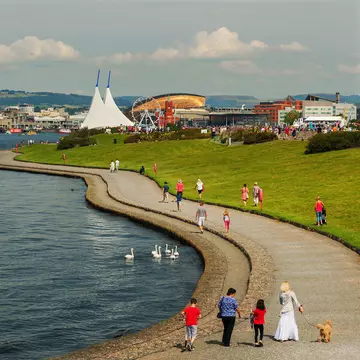
    Cardiff Bay Waterfront

    Lined with important national institutions, Cardiff Bay is where the modern Welsh nation is put on display in an architect's playground of interesting buildings, large open spaces and public art. It wasn't always this way. By 1913 more than 13 million tonnes of coal was being shipped from Cardiff's docks. Following the post-WWI slump the docklands deteriorated into a wasteland of empty basins, cut off from the city by the railway embankment. The bay outside the docks – which has one of the highest tidal ranges in the world (more than 12m between high and low water) – was ringed for up to 14 hours a day by smelly, sewage-contaminated mudflats.

    Since 1987 the area has be…

    reviewed

  24. S

    Senedd (National Assembly Building)

    Designed by Lord Richard Rogers (the architect behind London's Lloyd's Building and Paris' Pompidou Centre), the Senedd is a striking structure of concrete, slate, glass and steel with an undulating canopy roof lined with red cedar. It's won awards for an environmentally friendly design, which includes a huge rotating cowl on the roof for power-free ventilation and a gutter system that collects rainwater for flushing the toilets. The lobby and surrounding area are littered with public artworks.

    The Welsh National Assembly usually meets in a plenary session from 1.30pm on Tuesday and Wednesday, and seats in the public gallery may be pre-booked, although you can always take …

    reviewed

  25. T

    Maritime Quarter

    WWII bombing flattened much of central Swansea, which was rebuilt as a rather soulless retail development in the 1960s, '70s and '80s. What little remains of Georgian and Victorian Swansea stretches from Wind St and York St to Somerset Pl and Cambrian Way in the Maritime Quarter ; this is the most attractive part of the city centre.

    The area around the former docks to the southeast of the city centre was originally redeveloped as a residential area in the 1980s - low-rise red- and yellow-brick apartment blocks with blue-painted steel balconies, which are beginning to look a little tired now. The South Dock and the Tawe Basin (enclosed by a smaller version of Cardiff Bay's…

    reviewed

  26. U

    St Mary's Priory Church & Tithe Barn

    Relatively modest-looking, St Mary's contains a remarkable treasury of aristocratic tombs within. It was founded at the same time as the castle (1087) as part of a Benedictine priory, but the present building dates mainly from the 14th century, with 15th- and 19th-century additions and alterations. In the northern transept is one of the most important medieval carvings in Europe – a monumental 15th-century wooden representation of the biblical figure of Jesse.

    The priory's 13th century tithe barn has recently been restored and converted into an excellent heritage centre and a food hall focusing on locally sourced Welsh products.

    reviewed

  27. Skomer, Skokholm & Grassholm Islands

    Lying off Wales' best beaches in St Brides Bay, the islands are a marine nature reserve populated by immense sea-bird colonies, grey seals and dolphins. Skomer is home to over 500,000 breeding sea birds and about 150 grey seal pups are born here annually. Skokholm is the habitat for 35,000 Manx shearwaters and puffins and Grassholm has 33,000 gannet pairs.

    Skomer is the largest and easiest island to reach. Its breeding bird colonies include puffins, guillemots, razorbills, fulmars, cormorants, shags, and the burrow-breeding Manx shearwater. Together Skomer and Skokholm have the largest colony in the world: 160,000 strong.

    To visit Skomer, the Dale Princess cruiser offers …

    reviewed