go to content go to search box go to global site navigation

Uruguay

Things to do in Uruguay

‹ Prev

of 13

  1. Centro de Tortugas Marinas

    While Uruguay has no nesting beaches for sea turtles, the area from Barra del Chuy to Punta del Diablo is an important foraging area. The Center for Marine Turtles provides information on when to see these cute creatures, as well as running a volunteer program and educating visitors on environmental factors threatening the turtles and their habitat.

    reviewed

  2. A

    Mercado del Puerto

    Mercado del Puerto, on the Ciudad Vieja waterfront, is the classic place to eat in Montevideo. The densely packed parrillas here cater to every budget, competing like rutting elk to show off their obscenely large racks – of roasted meat and veggies, that is!

    reviewed

  3. B

    Plaza Independencia

    Plaza Independencia is at the heart of Montevideo's Ciudad Vieja (old city). This broad square, lined with palms, is dominated by a huge statue of José Artigas, Uruguay's greatest hero. You can pay your respects to Artigas at his underground tomb beneath the statue.

    reviewed

  4. C

    Mausoleo de Artigas

    In the middle of the downtown Plaza Independencia is the Mausoleo de Artigas, whose aboveground portion is a 17m, 30-ton statue of the country's independence hero. Below street level an honor guard keeps 24-hour vigil over Artigas' remains.

    reviewed

  5. Biblioteca Museo Eusebio Giménez

    The Biblioteca Museo Eusebio Giménez displays paintings by the local artist.

    reviewed

  6. Catedral de Nuestra Señora de las Mercedes

    The imposing Catedral de Nuestra Señora de las Mercedes dates from 1788.

    reviewed

  7. The Uruguayan Riviera

    This is one of the most Westernized places in Uruguay, with innumerable beach resorts, plenty of water activities and lots of well-groomed, narcissistic tourists sporting hibiscus shirts. Immediately east of the capital is the major resort of Atlántida, and Piriápolis is a mere flick of the towel away.

    The largest and best known of the resorts is Punta del Este, one of South America's most glamorous and exclusive destinations. The place is awash with yacht and fishing clubs, golf courses, casinos and beautiful holiday homes. If that's not enough, there are excellent bathing beaches, perfect for swimming and sunbathing.

    Just offshore are Isla Gorriti, which has more…

    reviewed

  8. D

    La Mano en la Arena

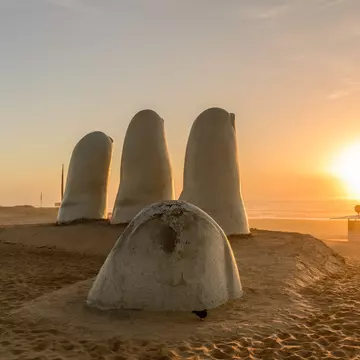
    Punta del Este's most famous landmark is the monster-sized hand emerging from the sands of Playa Brava. La Mano en la Arena, sculpted in iron and cement by Chilean artist Mario Irarrazabal in 1982, won first prize in a monumental art contest that year and has been a Punta fixture ever since. The hand exerts a magnetic attraction over visitors to Punta, who climb and jump off its digits and pose for thousands of photos with it every year.

    Up close, the hand is starting to show its age. There's graffiti scrawled all over it, and its ungraceful cement base often gets exposed by shifting sands. But watch out - the hand's still likely to reach out and grab you!

    reviewed

  9. In Search Of Iguassu—Rio to Buenos Aires

    In Search Of Iguassu—Rio to Buenos Aires

    17 days (Rio de Janeiro to Buenos Aires)

    by G Adventures

    Dance your way through the best of South America's colourful cities. Kick off your adventure in Rio where you're free to explore the carnival atmosphere or soak…

    Not LP reviewed

    from USD$2,349
  10. In Search Of Iguassu - Buenos Aires to Rio

    In Search Of Iguassu - Buenos Aires to Rio

    17 days (Buenos Aires to Rio de Janeiro)

    by G Adventures

    Get your South American rush with other young travellers not afraid to embrace the new. You'll kick off the adventure in sophisticated Buenos Aires before…

    Not LP reviewed

    from USD$2,349
  11. Advertisement

  12. Real de San Carlos

    At the turn of the 20th century, Argentine entrepreneur Nicolás Mihanovich spent US$1.5 million building an immense tourist complex 5km north of Colonia at Real de San Carlos. The attractions included a 10,000-seat bullring (made superfluous after Uruguay outlawed bullfights in 1912), a 3000-seat fronton (court) for the Basque sport of jai alai, a hotel-casino and a racecourse.

    Only the racecourse functions today, but the ruins of the remaining buildings make an interesting excursion, and the adjacent beach is popular with locals on Sundays.

    reviewed

  13. SOS Rescate de Fauna Marina

    Ten kilometers south of Piriápolis is Uruguay’s premier marine-animal rescue and rehabilitation center, SOS Rescate de Fauna Marina. Run entirely by volunteers, its emphasis is on educating schoolchildren, who can assist with daily feedings and observe penguins, sea lions, turtles and other rescued wildlife. Visitors willing to support the center’s mission with the requested donation are welcome with advance notice.

    reviewed

  14. Museo del Indio y del Gaucho

    Paying romantic tribute to Uruguay’s gauchos and indigenous peoples, this museum’s collection includes stools made from leather and cow bones, elegantly worked silver spurs and other accessories of rural life.

    reviewed

  15. Plaza Mayor 25 de Mayo

    At the southwest corner of the plaza are the Casa de Lavalleja (formerly General Lavalleja's residence), the ruins of the 17th-century Convento de San Francisco and the restored 19th-century faro (lighthouse). At the west end, on de San Francisco, the Museo Municipal has antique homewares, dinosaur remains and huge petrified mushrooms. The Casa del Virrey - which was never home to a viceroy - is just to the north.

    reviewed

  16. Bosque de Ombúes

    The Ombu is native to the Pampas, a hardy, fast-growing tree able to survive on very little water. A tour through Bosque de Ombúes (Ombu Forest) takes an hour by jeep or tractor, or two hours by foot. Your guide will point out unique forest flora, fascinating birdlife, and carpinchos - large rodents used traditionally to cure influenza and the common cold.

    reviewed

  17. La Penultima

    La Penultima has views of the wild ocean from the front balcony and a Mexican cantina feel. It serves up pizzas and seafood and sometimes has live music. Other little bars open up along the seafront during the summer, but the best parties happen on the beach where locals and visitors gather around beachfires to play guitars, sing songs and just generally hang out.

    reviewed

  18. Punta's Beaches

    From Playa Mansa, west along Rambla Williman, the main beach areas are La Pastora, Marconi, Cantegril, Las Delicias, Pinares, La Gruta at Punta Ballena, and Portezuelo. Eastward, along Rambla Lorenzo Batlle Pacheco, the prime beaches are La Chiverta, San Rafael, La Draga and Punta de la Barra. In summer, all have paradores (small restaurants) with beach service.

    reviewed

  19. E

    Iglesia Matriz

    Plaza de Armas is the home to Uruguay’s oldest church (begun in 1860), though it has been completely rebuilt twice. The plaza also holds the foundations of a house dating from Portuguese times.

    reviewed

  20. F

    Playa Mansa

    Beaches are the big daytime draw in sunny Punta, and there are plenty to choose from. On the west side of town, Rambla Artigas snakes along the calm Playa Mansa on the Río de la Plata, then passes the busy yacht harbor, overflowing with boats, restaurants, nightclubs and beautiful people, before circling around the peninsula to the open Atlantic Ocean.

    reviewed

  21. Casa Pueblo

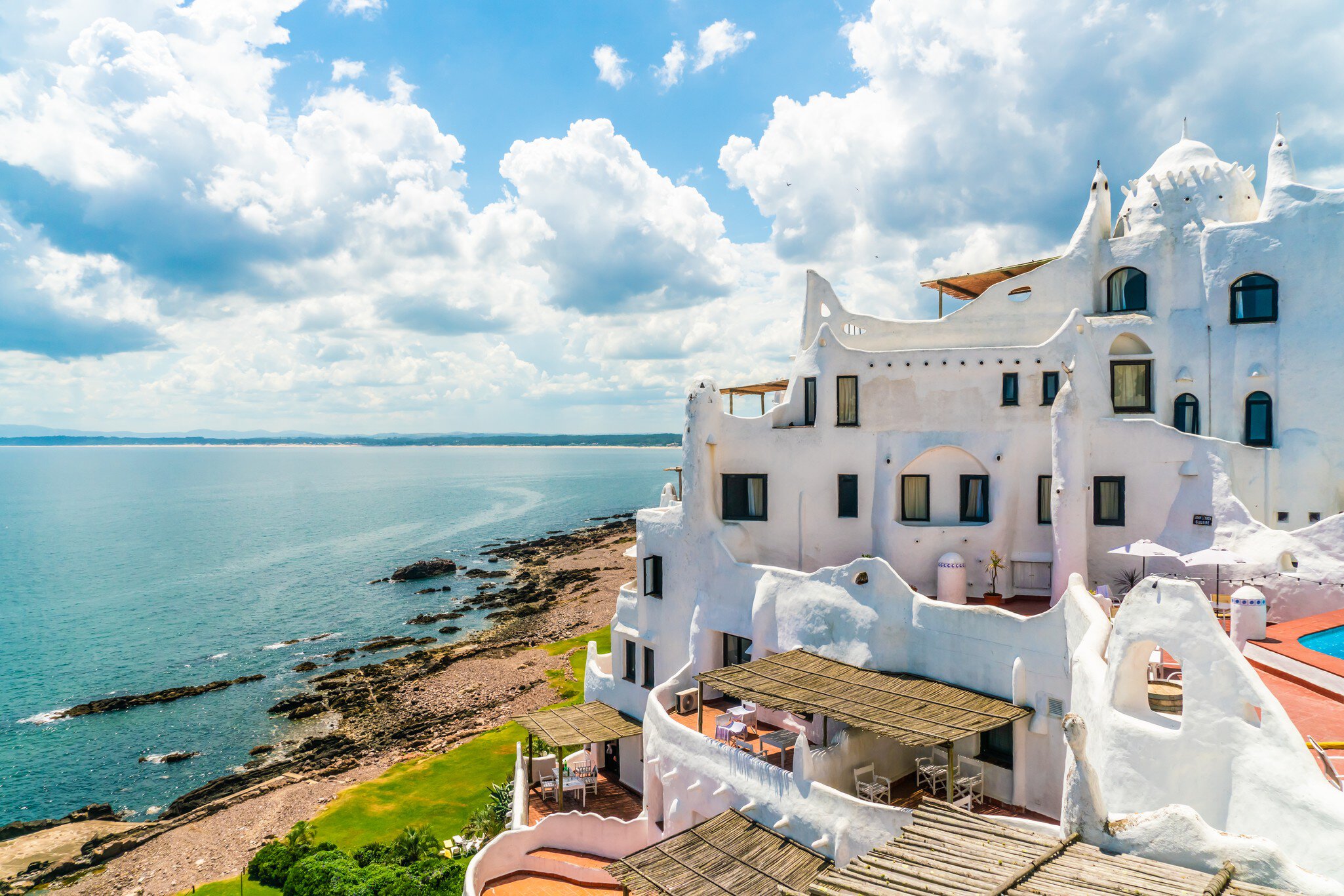
    Casa Pueblo is an astonishing Mediterranean villa and art gallery at scenic Punta Ballena, a short trip from Punta del Este. The villa was built by Carlos Páez Vilaró entirely without right angles and boasts jaw-dropping views. Visitors can tour five rooms, view a film on the artist's life and the building's creation, or have a drink at the bar.

    reviewed

  22. Advertisement

  23. Casa Pueblo

    Casa Pueblo is an astonishing Mediterranean villa and art gallery at scenic Punta Ballena, a short trip from Punta del Este. The villa was built by Carlos Páez Vilaró entirely without right angles and boasts jaw-dropping views. Visitors can tour five rooms, view a film on the artist's life and the building's creation, or have a drink at the bar.

    reviewed

  24. G

    El Faro del Cabo Santa María

    The 1874 completion of this local lighthouse, marked La Paloma’s genesis as a summer beach resort. The unfinished first attempt collapsed in a violent storm, killing 17 French and Italian workers who are buried nearby. Outside is a solar clock using shadows cast by the lighthouse.

    reviewed

  25. 1949 Hostel Bar

    This is a good place to meet up with other travelers. Once they boot you out of there, you'll have a gang together to roam the streets - either down to the port area for more drinks at the hip, minimalist Soho and Hop! or the slightly more laid-back Moby Dick. All stay open as long as there's a crowd and sometimes have live music on weekends.

    reviewed

  26. Cycling

    Get yourself a bike and go cruising along the walking-jogging-cycling track that follows the riverfront Rambla; bikes can be rented at both the Montevideo Hostel and the Ciudad Vieja Hostel. If all that seems a bit too energetic, bus 64 goes from Av 18 de Julio along the coast road - just jump off when you see a beach you like.

    reviewed

  27. El Viejo y El Mar

    At the dunes’ edge, south of the town center, ‘old man’ Ernesto has just re-opened this delightfully ramshackle restaurant, suffused with a rustic-hip atmosphere. The candlelit walls are adorned with fishing nets, wine bottles, lanterns and guitars, and you’re offered whatever he’s serving that night; the fixed-price menu usually includes fish, wine and dessert.

    reviewed