Sights in United Arab Emirates
-
A
Burj Khalifa
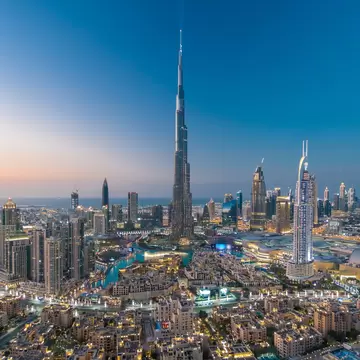
Call it impressive or preposterous, there’s no denying that Burj Khalifa is a ground-breaking feat of architecture and engineering. The world’s tallest building pierces the sky at 828m (seven times the height of Big Ben) and opened on 4 January 2010, only six years after excavations began. Up to 13,000 workers toiled day and night, at times putting up a new floor in as little as three days. Inside Dubai’s own ‘Tower of Babel’ is a mix of offices and apartments; at the time of writing, the sleek Armani Hotel was scheduled to open late in 2010. For visitors, the main attraction is the Observation Deck ‘At the Top’ on the 124th floor. From such lofty heights…
reviewed
-
B
XVA Gallery
One of Dubai’s best-loved and most reputable galleries, XVA occupies a warren of rooms in a beautifully restored Bastakia courtyard residence. Curators showcase contemporary paintings, sculptures and art installations from regional and international artists. They also organise the annual Bastakiya Art Fair and art-house movie screenings (November to April). The complex also houses the delightful XVA cafe and boutique hotel.
reviewed
-
C
Burj al-Arab
We’re suckers for trivia, so let’s kick off by telling you that the lobby of the Burj al-Arab is so high, the Statue of Liberty would fit quite nicely into it. Or that the sail-shaped building tops out at 321m, just a few metres shorter than the Eiffel Tower. And here’s one more: 1600 sq metres in the hotel are sheathed in gold leaf. OK, that’s enough. In its first decade since opening, the Burj al-Arab has been more than just the iconic symbol of a booming city in the sand; it has challenged preconceived ideas of what an Arab country in the Middle East can achieve. It’s built on an artificial island 280m offshore from the Jumeirah Beach Hotel, to which it is linked by a…
reviewed
-
D
Madinat Jumeirah
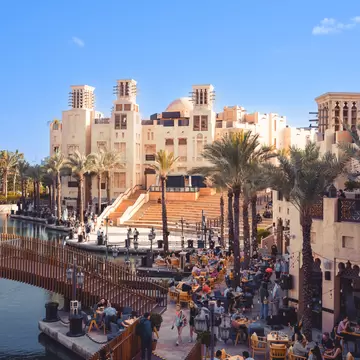
A city within a city, the Madinat Jumeirah is a Dubai must-see. There’s plenty to do at this fanciful hotel, shopping and entertainment complex with the Burj al-Arab in the background. Explore the Arabian-style architecture, snoop around the splendid Al-Qsar and Mina A’ Salam hotels, or get lost in the labyrinth of the souvenir-saturated souq. There are some exquisite details throughout, so if you see some stairs, take them – they might lead you to a secreted terrace with a mesmerising vista of the sprawling complex. If you’re a hotel guest, or have a restaurant reservation, you can catch the silent abras cruising along the 4km-long network of Venetian-style…
reviewed
-
Liwa Oasis
Few places in the UAE are as romantic as Liwa Oasis. With its magnificent apricot-coloured sand dunes, its sprinkling of verdant oases and its star-studded night skies, there's no wonder that it is a popular weekend getaway for locals. Positioned on the edge of Saudi Arabia's Rub'al-Khali (Empty Quarter), it lives up to its name, with the only things disturbing the magnificent horizon of dunes an occasional wandering camel.
Liwa Oasis itself is actually a belt of villages and farms spread out over a 150km (93mi) arc of land. Locals in 4WDs often camp in the area on weekends, and tour companies offer 4WD dune rides from Abu Dhabi. The most spectacular scenery can be seen…
reviewed
-
E
Nad al-Sheba Club
A passionate love of Arabian thoroughbreds courses through the blood of Emiratis, and the Dubai-based Godolphin stables are well known to horse-racing enthusiasts worldwide. Though racing season officially starts in November, the Dubai International Racing Carnival (late January through March) is when things really heat up. But it’s not the white-linen set that packs these weekly races. It’s the not-so-civilised drunk expats in shorts and T-shirts – at least in the public areas. For access to the stands, you must wear a ‘lounge suit’, basically a jacket and trousers. The season culminates in the Dubai World Cup, the world’s richest horse race, with prize money…
reviewed
-
F
Dubai Museum
Unless some mad scientist invents a magic time-travel machine, this nifty museum is your ticket to exploring Dubai’s history, culture and traditions in an hour or so. Exhibits are housed in the 1799 Al-Fahidi Fort, considered the oldest building in Dubai and once the seat of government and residence of Dubai’s rulers.
This low-key museum tells the Dubai story with minimal fuss and plenty of charm. Start with a quick spin around the courtyard with its old-time fishing boats and traditional dwellings, including a barasti house with wind tower. Pop behind the heavy carved wooden doors to check out modest displays of instruments and handcrafted weapons before heading down…
reviewed
-
G
Dubai Aquarium & Underwater Zoo
Dubai Mall’s most mesmerising sight is this gargantuan aquarium where 33,000 submarine beasties flit and dart amid artificial coral and behind the ‘world’s largest acrylic viewing panel’, as recorded in the Guinness Book of Records. Sharks and rays are top attractions, but other crowd-pleasers include a Sumo-sized giant grouper and massive schools of pelagic fish. You can view quite a lot for free from the outside or pay for access to the walk-through tunnel. A highlight here is a darkened cave where you can go nose-to-nose with dozens of toothy sharks. If that’s not close enough, don a wetsuit and join a dive instructor on a shark dive (Dh625 if PADI-certified,…
reviewed
-
Women's Handicraft Centre
If you have an interest in traditional crafts, the government-run Women's Handicraft Centre, in the Women's Union building, is definitely worth an hour of your time. Start with the displays of traditional weaving, costumes, textiles, camel bags and crafts in the Exhibition Hall; there are some products for sale in a small shop here.
Then head to the eight workshops out the back where covered old local ladies sit on the floor, gossiping and laughing (and totally oblivious to the German and French tour groups), as they demonstrate their crafts of saddu, talli, textile weaving, embroidering, tailoring, basket-weaving, palm-tree frond weaving, and henna. Take off your shoes…
reviewed
-
H
Dhow Wharfage
Dhows are long, flat, wooden vessels used in the Indian Ocean and Arabian Sea, and they’ve docked at the Creek since the 1830s when the Maktoums established a free-trade port, luring merchants away from Persia. Today’s dhows trade with Iran, Iraq, Pakistan, Oman, India, Yemen, Somalia and Sudan, and you’ll see them precariously loaded with everything from air-conditioners to chewing gum to car tyres, almost all of it re-exported after arriving by air or container ship from countries like China, South Korea and Singapore. Try to chat to the sailors if you can – if you find one who speaks English, you may learn that it takes a day to get to Iran by sea and seven days to…
reviewed
Advertisement
-
I
Qasr al-Husn
Once home to the ruling Al-Nahyan family, this splendid, white palace fort, built in 1761, is Abu Dhabi's oldest building. This is from where Abu Dhabi was governed from the 18th century until 1966. Not officially open to the public, the palace will soon be undergoing restoration to return it to its original state - until work begins you can call the Cultural Foundation to arrange an informal tour.
Decorated with gorgeous Portuguese tiles, the imposing main entrance features a small, wooden door spiked with black iron nails set within a larger wooden door. Within the walls there are pleasant courtyards and palm-filled gardens that are wonderful to wander around. Inside…
reviewed
-
Mosque (Badiyah)
The small fishing village of Badiyah (also spelt Bidyah and Bidiya), 8km north of Khor Fakkan but in the Fujairah emirate, is one of the oldest villages in the Gulf. Archaeological digs show that it has been settled continuously since the 3rd millennium BC. Today, it is known mainly for its mosque, a charming earth-coloured structure of stone, mud brick and gypsum built between 1446 and 1668. The building’s roof, with its four pointed domes supported by an internal pillar, is particularly distinctive and its simple interior has a lovely contemplative feel. Thought to be the oldest mosque in the UAE, it now functions mainly as a tourist attraction. Non-Muslims may enter if…
reviewed
-
J
Cultural Foundation
The vibrant Cultural Foundation is Abu Dhabi's artistic and cultural centre with a regular programme of live theatre, classical music, ballet, local poetry, music and dance, art and photography exhibitions, and screenings of world cinema. It's situated in the centre of the city in a modern Islamic-inspired building, with elegant arches and intricately decorated tiled passageways.
It's also home to the excellent Emirates Film Competition, which provides a rare insight into local culture through short films, the Abu Dhabi International Pearl Festival (www.ad-pearl.com), the Abu Dhabi Authority for Culture and Heritage, National Archives, the National Library, an Arts…
reviewed
-
Al-Ain
You can easily lose yourself in the labyrinthine lanes of Al-Ain, the main town in the Buraimi Oasis, straddling the border between Abu Dhabi and Oman. Its sister town, Buraimi, is on the Omani side of the border, but visitors can move freely between the two, making this a fine way to get a taste of Oman without the hassle of obtaining a visa.
The Al-Ain Museum contains exhibits on life in pre-oil days, Bedouin jewellery, weaponry, musical instruments and the interior of a Bedouin tent. If you're in the market for a sheep or goat, the nearby livestock souk attracts Bedouin and townspeople from all over southern UAE and northern Oman. North across the border, the…
reviewed
-
Camel Market
It’s dusty, noisy, pungent and chaotic, but never mind: Al-Ain’s famous camel market is a wonderful immersion in ancient Arabic culture that’s so hard to find in the UAE today. All sorts of camels are holed up in pens, from babies that might grow up to be racers to studs kept for breeding. The intense haggling is fun to watch, but you’ll also quickly realise that you’re as much an attraction to the traders as they are to you (especially if you’re a woman!). Some may try to make you pay for a tour but you’re free to walk around on your own. If you take photos of the animals or their owners (always ask first, of course) it’s nice to give a small tip. Note that the…
reviewed
-
K
Deira Spice Souq
Just follow your nose to the best buys at this atmospheric souq. The guttural singsong of Arabic bounces around the lanes of this small covered market as stallholders work hard on you to unload aromatic frankincense, dried lemons, chillies or exotic herbs and spices. This ain’t no Istanbul-like bazaar but it’s still worth a half-hour of your time to take in the wonderfully restored wind towers and the pungent aromas from the jute sacks. Since this is a working souq, not a tourist attraction, the tiny shops also sell groceries, plastics and other household goods to locals and sailors from the dhows. Good buys include incense burners, saffron, rose water, henna kits and…
reviewed
-
L
Bull Butting
The popular spectator sport of bull butting , held in an unassuming dirt area on the southern outskirts of town (before Al-Rughailat Bridge) has been held in the area for centuries. Bulls are brought here from all over the UAE to lock horns and test their strength against each other. The Emirati families (this is one sport that sees just as many female spectators as male) park their cars in a circle and stand and sit in front of them, forming something of an arena. The five or six Emirati men who judge the event sit cross-legged on the ground quite close to the action. While a wandering bull sees spectators racing for their cars, the judges rarely flinch.
reviewed
-
M
Sheikh Saeed Al-Maktoum House
The grand courtyard house of Sheikh Saeed, the grandfather of current Dubai ruler Sheikh Mohammed, is the crown jewel of the restored Shindagha Heritage Area. Built in 1896, under Sheikh Maktoum bin Hasher al-Maktoum, the house was home to the ruling family until Sheikh Saeed’s death in 1958. Aside from being an architectural marvel, the building now doubles as a museum of pre-oil times, with a neat collection of photographs of Dubai taken in the 1940s and ’50s on the Creek, in the souqs and at traditional celebrations. Other rooms feature coins, stamps and documents dating back as far as 1791, as well as an interesting display on pearl diving.
reviewed
-
N
Majlis Ghorfat Um-al-Sheef
It is unusual to find a traditional building still standing so far from the Creek, but this one has been well restored and is worth a quick stop. The two-storey structure was built in 1955 as a summer residence of the late Sheikh Rashid bin Saeed al-Maktoum. Made of gypsum and coral rock with a palm frond roof and a wind tower, it provided a cool retreat from the heat. The palm tree garden features a traditional falaj irrigation system. The actual majlis (meeting room) upstairs is decorated with cushions, rugs, a coffee pot, pottery and food platters, and is pretty close to the way it would have looked in Sheikh Rashid’s day.
reviewed
-
University City
A cross between Oxford and Disneyland, this sprawling and somewhat surreal campus is artificially greened, with splendid fountains, expansive lawns and flowerbeds galore. Its architecture is truly stunning and it's a popular stop on most expat's visitor sightseeing tours.
Check out the American University of Sharjah, with its Middle-East-meets-the-White-House building, the School of Sharia'a Law, the Sharjah Library, and the University of Sharjah. The city is unlike anything else in the country and is a sign of the importance placed on higher education in the UAE. It's next to Sharjah airport, 15km from the centre of town.
reviewed
Advertisement
-
O
Lost Chambers
This fantastical labyrinth of underwater halls, passageways and fish tanks recreates the legend of the lost city of Atlantis. Some 65,000 exotic marine creatures inhabit 20 aquariums, where rays flutter and jelly fish dance, moray eels lurk, and pretty but poisonous lion fish float. The centrepiece is the 11 million-litre Ambassador Lagoon. For 18 months its ‘star attraction’ was Sammy, an endangered whale shark captured off the coast of Dubai in 2008. Bowing to international pressure from animal rights activists, the magnificent creature was finally released back into the open sea in March 2009.
reviewed
-
P
Dhow-Building Yard
The gorgeous, traditional old dhows you see on Dubai Creek are still built by hand in the traditional style on the Creek waterfront, in Jaddaf, about 1km south of Al-Garhoud Bridge. Here, craftsmen use basic tools (a hammer, saw, chisel, drill and plane) to curve and fit sturdy teak planks, one on top of the other, before fitting the frame on the inside of the boat. Be impressed: this is in contrast to Western boat-building techniques where the frame is generally built first, and the planks fitted to it. These days, of course, the blokes pop an engine on the back before sliding it into the Creek.
reviewed
-
Q
Abu Dhabi Heritage Village
On the Breakwater, beside the big flagpole, is the charming Abu Dhabi Heritage Village. After renovations, it's now one of the most interesting in the UAE. Set in lush gardens with trickling fountains, it's a lovely place to spend a morning, before it gets too steamy.
It offers a glimpse of Abu Dhabi life in the pre-oil days, with a re-creation of a souq, a traditional old mosque, a Bedouin encampment with a goat-hair tent and camels, and a barasti house. Workshops are held where you can watch craftsmen making pots, blowing glass, beating brass and weaving on traditional looms.
reviewed
-
R
Ras al-Khor Wildlife Sanctuary
Right in the heart of the city, Ras al-Khor Wildlife Sanctuary is an amazing nature preserve. Pretty pink flamingos steal the show in winter, but in fact avid birdwatchers can spot more than 250 species in this pastiche of salt flats, intertidal mudflats, mangroves and lagoons. At the mouth of Dubai Creek, the sanctuary is also an important stopover on the East African–West Asian Flyway. There are three hides (platforms) with fantastically sharp binoculars for close-ups of the birds without disturbing them. The flamingo roost is off the junction of Al-Wasl and Oud Metha Rds.
reviewed
-
S
Al-Ahmadiya School
Dubai’s first school was founded by the pearl merchant Sheikh Ahmed bin Dalmouk and welcomed its first students, all boys, in 1912. You can see the original classroom where they squeezed behind wooden desks to learn the Holy Quran, grammar, Arabic calligraphy, mathematics, literature and astronomy. Otherwise, exhibits are pretty basic but the building itself is not: note the exquisite detail, especially the intricate carving within the courtyard arches and the decorative gypsum panels outside the entrance. It remained in use as a school until the student body outgrew the premises in 1963.
reviewed