KyivSights

Sights in Kyiv

‹ Prev

of 3

  1. A

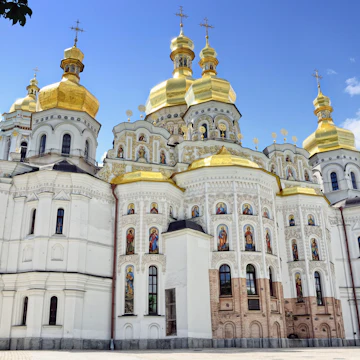
    Kievo-Pecherska Lavra

    Tourists and Orthodox pilgrims alike flock to the Kievo-Pecherska Lavra. It’s easy to see why the tourists come. Set on 28 hectares of grassy hills above the Dnipro River, the monastery’s tight cluster of gold-domed churches is a feast for the eyes, the hoard of Scythian gold rivals that of the Hermitage in St Petersburg, and the underground labyrinths lined with mummified monks are exotic and intriguing.

    reviewed

  2. B

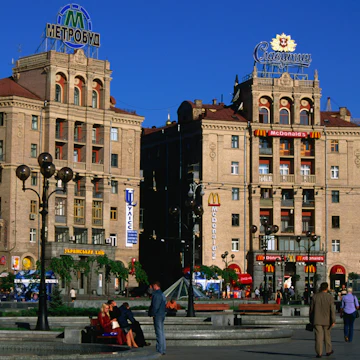
    Maydan Nezalezhnosti

    Fountain-filled maydan Nezalezhnosti is the city's most popular meeting place. This was made plain on worldwide TV at the end of 2004 when the square became ground zero for Ukraine's Orange Revolution and makeshift tent city.

    The square has held protests since the Orange Revolution and will probably see many more. But 'Maydan' does not require political strife to affirm its place as Kyiv's loudly thumping heart. All streets in the centre seem to spill into maydan Nezalezhnosti, and with them spills a cross-section of Kyiv life: vendors selling food and souvenirs, teenagers carousing under the watchful gaze of winged angel statues, skate rats and snake charmers, lovers and…

    reviewed

  3. C

    Museum of the Great Patriotic War

    There's not much to say about Rodina Mat (literally 'Nation's Mother', but formally called the Defence of the Motherland Monument). However, from certain parts of Kyiv it's highly visible and so requires a fittingly high-profile explanation. Especially when you're journeying in from the left (or east) bank, this 62m-tall statue of a female warrior is liable to loom up on the horizon and make you wonder, 'What the hell is that?'

    What the hell, indeed. It's the icing on top of the Museum of the Great Patriotic War. The statue has been nicknamed 'the Iron Lady' and 'Tin Tits'. Even if you don't like such Soviet pomposity, don't say too much; you'd be taking on a titanium wom…

    reviewed

  4. Antoniy Caves

    The Antoniy Caves, Chernihiv's answer to Kyiv's Kievo-Pecherska Lavra lurk beneath the ground a short walk north of the Troyitsko-Illynsky Monastery. The caves consist of 315m of passageways, galleries and chapels constructed from the 11th to 13th centuries.

    These are very different from those in Kyiv in that they lack both dead mummies and, for the most part, live tourists. The conditions here were too cold and humid to support mummification. Instead, the bones of monks killed during the Mongol invasion are preserved in a windowed sarcophagus; touching the sarcophagus is considered good luck. The cave's benefactor and namesake, St Antoniy of Pechersk, also helped burrow …

    reviewed

  5. Podil

    The funicular to the rear of St Michael's Gold-Domed Monastery and Andriyivsky uzviz both lead down to the riverside mercantile quarter of Podil. An appealing grid of streets lined with quaint lanterns and eclectic turn-of-the-20th-century buildings, it's the antidote to all those Soviet façades that dominate vul Khreshchatyk. Dating back to the earliest settlements, the area grew quickly around the port. Today it's a buzzing restaurant district.

    Podil was last rebuilt in 1811 after a devastating fire and emerged largely unscathed from WWII.

    reviewed

  6. D

    Zoloti Vorota

    The famous Zoloti Vorota sounds much better than it looks, but the summer patio around the fountain out front is a great place to have a drink. Erected in 1037 and modelled on Constantinople’s Golden Gate, this was the main entrance into the ancient city, with ramparts stretching out from both sides. However, the gate was largely destroyed in the 1240 Mongol sacking of Kyiv, and what you see today is a 1982 reconstruction­. The statue to the side is of Yaroslav.

    reviewed

  7. E

    St Andrew’s Church

    That blue, beautiful piece of baroque dominating the view as you walk up ‘the uzviz ’ is St Andrew’s Church. Built in 1754 by Italian architect Bartelomeo Rastrelli, who also designed the Winter Palace in St Petersburg, this is a magnificent interpretation of the traditional Ukrainian five-domed, cross-shaped church. Entry to the rich interior, where English placards explain the history of the church, is free during frequent services and 6uah at other times.

    reviewed

  8. F

    Andriyivsky uzviz

    It says a lot for Andriyivsky uzviz that it has retained its charm despite the souvenir stalls overflowing on its cobblestones. Historically this curving incline linked the high ground of the administrative centre, or Upper Town, to Podil. Nowadays it's frequented by purveyors of Ukrainian crafts, Soviet memorabilia, Yuri Gagarin T-shirts and the occasional stunning photo of Kyiv. Yet the quaint houses and crooked pavements still give the place plenty of atmosphere.

    reviewed

  9. Zhyvopysna aleya

    About three-quarters of the way up Andriyivsky uzviz on the left, just before you get to St Andrew's Church, is Zhyvopysna aleya, which turns into a giant outdoor art gallery on weekends. We can't say much for the art (anyone for an air-brushed portrait of a semi-clad vixen in front of St Andrew's Cathedral?), but the leafy path leading southeast from here to Volodymyrska Hirka park makes for a pleasant walk or jog.

    reviewed

  10. G

    Funicular

    Heading around the left of St Michael's Gold-Domed Monastery to the rear, you'll find the quaint funicular that runs down a steep hillside to the river terminal in the mercantile district of Podil. Although in the summer trees partially obscure your view, this is still the most fun public-transport ride in town.

    reviewed

  11. Advertisement

  12. Pyrohovo Museum of Folk Architecture

    Ukraine is dotted with ‘open-air’ museums like this, full of life-size models of different rustic buildings. However, the Pyrohovo Museum of Folk Architecture is one of the most fun and best maintained.

    reviewed

  13. H

    PinchukArtCentre

    The rotating exhibits at the world-class PinchukArtCentre feature elite names in the world of European contemporary art and design, all financed by billionaire mogul Viktor Pinchuk.

    reviewed

  14. Babyn Yar

    On 29 September 1941, Nazi troops rounded up Kyiv's 34,000-strong Jewish population, marched them to the Babyn Yar ravine, and massacred them all in the following 48 hours. Victims were shot and buried in the ravine. Over the next two years, many thousands more lost their lives at Babyn Yar when it was turned into a concentration camp, called Syrets after the Kyivan suburb it was in. Romany people, partisans and even footballers would be among those killed.

    The place's dreadful history only came to light after the war, and three monuments have been erected over time. The first was a colossal Soviet effort dating from 1976, which is found in the southern sector of the park…

    reviewed

  15. I

    Bohdan and Varvara Khanenko Museum of Arts

    Kyiv’s most impressive collection of European art is at the sumptuous Bohdan and Varvara Khanenko Museum of Arts. Bosch, Velazquez and Rubens are among the many masters represented, but they are only part of the attraction. The house, with its frescoed ceilings and intricately carved woodwork, alone is worth the price of admission. All the better that it’s packed with priceless antique furniture, ancient Greek sculptures, porcelain ceramics and dazzling paintings, such as a version of Hieronymus Bosch’s Temptation of St Anthony. The museum’s climax is on the top floor: four rare religious icons from the 6th and 7th centuries. Even if icons aren’t your thing, it’s ha…

    reviewed

  16. J

    Museum of Microminiature

    The Museum of Microminiature provides something even for atheists within this holiest of holies – and, boy, is it popular! The world’s smallest book (with some verses of Shevchenko), a balalaika with strings one-fourtieth the width of a human hair and a flea fitted with golden horseshoes are just some of his works of whimsy. Each is so small that microscopes are needed to view them, but you can occupy yourself with the brief English explanations while you wait. The museum also bears one of Kyiv’s great Everything is Illuminated –style creative English translations: ‘At the time of atmospheric precipitates exhibit is not function’.

    reviewed

  17. K

    Desyatynna Church ruins

    Up Andriyivsky uzviz past St Andrew's Church, look for a dense cluster of vendors selling Dynamo Kyiv & other sports paraphernalia on the right. The fenced-off archaeological site behind them covers the foundations of the Desyatynna Church ruins. Prince Volodymyr ordered the church built in 989 and devoted 10% of his income to it, hence the name (desyatyn means 'one-tenth'). The church collapsed under the weight of the people who took refuge on its roof during the Mongol sacking of Kyiv in 1240.

    Today the Moscow and Kyiv patriarchates of the Ukrainian Orthodox Church are fighting over the fate of the site - the latter wants to rebuild the church.

    reviewed

  18. L

    Dormition Cathedral

    Back out on the main path, you can't miss the seven gleaming gold domes of the Dormition Cathedral , a year-2000 replica of the famous and sacred original. To this day historians are unsure whether the Nazis or the Soviets were responsible for blowing up the original. You can enter the church only during services, typically held Saturday afternoons at 17:00 and Sunday mornings at 07:00. The big rock in the square between the cathedral and the bell tower is a fragment of the original cathedral.

    reviewed

  19. Spaso-Preobrazhensky Monastery

    Novhorod Siversky is the site of the idyllic Spaso-Preobrazhensky Monastery - a complex of wood-shingled buildings and golden-domed churches surrounded by charming 19th-century country homes and perched over the leafy banks of the Desna River. The monastery dates back to Igor’s era, although it has been rebuilt several times. Its last facelift was in 2004, on the occasion of a summit between presidents Kuchma, Lukashenko and Putin (Kuchma was born about 30km from here).

    reviewed

  20. M

    Chornobyl Museum

    It’s hard to convey the full horror of the world’s worst nuclear accident, but the Chornobyl Museum makes a valiant attempt. Displaying the identity cards and photos of those killed in the aftermath of the explosion of Chornobyl power plant reactor No 4, on 26 April 1986, it’s a shrine to their heroism. The photos of the area afterward and graphs of radiation contamination stand as a terrible reminder and stark warning: ‘Never again’.

    reviewed

  21. N

    Vydubytsky Monastery

    Few churches appear more frozen in time than those of the Vydubytsky Monastery, nestled into the hill’s dense foliage beneath the botanical gardens. The monastery, which is thought to be at least as old as Kyiv, is looking in fine fettle today after centuries of catastrophes followed by years of Soviet neglect. The monastery is home to a small community of monks who, quite frankly, have chosen a much more monk-friendly place to practise their faith.

    reviewed

  22. Advertisement

  23. O

    Museum of One Street

    There are diversions galore along And­riyivsky uzviz, including a few wonderful cafés, restaurants, galleries, craft shops and museums. At the foot of the uzviz, the individual histories of the descent’s buildings are laid out in the Museum of One Street. The sheer jumble-sale eclecticism of the collection – showcasing the lives of dressmakers, soldiers, a rabbi and more – exudes bags of charm.

    reviewed

  24. P

    Trinity Gate Church

    The main entrance to the Caves Monastery's upper lavra is through the striking Trinity Gate Church, a rather well-preserved piece of early-12th-century Rus architecture. Rebuilt in the 18th century, it once doubled as a watchtower and as part of the monastery fortifications. It's well worth going inside to observe its rich frescoes and lavish gilded altar. To access the church turn left immediately after entering through the main gate.

    reviewed

  25. Q

    Historical Treasures Museum

    The Historical Treasures Museum, behind the Dormition Cathedral, has an astounding collection of precious stones and metal found or made in Ukraine. The highlight is the fabulous hoard of gold jewellery worked for the Scythians by Greek Black Sea colonists. Much of the treasures come from two 4th-century BC burial mounds: the Tolstaya grave in the Dnipropetrovsk region and the Gaimana grave in the Zaporizhzhya region.

    reviewed

  26. R

    Monastery Museum

    St Michael's Gold-Domed Monastery's fascinating history is explained in great detail (in Ukrainian and English placards) in a museum located in the monastery's bell tower. The museum also explains the sad history of the neighbouring Tryokhsvyatytelska Church, destroyed by the Soviets in 1934. They then added insult to injury by building the gargantuan Ministry of Foreign Affairs (pl Mykhaylivska 1) on the site.

    reviewed

  27. S

    Bulgakov Museum

    The early home of the much-loved author of The Master and Margarita has become the memorable Bulgakov Museum. Mikhail Bulgakov lived here long before writing it, between 1906 and 1919 but this building was the model for the Turbin family home in The White Guard, his first full-length novel. You may want to take a guide to explain who’s who in the family photos.

    reviewed