Things to do in Taiwan
-
National Palace Museum
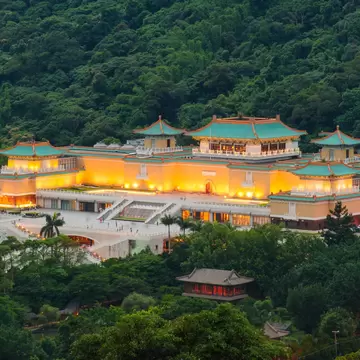
The National Palace Museum is home to what could quite easily be termed the world's largest and finest collection of Chinese art; it is unfortunate that the overall interior setup of the museum does not match with the grandeur of the collection. The museum's interior is poorly lit and for the most part its grand collection is laid out with little sense of theme or design, giving the museum a stagnant feel overall. This is especially strange in light of the fact that the exhibits are rotated frequently; the vast collection (much of it liberated from mainland China during the last retreat of the KMT) is far too large to exhibit at any given time. Nonetheless, the sheer volu…
reviewed
-
A
Dintaifung
With Taipei's most celebrated dumplings, Dintaifung is deservedly popular for Shanghai-style treats made fresh to order. Try the classic xiǎolóng bāo (steamed pork dumplings). Very popular with locals and visitors alike, so either phone in reservations (they speak enough English) or prepare to queue up.
reviewed
-
B
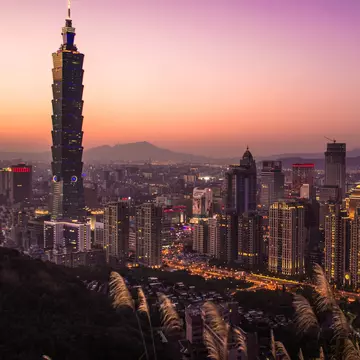
Taipei 101
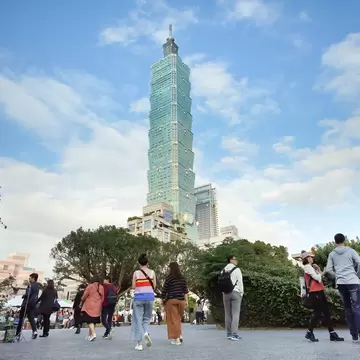
Towering above the city like the gigantic bamboo stalk it was designed to resemble, Taipei 101 is impossible to miss. At 508m, Taipei International Financial Centre 101, as it's officially named, is the world's tallest building (Dubai eat your heart out, for now at least!). In addition to holding the world record for height, Taipei 101 also holds the record for having the world's fastest elevator.
The pressure-controlled lift travels at 1010 meters per minute and takes 40 seconds to get from ground level to the 89th floor observation deck.
reviewed
-
Taroko Gorge
An awe-inspiring canyon with marble-walled canyons, lush vegetation and cliffs so giant they block out the sky, Taroko covers 120,000 hectares with mountain peaks rising to 3700m. The environment of this massive park is filled with high mountain peaks and the Liwu River, which cuts through the centre of the gorge, forging many deep valleys, ravines and waterfalls in its course. There are an abundance of hiking trails that lead visitors to shrines, temples, hot springs and panoramic vistas of the mountains and the sea.
reviewed
-
C
Chiang Kai-Shek Memorial Hall
Whether the imposing Chiang Kai-Shek Memorial Hall will always be known as the Chiang Kai-Shek Memorial Hall is anybody's guess. Many and strident are the voices in the high halls of Taiwan's government calling for this 70m-tall memorial to Taiwan's one-time dictator to be renamed, and the massive statue removed.
For now, this iconic monument with its white walls and blue octagonal roof still stands as a grandiose, ostentatious and perhaps fitting memorial to the man who, in life, was known in some circles as 'General Cash-my-check'. On the ground floor you'll find a museum dedicated to Chiang's life, with an assortment of military uniforms, medals, paintings and manuscri…
reviewed
-
D
Taipei Story House
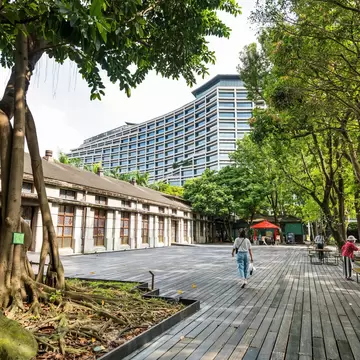
the Taipei Story House was built in 1914 by an aristocratic tea trader. Its style was said to have been inspired by a building he saw while visiting the 1900 Paris Expo. Today the house is an exhibition space for Taipei nostalgia and history. Exhibits change frequently and might include goodies such as toys, matchboxes and comic books.
reviewed
-
E
Shin Kong Mitsukoshi Department Store
Most older locals remember the days when this location housed a prison and execution room, and not an upscale mall.
reviewed
-
F
Shilin Night Market
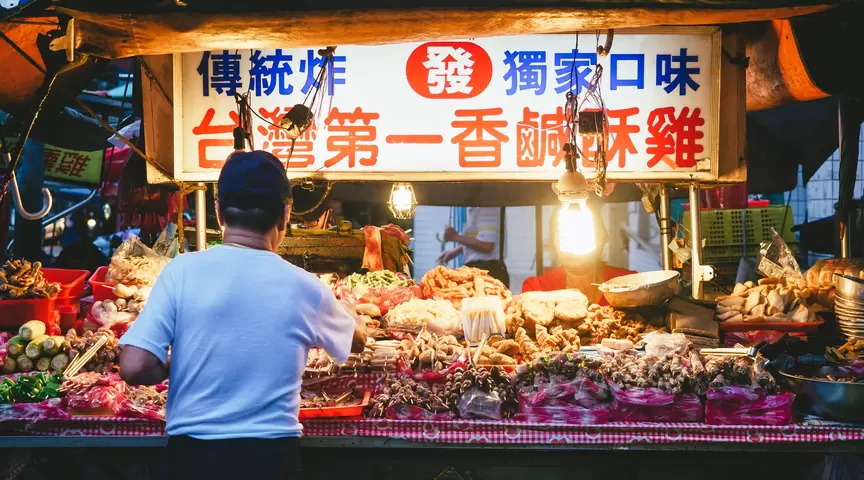
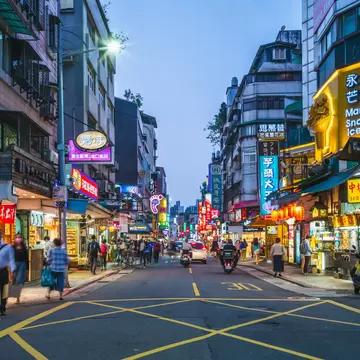
Considered by many to be the king of Taipei's night markets, the sprawling Shilin Night Market is a nightly carnival of snacking and shopping. Teeming with stalls selling delectable edibles far beyond our ability to describe, the latest in trendy clothing from shoes to hats (and everything in-between), games of skill and chance and much, much more. If you have only one night to spend in Taipei, spend it here.
reviewed
-
G
Longshan Temple
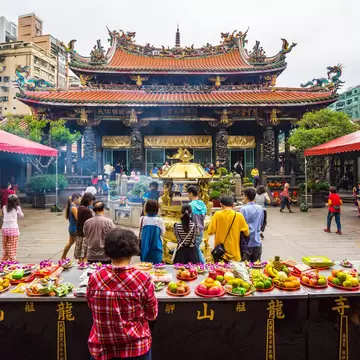
Religious life in Taiwan is alive and kicking seven days a week at the Longshan temple. Though not the biggest temple in the city, there is something unique and beautiful about the vibe at Longshan that keeps people coming back.
The temple dates back to 1738. As the story goes, a passer-by left an amulet of the Guanyin (goddess of mercy) hanging on a tree on the site of the present temple, and the amulet shone so brightly, even after dark, that all who passed by knew the site was blessed. Nearly three centuries later, the spot still exudes a certain warmth. The stones that line the courtyard of the temple were originally ballast on the ships that ferried immigrants from …
reviewed
-
H
Taipei Astronomical Museum
Opened in 1997, the Taipei Astronomical Museum houses four floors of constellations, ancient astronomy, space science and technology, telescopes and observatories. Though a good place to while away an hour with the kids, what keeps this otherwise excellent museum from being a must-visit is a dearth of English content though every exhibit features English and Chinese, but most of the actual information is in the latter language only.
Plans are underway to put full bilingual information online, so theoretically non-Chinese speaking visitors could download exhibit information and study up before arriving. More English-friendly attractions (at an extra charge) are an IMAX the…
reviewed
Advertisement
-
I
2-28 Memorial Museum
Located inside 2-28 park, the 2-28 Memorial Museum offers an explanation of the events of 28 February 1947 massacre and of the repercussions that followed. Acknowledgment of the 2-28 incident was a pivotal part of Taiwan's transformation from dictatorship to democracy.
Though there is little in the way of English signage in the museum, a multilingual walking tour device is available. However, there are generally bilingual volunteers on hand willing to walk you through and explain the significance of various events and displays. The building itself is significant, for it was from this, the former KMT radio station that officials tried to calm the masses as panic swept the …
reviewed
-
Shakadang Trail
The Shakadang Trail, formerly the Mysterious Valley Trail, is a flat 4.4km hike (one hour one way). The route follows the crystal-clear Shakadang River, which winds through marble canyons and boulder-strewn flats that create massive pools of blueish-green water (tinted by limestone in the rocks). Many outdoors groups from Hualien come here in summer to swim and river trace, though the park's board is not entirely happy about that.
Coming from the National Park Headquarters, the trailhead is to the right after emerging from the first tunnel. Follow the stairs down to the river to access the path. Note that you can only go as far as 3D Cabin without a permit.
reviewed
-
J
Miniatures Museum of Taiwan
Bigger is better, so some say; but not at the Miniatures Museum of Taiwan where quite the opposite is true. This small, private museum is dedicated to the exhibition of the minuscule, the tiny, the 'Sweet Jesus, I can't believe someone had the patience and steadiness of hand to create something so small and intricate!' Among the most (of many) astounding articles on display is a 40-bulb chandelier no bigger than a single grain of rice. A most impressive little museum indeed.
reviewed
-
K
National Museum Of History
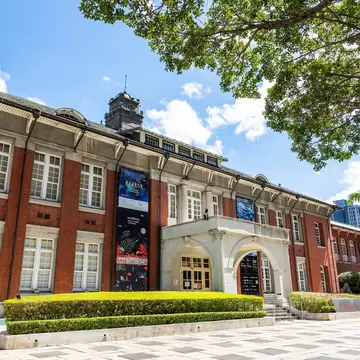
Just outside the Botanical Gardens, Taiwan's first National Museum Of History is still an anchor of local arts and culture housed in an elegant Japanese-era building. 'History' is actually a misnomer - Chinese art history would be more accurate, with thousands of Chinese artifacts from Tang, Shang and other dynasties. The tea room on the 3rd floor has views of the Botanical Gardens' lotus pond. A tour in English takes place each afternoon.
reviewed
-
L
Discovery Centre of Taipei
The Discovery Centre of Taipei is a good place to get your bearings on the city and its history. You can see maps and models depicting Taipei's evolution from a walled, gated city in 1882 to the bustling metropolis it is today. Discover more about its geography, topography, commerce, famous residents and natural resources. There's a free audio guide in English, and guided tours are available with advance notice.
reviewed
-
Tainan Tan-tsu-mien
Odd though it may seem to have rooms decorated like Versailles and Vienna in Snake Alley, that's what you'll find here. Select your own fish and seafood out the front and the chef will suggest a preparation method (grilled, steamed, fried etc). Don't forget to try the shop's namesake noodles (made with ground pork).
reviewed
-
M
Chocoholic
Leave room for desert. This tiny, brightly painted café is an old favourite, dating back to the days when good chocolate was impossible (as opposed to merely inconvenient) to find. Expect cakes, chocolate drinks and a clientele of smiley young things galore.
reviewed
-
N
Armory Pub
A few staples of the bar scene include Armory Pub and Willy's Second Base. Note that both places serve meals and the Armory has a decent range of vegetarian options.
reviewed
-
O
Amigo Mexican Food
Got a hankering for Mexican? Amigo has tacos, burritos, home-made soups and other 'south of the border' favourites. Dishes are served with flair matching a genuine taco-stand ambiance.
reviewed
-
Chung Tai Chan Temple
Completed in 2001, the massive Chung Tai Chan Temple is more than just another modern temple - it is an international centre of Buddhist academic research, culture and the arts.
The temple is 150m tall and sits on a 60-acre lotus hill outside Puli. It took 10 years and the donations of countless members of the Chung Tai Chan Buddhist community to complete. Chung Tai Chan is an international branch of Buddhism founded by the Venerable Master Wei Chueh - the Master who is said to have revived the Zen tradition in Taiwan.
From the start, the Master was determined to build something grand, something that would appeal to the modern eye as much as the soul. To achieve this, mod…
reviewed
Advertisement
-
P
Confucius Temple
Modelled after the temple in Confucius’ native town of Shandong, this temple is based on classical Chinese temple architecture. Confucius (551–479 BC) is generally acknowledged as China’s greatest educator and scholar. In his day, education was exclusive to nobility but Confucius successfully promoted popular education.
Confucius valued simplicity, a trait seen in the temple’s architecture and relatively muted adornments. Inscriptions that might be found on columns, doors and windows in other temples are banned here; who would have the temerity to think his or her writing could compare with that of the great master? Do take note of the detailed carvings of dragons o…
reviewed
-
British Consulate at Takou (Dagou)
Kaohsiung has a large number of well-preserved relics scattered around the city. The handsome redbrick consulate, built in 1865 by a British trading company, has recently become one of our favourite hang-out spots. The consulate sits about 70m or so above the mouth of Kaohsiung harbour, and it's a great location for watching the giant container ships sail through the tiny mouth of the harbour.
Recently the old dining and tearooms were reopened. With their Victorian British design, and arched windows letting in the sea views and breezes, they are a top spot for enjoying a meal or drink (open 10:00 to midnight).
While you're in the area check out a tiny temple to the left of…
reviewed
-
Lotus Pond
The pond has been a popular destination since the Qing dynasty and is well known for the 20 or so temples dotting the shoreline and nearby area. In recent years much money and effort has gone into returning the lake and its cultural and natural heritage to their former glory. There's now a path right around the lake, and efforts are underway to restore the wetlands on the west side. At night coloured lights give the lake a very festive and modern appearance.
Two long sections of the impressive Old Wall of Fengshan, built in 1826, lie to the southeast of the lake. The best section is along Chenfong Rd about 100m up Shengli Rd from the train station.
If you are going to the …
reviewed
-
Lin Family Mansion & Garden
The house was built in 1853 but opened to the public only in 2001. It's a prime example of a Qing-period mansion, with receiving halls, library and performance stages. There are eye-popping uses of gold leaf on the doors and gates among other decorations of auspicious imagery. From the Grain Viewing Pavilion family members were able to look out over the farmers at work. It is said that the residential buildings are all tongue-and-groove construction, meaning that no nails were used. Plus it's all set amid ponds and gardens you might swear you've seen in paintings.
Driving through this busy section of town, it may be difficult to believe that this was once all farmland. Ye…
reviewed
-
Q
Koxinga Shrine
When the Ming dynasty was overthrown by the Manchus in 1661, Koxinga (Cheng Cheng-kung) led his army to Taiwan with plans to restock supplies and then retake the mainland. He found the Dutch already here, but after nine months battle they surrendered and departed from Taiwan.
Koxinga did much to improve conditions on the island. But, like the KMT of modern times, he did not live to see the mainland retaken. He died after only a year in Taiwan, and his grandson surrendered to the Manchus in 1683.
There's a certain atmosphere of dignity surrounding the Koxinga Shrine, even though most of it is of rather recent origin: the original southern-style temple was rebuilt in a nort…
reviewed