Sights in Tahiti & French Polynesia
-
Musée Gauguin
The Musée Gauguin is definitely worth a visit. Much of the text about Gauguin and his life is in English, and although the museum is dimly lit and there is a conspicuous lack of original works by Gauguin, there’s a lovely natural setting. The museum gardens are home to three superb tiki from Raivavae in the Australs. Tiki do not like to be moved, and there are colourful stories about what happened to the men that moved these tiki here (they apparently died ‘mysteriously’ within weeks of the move). The huge tiki figure beside the walkway stands 2.2m high and weighs 900kg; it’s a baby compared with the figure towards the waterfront, which stands 2.7m high and weighs…
reviewed
-
Rangiroa
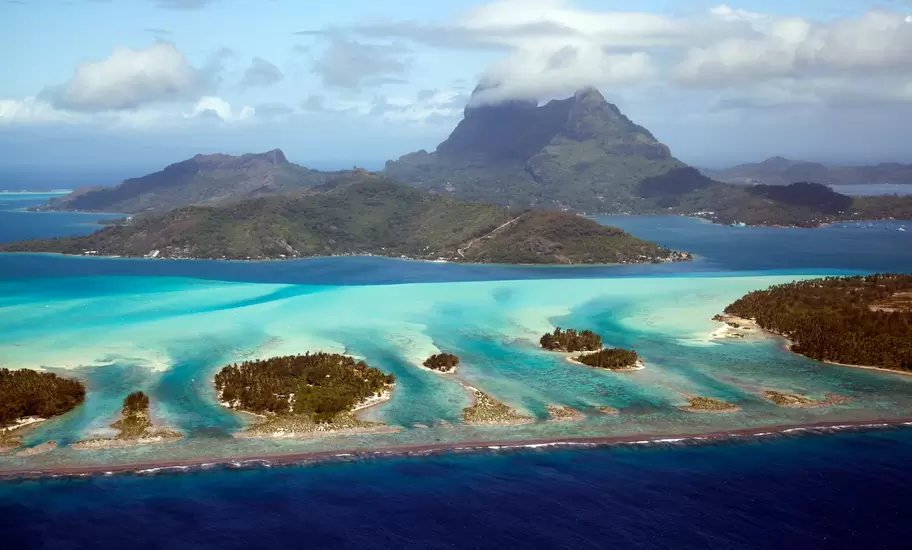
Rangiroa, in the Tuamotu Archipelago, is the second-biggest atoll in the world, behind Kwajalein in Micronesia. It measures 75km (46.6mi) by 25km (15.5mi) and is the most populated island in the archipelago. Its lagoon is more like a vast inland sea and dry land exists as a narrow chain of sandy motu (islets) encircling this huge waterway.
Divers come to Rangiroa from all over the world; the lagoon's configuration and tide movements cause powerful currents that they 'surf'. The lagoon is also home to a great abundance of diverse marine life. Pearl farming and mother-of-pearl production are important to the local economy.
reviewed
-
Jardin Botanique
The 137-hectare Jardin Botanique has walking paths that wind their way through the garden past ponds, palms and a superb mape forest. The gardens were founded in 1919 by an American, Harrison Smith, who introduced many plants to Tahiti including the large Southeast Asian pomelo known on Tahiti as pamplemousse, the French word for grapefruit. Unfortunately, Smith also introduced one or two botanical disasters that Tahiti could well have done without. Look out for the huge Galápagos tortoises. Mosquitoes in the gardens can be fierce.
reviewed
-
Taravao
Strategically situated at the narrow isthmus connecting Tahiti Nui with Tahiti Iti, the town of Taravao has been a military base on and off since 1844, when the first French fort was established. The original fort was intended to forestall Tahitian guerrilla forces opposed to the French takeover from mounting operations against Tahiti Nui from Tahiti Iti. Today the Faratea Port, on the northeastern side of the isthmus, is being built to shift commercial sea trade from Pape’ete (which is getting gussied up for tourists) to Taravao.
reviewed
-
Huahine Nui Pearls & Pottery
While in Faie, visit Huahine Nui Pearls & Pottery. Peter Owen, the owner, is a potter as well as a pearl farmer and his work is shown in Pape’ete’s galleries. His studio is on his pearl farm in the middle of the lagoon. From Faie a ferry departs for the studio every 15 minutes from 10am to 4pm. Upon arrival you’ll be given a demonstration of pearl farming and have an opportunity to browse the collection of pearls inside the shop – they’re particularly well priced.
reviewed
-
Musée de Tahiti et des Îles
Only 15km from Pape’ete along the west coast, the excellent Musée de Tahiti et des Îles is in Puna’auia. The museum is divided into four sections: geography and natural history; pre-European culture; the European era; and outdoor exhibits. It’s in a large garden and if you get tired of history, culture and art, you can wander out to the water’s edge to watch the surfers at one of Tahiti’s most popular breaks.
reviewed
-
Musée de Tahiti et des Îsles
The excellent Musée de Tahiti et des Îsles has one of the best collections in the Pacific. This is a great place to get your head around the geology, history, culture and art of the area. The museum is divided into four sections: geography and natural history; pre-European culture; the European era; and outdoor exhibits. One bonus of visiting this museum is that outside is one of Tahiti's most popular surf breaks.
reviewed
-
Espace Culturel Paul Gauguin
For Gauguin fans, a visit to the refurbished Espace Culturel Paul Gauguin is a must. Don’t get too excited, though; you won’t find any originals, just digital copies of his work. The detailed signs in English are very informative. Once you’ve done a full round of the paintings, timeline and literature, head outside and have a look at the Maison du Jouir (House of Pleasure), a replica of Gauguin’s own house.
reviewed
-
Hiva Oa
Hiva Oa contains some wonderful archaeological sites. One such place is Iipona, an exceptional me'ae (sacred site) featuring five monumental tiki (carved human figures). In the Faakua Valley are the Tehueto petroglyphs, where stylised, horizontal human figures have been carved into an enormous basalt block. The island is also noteworthy for being home to Belgian crooner Jacques Brel from 1975 to 1978.
reviewed
-
Lagoonarium
Just outside Pape’ete’s urban sprawl, the Lagoonarium is a pleasant tourist trap with a meshed-in area of lagoon with a modest underwater viewing room; it’s reached through a giant (though crumbling) concrete shark’s mouth. The entrance to the Lagoonarium is part of the Captain Bligh Restaurant, and if you eat at the restaurant there’s no charge to visit the Lagoonarium.
reviewed
Advertisement
-
Camika CED
To check out Mangareva’s famous mother-of-pearl carvings, head to the Camika CED, just downhill to the left from the intersection above Cathédrale Saint-Michel, where you can watch students as they engrave shells. You can buy finished products including small pendants and barrettes at the on-site shop. Prices for an engraved shell start at around 4000 CFP.
reviewed
-
Cathédrale Saint-Michel
In the upper part of Rikitea stands the Cathedral of St Michael, ultimate symbol of despotic French Catholic missionary Father Honoré Laval's single-minded obsession. Built between 1839 and 1848, its altar is decorated with mother-of-pearl and the woodwork is inlaid with pearl shell. It can accommodate 1200 people - several times the population of the island today!
reviewed
-
Marae Arahurahu
Whether or not you believe in the powers of the tiki (sacred statue), it’s hard to deny there is an amazing energy radiating from Marae Arahurahu in the Pa’ea district. Tranquil, huge and beautifully maintained, the marae (traditional temple) is undoubtedly the best-looking one on the island and even rivals those on other islands.
reviewed
-
Fare Potee
On the water's edge on the Fare side of Maeva, the fare potee (chief's house or community meeting place) houses a small archaeological museum. The original fare potee was destroyed in the 1998 cyclone but was rebuilt in 2001 using traditional materials. Around the site are 10 or more marae (temples), some of which date back to the 16th century.
reviewed
-
Point Vénus
Point Vénus, the promontory that marks the eastern end of Baie de Matavai (Matavai Bay), was the site of Captain Cook's observatory, built to record the transit of Venus across the face of the sun to try to calculate the distance between the sun and the earth. Today it's a popular, shaded black-sand beach overlooked by an impressive lighthouse.
reviewed
-
Maison Blanche
The early-20th-century Maison Blanche is a fine example of a fare vanira, a plantation house from Mo’orea’s vanilla-boom era. Located just past the Moorea Pearl Resort, the Maison Blanche is now a souvenir shop. It has a fairly typical selection of pareu (sarongs) and Balinese woodcarvings.
reviewed
-
Maraa Grotto
Lush gardens, overhung caverns, crystal-clear pools and ferny grottoes are all standard features at gorgeous Maraa Grotto. The fairytale park is found along the coastal road, and a manicured path runs throughout. It’s a popular stop on round-the-island circuits, but also well worth visiting on your own.
reviewed
-
Archaeological Museum
Situated on the water’s edge on the Fare side of Maeva, the fare potee (open traditional house) has a small archaeological museum. Around the site are 10 or more marae, some of which may date back to the 16th century. Flagstones cover a wide expanse of land along the shoreline.
reviewed
-
Arboretum
The fact that so many species have adapted to the dry Marquesan soil opens up great possibilities for local agriculture. The species best adapted to the climate are used for reforestation where the vegetation has been destroyed by wild goats and horses. The arboretum is located halfway between Vaipaee and Hane.
reviewed
-
Museum
Located next to the mayor’s office, this little museum features pestles, tiki, finely carved sculptures, pahu (drums), jewellery and period photos as well as a ha’e (traditional house). Donations are appreciated. Hours are erratic; ask at the mayor’s office.
reviewed
Advertisement
-
Centre Jacques Brel
Housed in a big aircraft hangar, behind the Espace Culturel Paul Gauguin, is Centre Jacques Brel. In the centre is Brel’s plane, Jojo; posters tracing the musician’s life adorn the walls and his music plays dreamily over the sound system.
reviewed
-
Marine Museum
This modest museum, in the white house on the seafront, shows the evolution of traditional pirogues (outrigger canoes) as well as hooks used for shark fishing. Ask around for someone to help you get the key.
reviewed
-
Gallery Umatatea
Don’t miss a stop at Gallery Umatatea, where the exotic paintings of the highly respected artist Melanie Dupre are on display and prints are on sale. The gallery is open when the artist is home.
reviewed
-
Musée de la Marine
The small, private Musée de la Marine has a collection of model ships made by architect Bertrand Darasse. The opening hours are fairly haphazard, so you might like to call ahead.
reviewed
-
Petroglyph Museum
On the waterfront, the small petroglyph museum displays well-presented photographs of the petroglyphs around the island.
reviewed