Things to do in Toledo
-
A
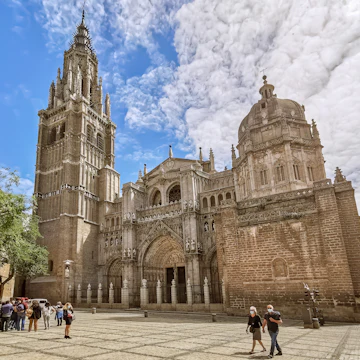
Catedral de Toledo
Toledo's cathedral dominates the skyline, reflecting the city's historical significance as the heart of Catholic Spain.
From the earliest days of the Visigothic occupation, the current site of the cathedral has been a centre of worship. During Muslim rule, it contained Toledo's central mosque, destroyed in 1085. Dating from the 13th century and essentially a Gothic structure, the cathedral is nevertheless a melting pot of styles, including Mudéjar and the Spanish Renaissance.
The main nave is dominated by the coro (choir stalls), a feast of sculpture and carved wooden stalls. The 15th-century lower tier depicts the conquest of Granada.
Opposite is the Capilla Mayor, an extr…
reviewed
-
B
Alcázar
At the highest point in the city, looms the foreboding Alcázar. Abd ar-Rahman III raised an al-qasr here in the 10th century, which was thereafter altered by the Christians. Alonso Covarrubias and Herrera rebuilt it as a royal residence for Carlos I, but the court moved to Madrid and the fortress became a white elephant, eventually becoming the Academia de la Infantería (Military Academy).
The Alcázar was largely destroyed during the siege of Franco's forces in 1936 but Franco had it rebuilt and turned into a military museum. At the time of research the museum was closed for major renovations, with no completion date available.
reviewed
-
C
Plaza de Zocodover
This lively square is flanked by cafes that are prime places for people-watching.
From 1465 until the 1960s Zocodover was the scene of the city's Tuesday market and successor to the Arab souq ad-dawab (livestock market), hence the name. It was also here that toledanos for centuries enjoyed their bullfights or, morbidly, gathered to witness public burnings at the stake carried out by the Inquisition.
The southern flank dates from the 17th century – the McDonald's certainly does not.
reviewed
-
D
Sinagoga del Tránsito
This magnificent synagogue was built in 1355 by special permission of Pedro I (construction of synagogues was prohibited in Christian Spain). Toledo's former judería (Jewish quarter) was once home to 11 synagogues. The bulk of Toledo's Jews were tragically expelled in 1492. From 1492 until 1877, it was variously used as a priory, hermitage and military barracks. The synagogue now houses the Museo Sefardi, open the same hours as the synagogue. The vast main prayer hall has been expertly restored and the Mudéjar decoration and intricately carved wooden ceiling are striking. Exhibits provide an insight into the history of Jewish culture in Spain, and include archaeological …
reviewed
-
E
Museo de Santa Cruz
Just off the Plaza de Zocodover, the 16th-century Museo de Santa Cruz is a beguiling combination of Gothic and Spanish Renaissance styles. The cloisters and carved wooden ceilings are superb, as are the upstairs displays of Spanish ceramics. The ground-level gallery contains a number of El Grecos (look for the Asunción de la Virgen and the superbly rendered La Veronica), a painting attributed to Goya (Cristo Crucificado), and the wonderful 15th-century Tapestry of the Astrolabes.
reviewed
-
Carranque
Since 1983 archaeologists at Carranque have been excavating what they believe to be the foundations of a late-4th-century Roman basilica, which would make it the oldest in Spain. The skeletal remains of Roman villas and temple-fountains are among the site's other highlights, while the remains of a 12th-century monastery with some valuable mosaics are also undergoing excavation. The admission fee includes entrance to a small interpretation centre and museum.
reviewed
-
F
Alfileritos
Columns, beams and barrel-vault ceilings are happily combined with modern artwork here. The dining rooms are spread over four bright floors below a skylight, and the menu includes such delights as langostinos con mojo (large prawns in a spicy tomato and chilli sauce) and sopa de fresas con helado de pimiento de Sichuan (strawberry 'soup' with Szechuan pepper ice cream), which sure makes a change from the ubiquitous flan.
reviewed
-
G
Museo Sefardi
The synagogue now houses the Museo Sefardi. The vast main prayer hall has been expertly restored and the Mudéjar decoration and intricately carved (and colourful) wooden ceiling are striking. Exhibits provide an insight into the history of Jewish culture in Spain, and include archaeological finds, a memorial garden with tombstones inscribed in Hebrew, typical costumes of the Sephardic Jews and ceremonial artefacts.
reviewed
-
H
Mezquita del Cristo de la Luz
On the northern slopes of town you'll find a modest, yet beautiful, mosque, where architectural traces of Toledo's medieval Muslim conquerors are still in evidence. Built in the 10th century, it suffered the usual fate of being converted to a church (hence the religious frescoes), but the original vaulting and arches survived. The narrow, steep Calle del Cristo de la Luz continues via the Islamic-named Bab al-Mardum gate.
reviewed
-
I
Centro de Interpretación
The city's latest attraction is this excellent Centro de Interpretación comprising an expansive audio-visual display covering a rambling 800 sq metres. The surrounding exhibits highlight the cultural and religious history of the city with models, photos, soundtrack and film. Currently the explanations are only in Spanish, however there are plans to introduce English audioguides in the near future.
reviewed
Advertisement
-
J
Pedro Maldonado Gonzalez
For centuries Toledo was renowned for the excellence of its swords and you’ll see them for sale everywhere (although be wary of taking them in your hand baggage through customs!). Another big seller is anything decorated with damasquinado (damascene), a fine inlay of gold or silver in the Arab artistic tradition. A reliable outlet is Pedro Maldonado Gonzalez.
reviewed
-
K
Iglesia de Santo Tomé
Iglesia de Santo Tomé contains El Greco’s masterpiece El Entierro del Conde de Orgaz (The Burial of the Count of Orgaz). When the count was buried in 1322, Saints Augustine and Stephen supposedly descended from heaven to attend the funeral. El Greco’s work depicts the event, complete with miracle guests including himself, his son and Cervantes.
reviewed
-
L
Alfileritos 24
The 14th-century surroundings of columns, beams and barrel-vault ceilings are snazzily coupled with modern artwork and bright dining rooms spread over four floors. The menu demonstrates an innovative flourish in the kitchen, with dishes like red-tuna tartare with seaweed and guacamole, and strawberry 'soup' with Szechuan pepper ice cream.
reviewed
-
M
La Abadía
In a former 16th-century palace, this atmospheric bar and restaurant is ideal for romancing couples. Arches, niches and subtle lighting are spread over a warren of brick-and-stone-clad rooms. The menu includes lightweight dishes like verduras a la parrilla (grilled fresh vegetables) – perfect for small (distracted) appetites.
reviewed
-
N
Convento Santa Úrsula
Toledo is famed for its ceramics and its mazapán (marzipan), which every shop seems to sell regardless of the quality. The Santo Tomé brand is reputable and there are several outlets in town, including one on Zocodover. Even the local nuns get in on the marzipan act - check out Convento Santa Úrsula.
reviewed
-
O
Madre Tierra
A cool cavernous space, with exposed brick arches, a soft ochre colour scheme and muted light, creates a romantic atmosphere for enjoying Indian-, Asian- and Mediterranean-inspired vegetarian meals, including sushi, moussaka, pastas, pakoras (vegetables in a spicy batter) and salads. Reservations recommended.
reviewed
-
P
Jewish Quarter
Near the Museo de El Greco is what was once the judería (Jewish Quarter). 'Once' because, as a huge plaque in the cathedral proudly proclaims, the bulk of Toledo's Jews, like those elsewhere in Spain, were expelled in 1492. In the centuries prior to this, Toledo's Jews worshipped in 11 synagogues.
reviewed
-
Q
Pedro Maldonado
For centuries, Toledo was renowned for the excellence of its swords, and you'll see them for sale everywhere. Another big seller in Toledo is anything decorated with damasquinado (damascene), a fine encrustation of gold or silver in Arab artistic tradition. A reliable outlet is Pedro Maldonado.
reviewed
-
R
La Venta del Alma
For an older crowd, La Venta is mild-mannered during the day, but gets rowdy on Friday and Saturday when the full-on atmosphere hits a prolonged high. It's just outside the city: cross Puente de San Martín and turn left up the hill; the bar is about 200m up on your left.
reviewed
-
S
Monasterio de Santo Domingo El Antiguo
One of the oldest convents in Toledo, the 11th-century Monasterio de Santo Domingo El Antiguo includes some of El Greco’s early commissions (most are copies). Visible through an iron grating is the crypt and wooden coffin of the painter himself.
reviewed
Advertisement
-
T
Palacios
An unpretentious place, where stained glass, beams and efficient old-fashioned service combine with traditional no-nonsense cuisine. Hungry? Try a gut-busting bowl of traditional judías con perdiz (white beans with partridge) for starters.
reviewed
-
U
Cable Ferry
For great views, get the tiny, free cable ferry in summer from near Hotel El Diamantista, and walk up the opposite bank of Río Tajo. Scattered about this hinterland are many cigarrales (country estates of wealthy toledanos).
reviewed
-
V
Taller del Moro
The 14th-century Taller del Moro. Although the museum is closed for renovation (check at the tourist office for an update), the building is still interesting for its classic Islamic architecture, built in the Mudéjar style.
reviewed
-
W
Palacio
An unpretentious place where stained glass, beams and efficient old-fashioned service combine with traditional no-nonsense cuisine. Hungry? Try a gut-busting bowl of judías con perdiz (white beans with partridge) for starters.
reviewed
-
X
Aurelio
The three restaurants under this name are among the best of Toledo's top-end eateries (the other locations are Calle de la Sinagoga 1 and 6). Game, fresh produce and traditional dishes are prepared with panache. Reservations recommended.
reviewed