Things to do in Barcelona
-
A
El Sortidor
Step back in history. Hot food has been dished up here since 1908. The ceramic-fronted fridge, tiled floor and bar seem to have changed little since then – but appearances can deceive. Turin-born Flavio runs this place, and offers a typical menú del día that isn’t that typical – how many Catalans have eaten handmade pappardelle (a broad ribbon pasta from Italy)? On Friday nights he serves up couscous and live Irish music. And on other nights he’ll only open for a reservation of 20 or more!
reviewed
-
B
Bodega Sepúlveda
This tavern has been showering tapas on its happy diners since 1952. The range of dishes is a little overwhelming and mixes traditional (Catalan faves like cap i pota – chunks of fatty beef in gravy) with more surprising options like carpaccio de calabacín con bacalao y parmesán (thin zucchini slices draped in cod and parmesan cheese). You can hang out until 1am.
The main dining area is out the back and downstairs, with a small, low-ceilinged area upstairs.
reviewed
-
Barcelona Day Trip: Montserrat, Colonia Guell and Gaudi Crypt
8 hours (Departs Barcelona, Spain)
by Viator
Visit two outstanding attractions on a day trip from Barcelona to Colonia Guell and Montserrat! Discover a lesser-known work of Antoni Gaudí – the crypt at…Not LP reviewed
from USD$79.11 -
C
Església de Sant Pere de les Puelles
Not a great deal remains of the original church or convent that stood here since early medieval times. The church’s pre-Romanesque Greek-cross floor plan survives, as do some Corinthian columns beneath the 12th-century dome and a much-damaged Renaissance vault leading into a side chapel.
It was around this church that settlement began in La Ribera. In 985, a Muslim raiding force under Al-Mansur attacked Barcelona and largely destroyed the convent, killing or capturing the nuns.
reviewed
-
D
Església de la Puríssima Concepció I Assumpció de Nostra Senyora
One hardly expects to run into a medieval church on the grid-pattern streets of the late-19th-century city extension, yet that is just what this is. Transferred stone by stone from the old centre in 1871–88, this 14th-century church has a pretty 16th-century cloister with a peaceful garden.
Behind is a Romanesque-Gothic bell tower (11th to 16th century), moved from another old town church that didn’t survive, Església de Sant Miquel. This is one of a handful of such old churches shifted willy-nilly from their original locations to L’Eixample.
reviewed
-
E
Museu-Monestir de Pedralbes
This peaceful old convent was first opened to the public in 1983 and is now a museum of monastic life (the few remaining nuns have moved into more modern neighbouring buildings). It stands at the top of Avinguda de Pedralbes in a residential area that was countryside until the 20th century, but which remains a divinely quiet corner of Barcelona.
The architectural highlight is the large, elegant, three-storey cloister, a jewel of Catalan Gothic, built in the early 14th century. Following its course to the right, stop at the first chapel, the Capella de Sant Miquel, whose murals were done in 1346 by Ferrer Bassá, one of Catalonia’s earliest documented painters. A few steps…
reviewed
-
F
One
A classic dance place inside the fantasy land of Poble Espanyol. The main dance floor, with the latest in lighting effects and video screens, gets jammed with people from all over town as the night wears on. Shuttle buses run from Plaça de Catalunya and Plaça d’Espanya from midnight to 3.30am and back down into town from 5am to 6.30am.
reviewed
-
G
Palau Montaner
Interesting on the outside and made all the more enticing by its gardens, this creation by Domènech i Montaner is spectacular on the inside. Completed in 1896, its central feature is a grand staircase beneath a broad, ornamental skylight. The interior is laden with sculptures (some by Eusebi Arnau), mosaics and fine woodwork. It is advisable to call ahead if you want to visit, as the building is sometimes closed to the public on weekends.
reviewed
-
H
Sant Cugat del Vallès
Marauding Muslims razed the one-time Roman encampment–turned–Visigothic monastery of Sant Cugat del Vallès to the ground in the 8th century. What you see today is a combination of Romanesque and Gothic buildings. The lower floor of the cloister is a fine demonstration of Romanesque design and it’s the principal reason for coming. From the train station, head left along Avinguda d’Alfonso Sala Conde de Egara and turn right down Carrer de Ruis i Taulet, followed by a left into Carrer de Santiago Rusiñol, which leads to the monastery.
reviewed
-
I
L’Havana
Little has changed in this cavernous, family-run place since it opened in the 1940s. The front dining area, with frosted glass windows, Modernista design touches and spaciously spread tables, is a touch more severe than the better-lit rear area. A great starter is the combinat, with three mussels, a smidge of amanida russa (potato salad), esqueixada and more. Meat and fish options follow, and the calamars farcits (stuffed calamari) are filling. Round off with homemade crema catalana.
reviewed
Advertisement
-
J
Pavelló Mies van der Rohe
The Pavelló Mies van der Rohe is not only a work of breathtaking beauty and simplicity, it is a highly influential building emblematic of the modern movement. The structure has been the subject of many studies and interpretations, and it has inspired several generations of architects.
Designed in 1929 by Ludwig Mies van der Rohe (1886–1969) as the Pavelló Alemany (German Pavilion) for the World Exhibition, it was removed after the show and reconstructed only in 1980, after the building had been consistently referred to as one of the key works of modern architecture. The Pavelló was built using glass, steel and marble, reflecting Mies van der Rohe's originality in the…
reviewed
-
K
Cafè de l’Acadèmia
Expect a mix of traditional dishes with the occasional creative twist. At lunchtime, local Ajuntament (town hall) office workers pounce on the menú del día (for €14, or €10 at the bar). In the evening it is rather more romantic, as low lighting emphasises the intimacy of the timber ceiling and wooden decor. Offerings range from chuletón (huge T-bone steak) for two to guatlla farcida de foie d’ànec i botifarra amb salsa de ceps (quail stuffed with duck foie gras and sausage with a mushroom sauce).
reviewed
-
L
Saüc
Pop into this basement place down a little Eixample laneway and you enter a soothing sanctuary. Sober designer decor, dominated by ochres, creams and buttercup yellows, allows you to concentrate on what emerges from the kitchen, such as tàrtar de anguila fumada, poma verda i caviar d’arengada (smoked eel tartare with green apples and salted sardine caviar). You can request half-size portions at 60% of the price. The tasting menu comprises an appetiser, four courses, then a cheese selection and two desserts (€78).
reviewed
-
Portal de l’Àngel
This is one of the annual markets that is worth looking out for. For 10 days in mid-May (dates change each year), stands set up in the Portal de l’Àngel for the Fira del Llibre Antic (Antique Book Fair). The same spot hosts the Fira de Terrissa (Pottery Fair), which lasts for five days starting around 20 September, coinciding with the Festes de la Mercè and the similar Fira de Ceràmica Creativa (Ceramicists Fair), around 23 December to 5 January.
reviewed
-
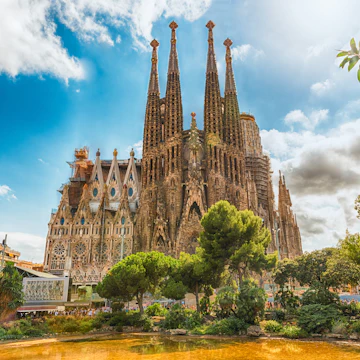
Skip the Line: Barcelona Sagrada Familia Tour
by Viator
La Sagrada Familia is one of the most popular attractions in all of Spain, but you can see it without waiting in the long lines. If you pre-book this one-hour,…Not LP reviewed
from USD$41.56 -
M
Museu del Modernisme Català
Housed in a Modernista building, the ground floor seems a like a big Modernista furniture showroom. Several items by Antoni Gaudí, including chairs from Casa Batlló and a mirror from Casa Calvet, are supplemented by a host of items by his lesser-known contemporaries, including some typically whimsical, mock medieval pieces by Puig i Cadafalch.
The basement, showing off Modernista traits like mosaic-coated pillars, bare brick vaults and metal columns, is lined with Modernista art, including paintings by Ramon Casas and Santiago Rusiñol, and statues by Josep Llimona and Eusebi Arnau.
reviewed
-
N
Museu d’Història de Catalunya
The Palau de Mar building facing the harbour once served as warehouses, but was transformed in the 1990s. Inside is the Museu d’Història de Catalunya, something of a local patriotic statement, but interesting nonetheless.
The permanent display covers the 2nd and 3rd floors, taking you from the Stone Age through to the early 1980s. It is a busy hotchpotch of dioramas, artefacts, videos, models, documents and interactive bits: all up, an entertaining exploration of 2000 years of Catalan history.
See how the Romans lived, listen to Arab poetry from the time of the Muslim occupation of the city, peer into the dwelling of a Dark Ages family in the Pyrenees, try to mount a…
reviewed
-
O
Golondrina Excursion Boats
For a trip around the harbour, board a Golondrina Excursion Boatsgolondrina (swallow) from Moll de les Drassanes in front of Mirador de Colom. The one-hour round trip takes you to Port Olímpic, the Fòrum and back again. The number of departures depends largely on the season and demand. If you just want to discover the area around the port, you can opt for a 35-minute excursion to the breakwater and back (adult/child under four years/child aged four to 10 years €6.50/free/2.60).
reviewed
-
P
Kiosco la Cazalla
For decades from 1912, the Kiosco La Cazalla served passers-by beer, wine or a glass of morello cherry-based firewater known as cazalla. This little-known Andalucian beverage, often served with a few raisins floating in it, is an acquired taste (some Italians claim it is similar to sambuca). After years closed up, the hole in the wall just off La Rambla (claiming to be Barcelona’s smallest bar) is back in business. A shot of 50-proof cazalla costs €1.50.
reviewed
-
Q
MUHBA Refugi 307
Part of the Museu d'Història de Barcelona (MUHBA), this is a shelter that dates back to the days of the Spanish Civil War. Barcelona was the city most heavily bombed from the air during the Spanish Civil War and had more than 1300 air-raid shelters. Local citizens started digging this one under a fold of Montjuïc in March 1937.
In the course of the next two years, the web of tunnels was slowly extended to 200m, with a theoretical capacity for 2000 people. People were not allowed to sleep overnight in the shelter – when raids were not being carried out work continued on its extension. Vaulted to displace the weight above the shelter to the clay brick walls (clay is…
reviewed
Advertisement
-
R
Barcelona Rouge
Decadence is the word that springs to mind in this bordello-red lounge-cocktail bar, with acid jazz, drum and bass and other soothing sounds drifting along in the background. The walls are laden with heavy-framed paintings, dim lamps and mirrors, and no two chairs are alike. Stick to simple drinks, as the €10 glamour cocktails are on the watery side.
reviewed
-
S
De Tapa Madre
A chatty atmosphere greets you from the bar from the moment you swing open the door. A few tiny tables line the window, but head upstairs for more space in the gallery, which hovers above the array of tapas on the bar below, or go deeper inside past the bench with the ham legs. The arròs caldós amb llagostins (a hearty rice dish with king prawns) is delicious.
reviewed
-
T
Botafumeiro
It is hard not to mention this classic temple of Galician shellfish and other briny delights, long a magnet for VIPs visiting Barcelona. You can bring the price down by sharing a few medias raciones (medium tapas plates) to taste a range of marine offerings or a safata especial del Mar Cantàbric (seafood platter) between two. Try the percebes, the strangely twisted goose barnacles harvested along Galicia’s north Atlantic coast, which many Spaniards consider the ultimate seafood delicacy.
reviewed
-
U
Restaurant 7 Portes
Founded in 1836 as a cafe and converted into a restaurant in 1929, this is a classic. It exudes an old-world atmosphere with its wood panelling, tiles, mirrors and plaques naming some of the famous – such as Orson Welles – who have passed through. Paella is the speciality, or go for the surfeit of seafood in the gran plat de marisc (literally ‘big plate of seafood’), big enough for two.
reviewed
-
Barcelona Museum Pass
Flexible (Departs Barcelona, Spain)
by Viator
Get the Barcelona Museum Pass for the best deal in Barcelona. Your Barcelona Museum Pass saves you time and money as you skip long ticket queues for entry to…Not LP reviewed
from USD$40.22